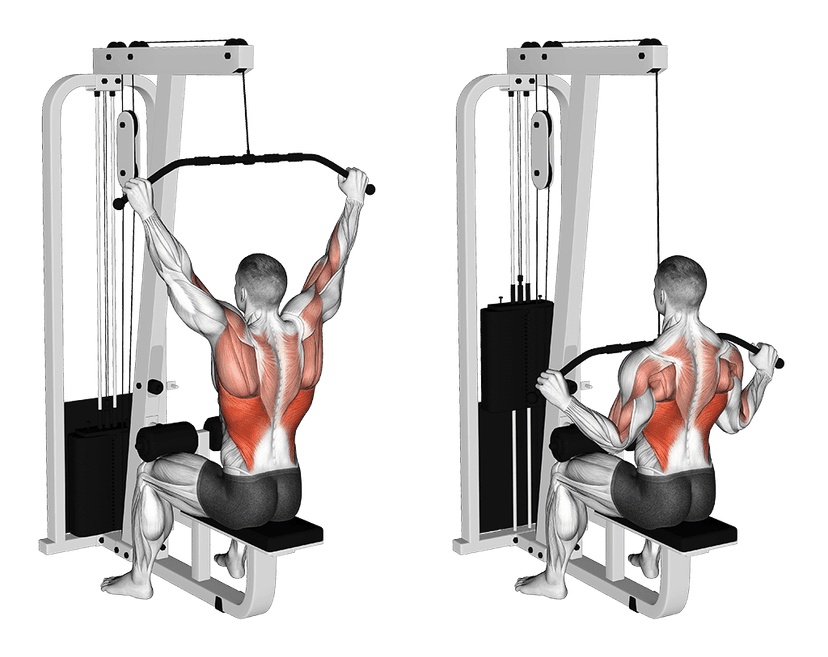
Lat Pulldown to Chest: Complete Guide
The lat pulldown is the go-to machine exercise for developing back width. It replicates the pull-up movement pattern but allows precise load adjustment. Whether you are a beginner who cannot do a pull-up or an advanced lifter chasing volume, the lat pulldown belongs in your program.
Targeted Muscles
- Latissimus dorsi: primary mover, responsible for back width (V-taper)
- Teres major: assists the lats in arm adduction
- Lower trapezius: scapular depression and retraction
- Rhomboids: stabilization and shoulder blade approximation
- Biceps: elbow flexors, active throughout the movement
- Brachialis and brachioradialis: synergists with the biceps
- Posterior deltoid: secondary contribution
The lats do most of the work when execution is correct. If you mainly feel your biceps, you are pulling with your arms instead of your back.
Proper Execution
Machine Setup
- Sit facing the machine with your thighs locked under the pads.
- The pads should press against the top of your thighs to prevent you from lifting off the seat.
- Wide overhand grip on the bar, hands spaced about 1.5 times shoulder width.
Concentric Phase (Pulling the Bar Down)
- Before pulling, depress your shoulder blades (think "put your shoulder blades in your back pockets").
- Pull the bar toward the top of your chest (collarbone area), not toward your chin.
- The movement starts from your elbows: drive them down and slightly back.
- Lean your torso very slightly backward (10-15 degrees maximum), no more.
- At the bottom, the bar touches or nearly touches your upper chest, elbows pointing toward the floor.
Eccentric Phase (Returning)
Let the bar rise over 2 to 3 seconds. Control the weight. Do not let it pull you upward. Extend your arms fully at the top without releasing shoulder tension (maintain a slight engagement).
Breathing
Exhale while pulling the bar to your chest. Inhale while letting it rise.
Common Mistakes
1. Pulling the bar behind the neck This is a gym classic, and it is a mistake. The behind-the-neck pulldown places the shoulder in external rotation under load, stressing the rotator cuff. The front pulldown is safer and equally effective for the lats.
2. Leaning back too far 15 degrees of lean is fine. 45 degrees is a disguised seated row. The more you lean, the more you recruit the traps at the expense of the lats. Stay nearly vertical.
3. Not depressing the shoulder blades before pulling If you pull straight with your arms, the biceps take over. Scapular depression pre-activates the lats and improves the mind-muscle connection.
4. Using momentum Leaning back and then snapping forward to pull the weight is cheating. It increases injury risk and reduces back tension. Keep the movement smooth and controlled.
5. Grip too narrow A grip that is too narrow reduces lat recruitment and overloads the biceps. Keep your hands at about 1.5 times shoulder width to maximize back activation.
Variations
Close-Grip Supinated Pulldown (Intermediate) Hands close together, palms facing you. Recruits more lower lats and biceps. An excellent complement to the wide-grip version for complete back development.
Neutral-Grip Pulldown (Beginner) Using a parallel-grip bar. Natural wrist position, comfortable for the shoulders. Ideal for beginners or if you experience shoulder pain with an overhand grip.
Single-Arm Cable Pulldown (Intermediate) One arm at a time with a handle. Allows you to correct imbalances and increase range of motion. Your trunk must remain stable.
Lat Pulldown with Isometric Hold (Advanced) Hold the bar against your chest for 2 to 3 seconds on each rep. Builds an intense mind-muscle connection and increases time under tension. Reduce the load by 20%.
Programming
Beginner / Pull-Up Progression (3-4x10-12 reps) Use the lat pulldown as your primary back exercise. Gradually increase the weight. When you can cleanly pull your bodyweight for 10 reps, you are ready for pull-ups.
Hypertrophy (3-4x8-12 reps) As a complement to pull-ups or rows. Place it in the middle of your back session. Tempo 3-1-2. Rest 60 to 90 seconds.
Volume / Pump (3x15-20 reps) Light load, perfect execution, maximum squeeze at the bottom. Ideal at the end of a session to flood the back with blood.
Frequency: 1 to 2 times per week. The lat pulldown is easy to recover from since it does not load the lower back like rows do.
Key Takeaways
- Depress your shoulder blades before pulling: this is the key to back activation.
- Pull toward your upper chest, never behind your neck.
- Torso lean: 10-15 degrees maximum.
- Wide overhand grip for width, close underhand grip for thickness.
- Control the eccentric phase, that is where growth happens.
