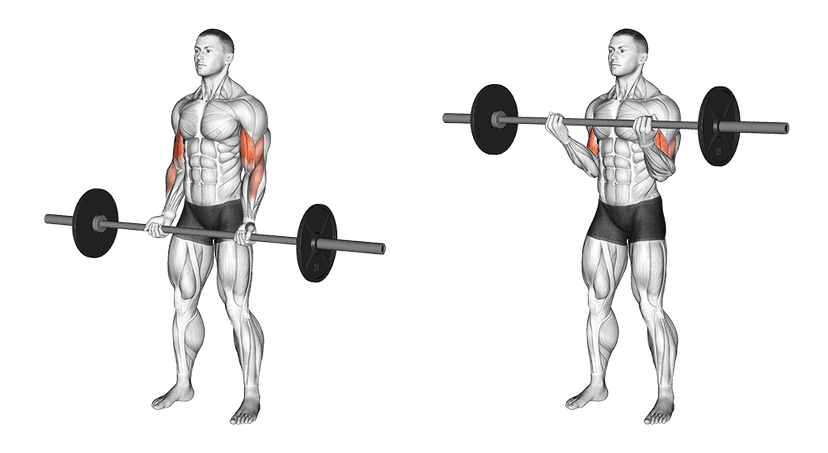
Barbell Curl: Complete Guide
The barbell curl is the most classic and effective biceps exercise. Standing with a barbell in hand, you flex your elbows to bring the weight toward your shoulders. No other isolation movement lets you load as heavy on the biceps. If you want bigger arms, the barbell curl is your starting point.
Muscles targeted
- Biceps brachii (short head): the inner portion of the biceps. It creates the visible ball when you flex your arm from the front.
- Biceps brachii (long head): the outer portion. It contributes to the biceps peak and lateral thickness.
- Brachialis: deep muscle underneath the biceps. It contributes significantly to elbow flexion and pushes the biceps upward, making the arm look bigger.
- Brachioradialis: forearm muscle involved in elbow flexion, especially with pronated or neutral grips.
- Wrist flexors: stabilize the wrist under load.
The biceps makes up roughly one third of the upper arm volume. The brachialis, often neglected, accounts for the second third. The barbell curl works both simultaneously.
Proper execution
Starting position
Stand with feet hip-width apart, knees slightly bent. Grab the bar with a supinated grip (palms facing up), hands shoulder-width apart or slightly wider. Arms extended along your body, elbows close to your sides. Shoulders down, chest up, core braced.
Concentric phase (curling up)
- Flex your elbows to curl the bar up. Only the forearms move, the elbows stay pinned to your sides.
- Raise the bar until you reach maximum contraction, when the forearms are nearly vertical (roughly shoulder height).
- Squeeze the biceps for 1 second at the top.
- Exhale during the curl.
Eccentric phase (lowering)
- Lower the bar slowly (2 to 3 seconds), resisting gravity.
- Return to near-full arm extension. Do not slam into lockout at the bottom.
- Inhale on the way down.
Recommended tempo: 1-2 seconds up, 1 second squeeze at the top, 2-3 seconds down (1-1-3).
Common mistakes
1. Swinging the body (cheat curl) The most classic mistake. You use hip momentum to propel the bar up instead of curling with the biceps. Fix: press your back against a wall or lower the weight until you can curl without any swing.
2. Elbows drifting forward The elbows slide forward during the curl, turning it into a shoulder movement. Elbows must stay fixed against your sides. A slight natural drift is fine, but if your elbows rise more than 5 cm, it is too much.
3. Dropping too fast Letting the bar fall without control eliminates the eccentric phase, which is responsible for a large portion of muscle stimulation. Resist the descent for at least 2 seconds.
4. Incomplete extension at the bottom Some people only lower to 90 degrees to maintain tension. This is counterproductive: full range of motion is necessary to recruit all muscle fibers. Lower to near-full extension.
5. Wrists bent back Wrists collapse into extension under load. This overloads the tendons and reduces grip strength. Keep your wrists straight and firm.
Variations
EZ bar curl (beginner to intermediate) The EZ bar places the wrists at a more natural angle, relieving joint stress. It targets the brachialis and brachioradialis more. This is the best option if your wrists or elbows are sensitive.
Wide-grip curl (intermediate) Widening the grip beyond shoulder width shifts emphasis to the short head (inner biceps). Conversely, a narrow grip targets the long head (outer biceps).
21s (intermediate to advanced) 7 reps in the bottom half, 7 reps in the top half, 7 reps full range of motion. Total: 21 brutal reps. The pump is massive. Use about 50% of your usual weight.
Controlled cheat curl (advanced) You use a slight hip drive to curl a heavier weight than normal, then lower it in 4-5 seconds, controlling every centimeter. This is an eccentric overload technique, not an excuse to swing. Reserved for experienced lifters.
Programming
Placement: after pulling exercises (pull-ups, rows). The biceps are already pre-fatigued from pulling, and the barbell curl finishes them off.
Volume and intensity:
- Beginner: 3 x 10-12 reps, moderate weight, focus on technique
- Intermediate: 3-4 x 8-12 reps, controlled tempo
- Advanced: 4 x 6-10 reps + intensification techniques (21s, drop sets, slow negatives)
Frequency: 1-2 times per week. Biceps are also recruited during all pulling exercises (pull-ups, rows, deadlifts). Two biceps exercises per session is more than enough.
Effective pairings:
- Arm superset: barbell curl + skull crusher or triceps pushdown
- Biceps chain: barbell curl (heavy), incline dumbbell curl (stretch), concentration curl (contraction)
- Pull day: pull-ups, rows, barbell curl as a finisher
Key takeaways
- Elbows fixed: they do not move. All the force comes from flexing the forearms.
- Slow descent: the 2-3 second eccentric phase is crucial for muscle growth.
- Full range of motion: from near-full extension at the bottom to maximum contraction at the top.
- No cheating: if you have to swing to move the bar, it is too heavy.
- Progression: add 1-2.5 kg every 2-3 weeks. Biceps are small muscles, so progress is slower than on squats.
