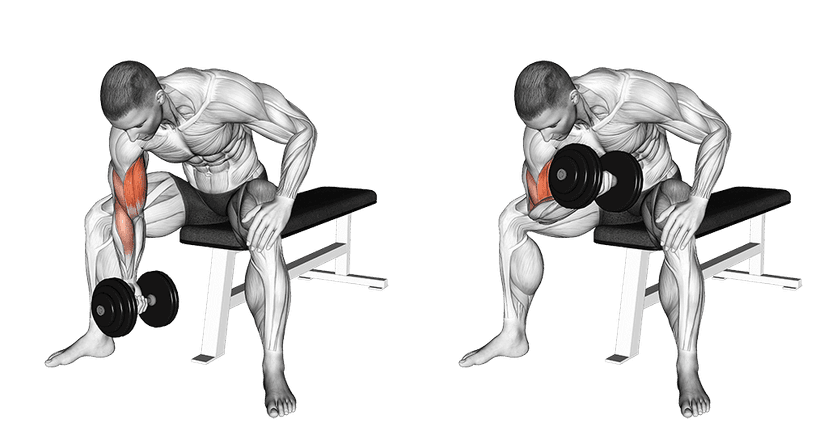
Concentration Curl: Complete Guide
The concentration curl is the ultimate isolation exercise for the biceps. Seated on a bench with your elbow braced against your inner thigh, you eliminate all cheating and force the biceps to work alone. This is the exercise that builds that famous bicep "peak," the visible bump at the top of the muscle during contraction. If you want detailed, symmetrical arms, the concentration curl is your best tool.
Targeted Muscles
- Biceps brachii (long head and short head): primary mover of elbow flexion, with the short head especially recruited due to the internally rotated arm position
- Brachialis: located beneath the biceps, it assists flexion and adds arm thickness
- Brachioradialis: outer forearm muscle, stabilizes the wrist and assists flexion
- Wrist flexors: maintain grip on the dumbbell
The concentration curl primarily targets the short head of the biceps (inner portion). The elbow-against-thigh position prevents any compensation from the anterior deltoid or back, making it one of the exercises with the highest EMG activation for the biceps.
Correct Execution
Starting Position
Sit on a bench with your feet spread wider than shoulder-width, flat on the floor. Lean your torso slightly forward. Grab a dumbbell with one hand, elbow pressed against the inside of the same-side thigh, arm extended without locking out. Your free hand can rest on the opposite knee for trunk stability.
Concentric Phase (Lifting)
- Contract the biceps to flex the elbow and curl the dumbbell toward your shoulder.
- Keep the elbow strictly stationary against the thigh: this is your fixed pivot point.
- Curl up to maximum contraction, roughly shoulder height.
- Hold for one second at the top, squeezing the biceps hard.
Eccentric Phase (Lowering)
- Lower slowly over 2 to 3 seconds, controlling every centimeter.
- Stop just before full extension to maintain continuous tension.
Breathing and Tempo
- Exhale during the lift, inhale during the lowering.
- Recommended tempo: 1 second up, 1 second pause, 3 seconds down.
Common Mistakes
1. Swinging the torso to help the lift The most frequent mistake. If you need to lean back or swing your body to finish a rep, the dumbbell is too heavy. Your torso stays stable, only the forearm moves. Reduce the weight and focus on the contraction.
2. Elbow lifting off the thigh When the elbow leaves its brace, the anterior deltoid takes over and the biceps loses its load. Press the elbow firmly against the inner thigh throughout the set. If you cannot, lower the weight.
3. Dropping the weight too fast Letting the dumbbell fall wastes 50% of the exercise's potential. The eccentric (lowering) phase causes the most muscle damage and therefore the most growth. Control the descent for at least 2-3 seconds.
4. Wrist bent backward A wrist extended backward puts the distal biceps tendon in a vulnerable position. Keep the wrist straight and firm, aligned with the forearm.
5. Incomplete range of motion Not lowering far enough or not curling high enough reduces the work done. Lower to near-full extension (without locking) and curl to maximum contraction.
Variations
Standing Concentration Curl (Beginner) Bent forward, arm hanging freely without support. Less strict than the seated version but allows you to feel the movement. Useful for beginners who lack seated coordination.
Concentration Curl with Rotation (Intermediate) Start with a neutral (hammer) grip at the bottom and gradually rotate into supination during the lift. The rotation amplifies short head and brachialis recruitment. Excellent for muscular detail.
Cable Concentration Curl (Intermediate) Replace the dumbbell with a handle attached to a low pulley. Cable tension remains constant throughout the range of motion, unlike a dumbbell which is easier at the bottom and top. Perfect for maximizing time under tension.
Overloaded Eccentric Concentration Curl (Advanced) Use both hands (assist with the free hand) to lift a weight 20-30% above your max, then lower with only the working arm over 4-5 seconds. Advanced technique to break through a plateau.
Program Integration
Placement in Your Session: The concentration curl is a finishing exercise. Place it at the end of an arm session or at the end of a back/biceps session, after compound movements (pull-ups, rows) and bilateral curls (barbell curl, standing dumbbell curl).
Volume and Intensity by Goal:
- Hypertrophy: 3 x 10-15 reps per arm, 60-70% of max, slow tempo
- Detail and peak: 4 x 12-15 reps, 2-second squeeze at the top
- Imbalance correction: always start with the weaker arm, same rep count on both sides
Frequency: 1 to 2 times per week. Biceps recover quickly but are also used in every pulling exercise. 2 dedicated sessions per week maximum.
Recommended Starting Weight: 6 to 10 kg for a beginner male, 3 to 6 kg for a beginner female. Ego has no place here: this is an isolation exercise, not a strength one.
Key Takeaways
- Fixed elbow: braced against the thigh, it does not move a single millimeter
- Total control: no swinging, both the lift and the lowering are slow and deliberate
- Squeeze at the top: hold for one second at peak contraction to activate maximum muscle fibers
- Finishing exercise: place it at the end of your session, not at the beginning
- Symmetry: excellent for correcting an imbalance between right and left arms
