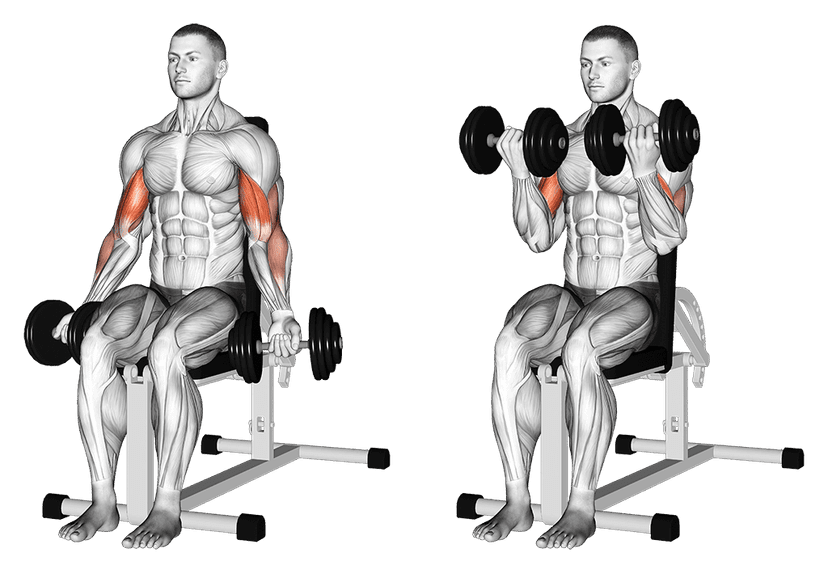
Seated Dumbbell Curl: Complete Guide
The seated dumbbell curl is a classic biceps training exercise. In the seated position, you limit lower body cheating and gain stability compared to the standing version. Dumbbells allow a natural range of motion and correct imbalances between both arms. This is a versatile exercise suited for all levels that belongs in any serious strength training program.
Targeted Muscles
- Biceps brachii (long head and short head): primary mover of elbow flexion, both heads work evenly in the seated position
- Brachialis: contributes to flexion and adds thickness to the arm when viewed from the side
- Brachioradialis: forearm muscle, assists flexion especially at the start of the movement
- Wrist flexors: stabilize the grip throughout the set
- Anterior deltoid: slight stabilization role if the elbows drift forward
The seated position reduces lower back and leg involvement in the movement. Effort is concentrated on the arms, making this a stricter exercise than the standing curl.
Correct Execution
Starting Position
Sit on a bench set at 90 degrees (vertical backrest). Feet flat on the floor, back pressed against the pad. One dumbbell in each hand, arms hanging at your sides, palms facing forward (supinated). Shoulders low and relaxed, not shrugged up toward the ears.
Concentric Phase (Lifting)
- Contract the biceps to flex the elbows and curl the dumbbells toward your shoulders.
- Keep the elbows pinned to your sides. They should not drift forward or backward.
- Curl up to maximum contraction, dumbbells at shoulder height without touching the shoulders.
- You can lift both arms simultaneously or alternate. Alternating allows you to focus on one arm at a time.
Eccentric Phase (Lowering)
- Lower slowly over 2-3 seconds, resisting gravity.
- Lower to near-full extension without locking the elbows.
Breathing and Tempo
- Exhale on the way up, inhale on the way down.
- Standard tempo: 2 seconds up, 1 second pause, 2-3 seconds down.
Common Mistakes
1. Back lifting off the pad When the back leaves the pad, the movement becomes a disguised standing curl. The anterior deltoid and lower back compensate. Press your upper back and shoulder blades against the pad throughout the set.
2. Elbows drifting forward Elbows migrating forward turns the movement into a partial front raise. The deltoid takes over from the biceps. Keep the elbows fixed, aligned with your torso.
3. Using shoulder momentum Shrugging the shoulders to launch the dumbbells is a classic compensation when the weight is too heavy. Shoulders stay low and relaxed. Reduce the load if needed.
4. Shortened range of motion Only lowering halfway reduces total mechanical work. Lower to near-full extension on every rep to maximize stretch under tension.
5. Excessive speed Lifting and lowering quickly with momentum decreases time under tension and muscle activation. Control every rep, especially the lowering phase.
Variations
Simultaneous Seated Dumbbell Curl (Beginner) Both arms rise at the same time. Easier to coordinate for beginners, though you cannot focus on one arm at a time. Good starting point.
Alternating Seated Dumbbell Curl (Intermediate) One arm rises while the other lowers or stays at the bottom. Allows better per-arm concentration and slightly increases total time under tension for the set. The most common and recommended variation.
Seated Dumbbell Curl with Rotation (Intermediate) Start with a neutral (hammer, palms facing the body) grip and rotate into supination during the lift. The rotation adds short head biceps and supinator work. Excellent for overall arm mass.
Seated Incline Dumbbell Curl (Advanced) Recline the backrest to 45 degrees, which stretches the long head of the biceps further. This is a standalone exercise (covered in the incline curl article), but it represents the natural progression from the upright seated curl.
Program Integration
Placement in Your Session: The seated dumbbell curl sits in the middle of a biceps session, after a compound exercise (supinated pull-ups, barbell curl) and before final isolation exercises (concentration curl, preacher curl).
Volume and Intensity by Goal:
- Strength: 4 x 6-8 reps, heavy load, 2-3 min rest
- Hypertrophy: 3-4 x 8-12 reps, moderate load, 60-90 sec rest
- Endurance: 3 x 15-20 reps, light load, 45-60 sec rest
Frequency: 1 to 2 times per week. Combine with 1-2 other biceps exercises for a total weekly volume of 10 to 16 sets.
Recommended Starting Weight: 8 to 12 kg per dumbbell for a beginner male, 4 to 8 kg for a beginner female. Increase by 1-2 kg when you complete all reps with controlled tempo for 2 consecutive sessions.
Key Takeaways
- Back pinned: shoulder blades against the pad, no arching or lifting off
- Fixed elbows: they stay glued to your sides, no drifting forward or backward
- Controlled tempo: 2-3 seconds minimum on the lowering phase, no momentum
- Unilateral progression: alternating allows you to correct imbalances between right and left arms
- Mid-session exercise: after compounds, before final isolation work
