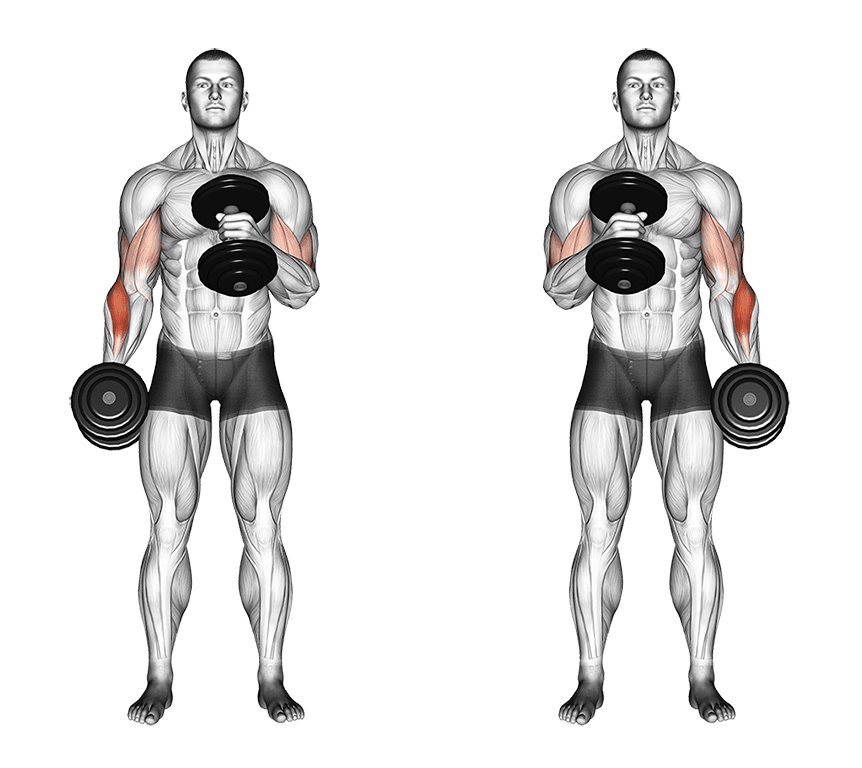
Hammer Curl: complete guide
The hammer curl is one of the most underrated arm exercises. While the standard bicep curl gets most of the attention, the hammer curl targets different muscles and builds the arm thickness and grip strength that the standard curl cannot. If you want arms that look strong from every angle, the hammer curl belongs in your routine.
Muscles targeted
The hammer curl is performed with a neutral grip (palms facing each other, like holding a hammer). This position shifts emphasis away from the biceps brachii and toward:
- Brachialis: A muscle that runs under the biceps brachii. Developing the brachialis pushes the biceps up and adds overall arm thickness. It cannot be directly targeted with a supinated (palms-up) grip.
- Brachioradialis: A large forearm muscle that runs along the outer forearm and is heavily recruited in the neutral-grip position. This is why hammer curls build forearm size as well as upper arm size.
- Biceps brachii: Still involved, but as a secondary mover rather than the primary one.
Proper execution
Starting position: Stand with feet hip-width apart, holding a dumbbell in each hand with a neutral grip (thumbs pointing up, palms facing each other). Let your arms hang fully extended at your sides. Keep your chest up and shoulders back.
The curl: Keeping your elbows fixed at your sides, curl both dumbbells toward your shoulders in a smooth arc. Do not let your elbows drift forward or your upper arms swing. The movement comes entirely from elbow flexion, not momentum.
Top position: Bring the dumbbells to shoulder height or slightly above. Squeeze the contraction briefly.
The descent: Lower the weights slowly and under control back to the starting position. A 2-3 second eccentric phase maximizes muscle tension and growth stimulus. Do not let the weights drop.
Breathing: Exhale on the curl, inhale on the descent, or breathe naturally between reps at lighter weights.
Common mistakes
Swinging the torso. Rocking your body back to help lift the weight takes tension off the target muscles and puts strain on your lower back. If you need to swing, reduce the weight. This is an isolation exercise: the only thing that should move is your forearm.
Elbow drift. Letting your elbows creep forward as you curl shortens the range of motion and reduces tension on the brachialis. Keep your elbows pinned to your sides throughout the entire rep.
Rushing the eccentric. Dropping the weights quickly after the curl wastes half the exercise. The lowering phase is where significant muscle damage and growth stimulus occur. Control every rep on the way down.
Using too much weight. The hammer curl is not a max-effort movement. Choose a weight that lets you feel the target muscles working through the full range. Ego loading defeats the purpose.
Gripping the dumbbell off-center. Hold the dumbbell in the center of the handle for a balanced neutral grip. Gripping toward one end changes the wrist load and reduces comfort.
Variations
Cross-body hammer curl. Instead of curling straight up, curl the dumbbell diagonally across your body toward the opposite shoulder. This variation increases brachialis activation and adds a stretch to the outer forearm. Alternate arms.
Cable hammer curl with rope attachment. Attach a rope to a low pulley cable. The cable provides constant tension through the entire range of motion, including at the bottom where dumbbells have very little resistance. Excellent for high-rep pump work and finishing sets.
Incline hammer curl. Perform the curl seated on an incline bench (45-60 degrees), letting your arms hang behind the vertical plane. This increases the stretch on the brachialis at the bottom and increases range of motion. One of the most effective brachialis-building variations.
Concentration hammer curl. Seated, brace your upper arm against your inner thigh and curl. Eliminates all momentum and forces strict isolation. Use this when you want maximum mind-muscle connection.
Programming
The hammer curl is an accessory exercise, not a primary compound movement. Program it after your main lifts (rows, pull-ups, deadlifts).
For hypertrophy, use 3-4 sets of 10-15 reps with a slow eccentric (2-3 seconds down). Rest 60-75 seconds between sets. This is the rep range where the brachialis and brachioradialis respond best.
For strength and grip development, use 4-5 sets of 6-8 reps with heavier loads.
Combine hammer curls with standard bicep curls in the same session for complete arm development: the standard curl builds the bicep peak, the hammer curl builds thickness and width.
Train arms 1-2 times per week as direct work, keeping in mind that your biceps and brachialis are already trained indirectly during all pulling movements (rows, pull-downs, pull-ups).
Key takeaways
- The hammer curl targets the brachialis and brachioradialis, not just the biceps: this makes it essential for complete arm development
- Neutral grip (palms facing each other) is what defines the exercise: do not let your wrists rotate during the movement
- Control the eccentric: lower the weight slowly on every rep
- The incline hammer curl and cross-body variation are the two most effective brachialis-focused options
- Keep elbows fixed at your sides: no swinging, no elbow drift forward
