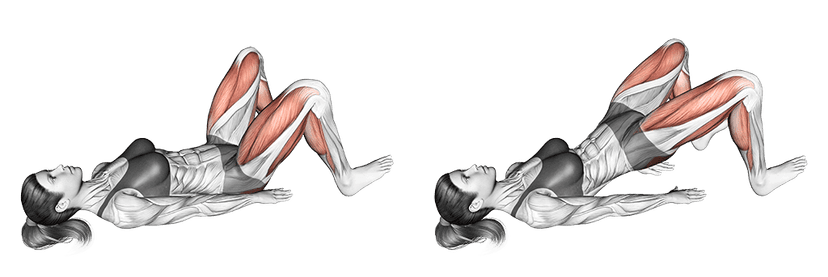
Glute Bridge: Complete Guide
The glute bridge is the foundational exercise for activating and strengthening the glutes. Accessible to all levels, it requires no equipment and serves as the ideal gateway to more advanced movements like the hip thrust. Whether you want to improve your posture, relieve lower back pain, or simply build stronger glutes, the glute bridge deserves a spot in your routine.
This exercise is also a valuable rehabilitation tool. Many lifters underestimate its difficulty because it looks simple. Yet when performed correctly with real control, it becomes remarkably effective at isolating the gluteus maximus and correcting posterior chain compensations.
Muscles targeted
- Gluteus maximus: primary mover, responsible for hip extension
- Hamstrings: assist hip extension, especially when feet are placed farther from the glutes
- Transverse abdominis: pelvic stabilization during the push
- Erector spinae: spinal alignment maintenance
- Gluteus medius: lateral pelvic stabilization at the top of the movement
The gluteus maximus does most of the work. If you mainly feel your hamstrings, bring your feet closer to your glutes and focus on squeezing at the top.
Proper execution
Starting position
Lie on your back, knees bent, feet flat on the floor at hip width. Your heels should sit about 15-20 cm from your glutes. Arms at your sides, palms facing down. Your lower back rests on the floor at the start.
Concentric phase (ascent)
- Drive through your heels while contracting your glutes.
- Lift your hips until your body forms a straight line from shoulders to knees.
- At the top, squeeze your glutes as hard as possible for 1-2 seconds.
- Avoid going too high: lumbar hyperextension shifts the load to your lower back.
Eccentric phase (descent)
- Lower slowly over 2-3 seconds.
- Control the descent. Do not drop.
- Lightly tap the floor with your glutes without fully resting between reps.
Breathing: exhale on the way up (contraction), inhale on the way down.
Common mistakes
1. Lumbar hyperextension
Pushing your hips too high arches your lower back excessively. Stop when your body forms a straight line from shoulders to knees. Beyond that point, your lower back takes over instead of your glutes.
2. Pushing through the toes
Driving through the forefoot activates the quads and calves instead of the glutes. Dig your heels into the floor. You should be able to lift your toes at any point during the movement.
3. Knees caving in or flaring out
Your knees should stay aligned with your feet. If they drift inward or outward, the gluteus medius is not stabilizing properly. Place a resistance band above your knees to reinforce this engagement.
4. Dropping too fast
Letting your hips fall reduces time under tension and limits muscle development. Control every rep on the eccentric. That is often where muscle growth happens.
5. No squeeze at the top
Lifting your hips without pausing at the top wastes the most effective moment of the exercise. Squeeze your glutes for 1-2 seconds in the top position to maximize recruitment.
Variations
Banded glute bridge (beginner to intermediate)
Place a resistance band above your knees. It forces the gluteus medius to work to keep the knees apart, increasing overall glute activation. Excellent as a warm-up or finisher.
Weighted glute bridge (intermediate)
Place a dumbbell, plate, or sandbag on your hip crease. The added resistance allows strength progression without changing exercises. Hold the weight with your hands to stabilize it.
Feet-elevated glute bridge (intermediate)
Place your feet on a bench, step, or box. The elevation increases the range of motion and recruits more hamstring in addition to the glutes.
Isometric glute bridge (beginner)
Hold the top position for 20-45 seconds. This variation builds muscular endurance and teaches maximal glute contraction. Ideal for beginners who struggle to feel their glutes working.
Programming
Placement in your session: As a warm-up or activation drill before squats or hip thrusts. Or as a main exercise if you are a beginner. It also works as a finisher to exhaust the glutes.
Volume and intensity:
- Beginner: 3 x 15-20 reps at bodyweight, focus on contraction
- Intermediate: 3-4 x 12-15 reps with a band or light weight
- Advanced: 4 x 10-12 reps with significant load, tempo 3-1-2
Frequency: 2-4 times per week. Bodyweight glute bridges can be performed daily as activation. With load, allow 48 hours of recovery.
Progression: Start at bodyweight until you master 3 x 20 reps with a solid squeeze at the top. Then add a resistance band, then weight. When you easily exceed 3 x 15 with load, progress to the barbell hip thrust on a bench.
Key takeaways
- Drive through the heels: not the toes, to target the glutes
- Straight line: shoulders-hips-knees aligned at the top, no hyperextension
- Squeeze at the top: 1-2 seconds of maximal contraction every rep
- Eccentric control: slow descent to maximize time under tension
- Logical progression: bodyweight then band then weight then hip thrust
