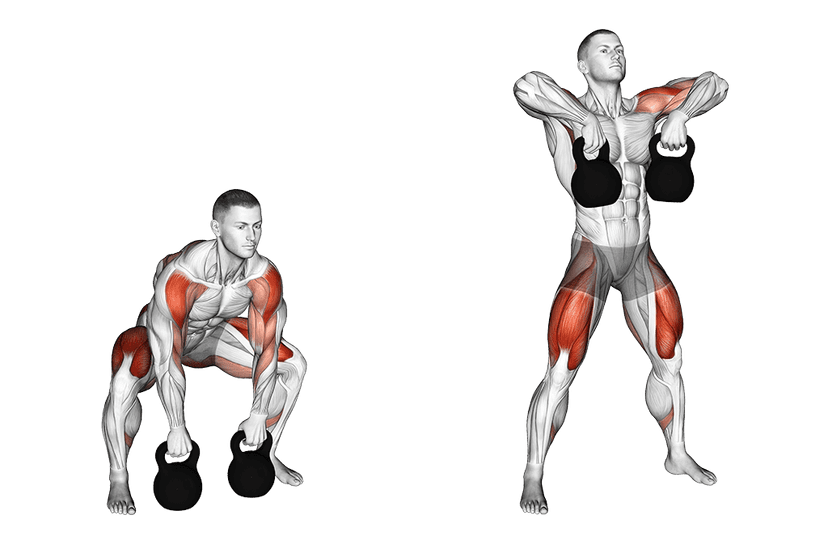
Kettlebell High Pull: Complete Guide
The kettlebell high pull is an explosive exercise that combines the power of the swing with a vertical pull. Instead of letting the kettlebell float in front of you at the top of the swing, you pull the elbow back to bring the load to chin height. It is a hybrid between the swing and the clean, more aggressive than the former and simpler than the latter. It develops posterior chain power, upper back strength, and cardiovascular conditioning in one motion.
The high pull is also an excellent progression toward the kettlebell snatch. It teaches the timing of the pull and elbow positioning without the complexity of the overhead turnover. If you have mastered the one-arm swing and are aiming for the snatch, the high pull is the logical intermediate step.
Muscles targeted
- Hamstrings and glutes: hip hinge propulsion, exactly like the swing
- Traps and rhomboids: pulling the elbow back, powerful scapular retraction
- Rear deltoids: contributing to the horizontal-vertical pull
- Lateral deltoids: stabilization at the end of the pull
- Biceps: elbow flexion during the pull
- Abs and obliques: anti-rotation bracing during unilateral work
- Forearms and grip: controlling the kettlebell under rapid acceleration and deceleration
The high pull stands out from the swing through its intense upper back recruitment. The traps and rhomboids work dynamically on every rep, making it an excellent posture builder.
Proper execution
Starting position
Identical to the one-arm swing. Kettlebell in front of you, feet shoulder width, hip hinge to grab the handle with one hand. The other arm is free, slightly out to the side for balance.
Propulsion phase
- Perform a hiking pass to load the movement.
- Drive your hips forward as you would for a one-arm swing.
- When the kettlebell passes hip height, pull your elbow back and up.
- The kettlebell rises alongside your body (not in front) and arrives at chin or collarbone height.
- At the top, your elbow points back and up. The kettlebell is close to your torso, not far out in front.
Return phase
- Release the pull and let your arm extend in front of you.
- Guide the kettlebell down, accompanying with a hip hinge.
- The load passes between your legs. Flow into the next rep.
Critical point: the pull does NOT start from the bottom. Hip propulsion generates 80% of the energy. The elbow pull only kicks in during the last 20 centimeters to direct the load upward. If you pull from the bottom, you are doing a ballistic row, not a high pull.
Breathing: exhale on the hip snap and during the pull. Inhale during the return between the legs.
Common mistakes
1. Pulling with the arm from the bottom
The most common mistake. The high pull is a swing with a pull at the top, not a pull from the floor. If your biceps and shoulders burn before your glutes, you are compensating with the upper body. Let the hips do the heavy lifting.
2. Letting the kettlebell drift away from the body
At the top of the pull, the kettlebell must stay close to your torso. If it drifts away, the lever arm increases and your shoulder takes excessive stress. Think about "zippering" the kettlebell toward your chin while keeping the elbow high and close.
3. Excessive trunk rotation
During unilateral work, the temptation is to rotate the torso to assist the pull. The trunk stays facing forward. This is an anti-rotation exercise: the obliques and abs work to prevent rotation, not to accompany it.
4. Broken wrist at the top
The wrist must stay neutral at the top of the pull. If your wrist bends under the weight of the kettlebell, you lose control. Grip the handle firmly and keep the wrist aligned with the forearm.
5. Choppy transition between swing and pull
The high pull is one fluid movement, not two movements glued together. The transition from hip drive to elbow pull should be progressive and natural. If you feel a "jerk" in the middle, work on the timing with a light load.
Variations
Double kettlebell high pull (advanced)
Two kettlebells at once. Removes the anti-rotation component but doubles the load on the upper back and hips. Requires excellent bilateral swing technique.
Sumo stance high pull (intermediate)
Very wide stance, kettlebell between the legs. Recruits the adductors more and allows a more upright torso position. Useful for people with lumbar mobility limitations.
Dead stop high pull (beginner)
Set the kettlebell down between each rep. Eliminates momentum and forces you to generate power from zero. Perfect for learning the pull timing without managing the inertia of a continuous swing.
Slow tempo high pull (intermediate)
Slow down the descent (3-4 seconds eccentric). Increases time under tension on the traps, rhomboids, and grip. Excellent for upper back muscle development.
Programming
Placement in your session: After pure strength work (deadlift, squat) and before conditioning. The high pull bridges strength and metabolic work. It also works as a standalone for short, intense sessions.
Volume and intensity:
- Beginner: 3-4 x 8-10 reps per arm, 8-12 kg kettlebell (women) / 12-16 kg (men)
- Intermediate: 4-5 x 10-15 reps per arm, 12-16 kg / 16-24 kg
- Advanced: EMOM 5-8 reps per arm for 10-20 minutes, or superset with swings
Frequency: 2-3 times per week. The high pull is more taxing than the swing because of the pull, so allow a rest day between sessions. Alternate with classic swing days to vary the stimulus.
Starting weight: Begin with the weight you use for the one-arm swing. The pull does not add much difficulty in terms of load, but it demands good timing. Start light until you master the coordination.
Key takeaways
- Swing first, pull second: 80% of the power comes from the hips, 20% from the pull
- Elbow high and close: pull the elbow back and up, not the hand forward
- Kettlebell close to the body: at the top, the load stays against the torso
- Anti-rotation: the trunk stays facing forward despite unilateral work
- Logical progression: swing, high pull, then snatch
