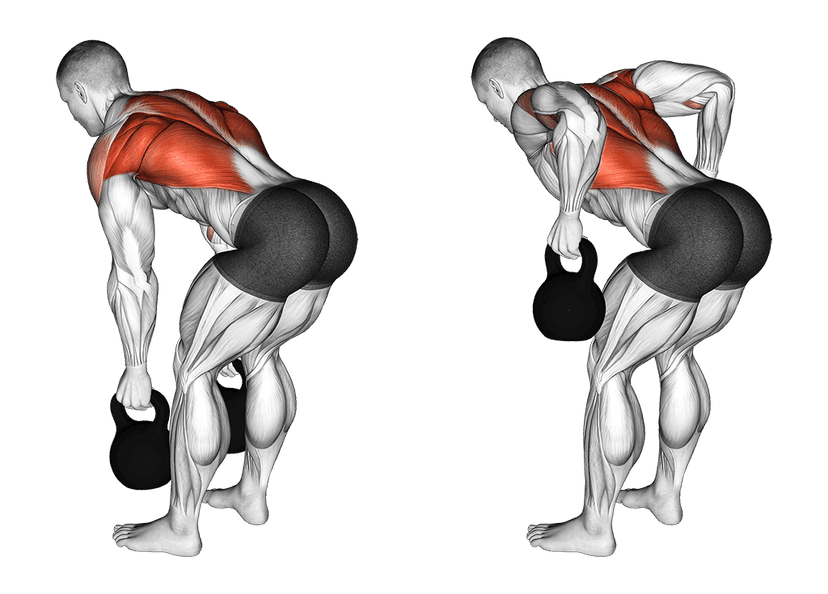
Kettlebell Row: Complete Guide
The kettlebell row is a powerful unilateral pulling exercise for building a thick and balanced back. Unlike the classic dumbbell row, the kettlebell handle changes your grip and shifts the center of gravity, forcing the shoulder stabilizers to work harder. If you want to strengthen your lats, traps, and rotator cuff in a single movement, the kettlebell row deserves a spot in your routine.
The unilateral format naturally corrects imbalances between your right and left sides. Many lifters pull harder on one side without realizing it. Single-arm work reveals these asymmetries and fixes them over weeks of consistent training.
Muscles targeted
- Latissimus dorsi: primary mover, responsible for shoulder adduction
- Mid and lower trapezius: scapular retraction and depression
- Rhomboids: pulling the shoulder blades together at the top
- Posterior deltoid: horizontal shoulder extension
- Biceps and brachialis: elbow flexion
- Core muscles (obliques, quadratus lumborum): anti-rotation stabilization during unilateral work
The lats handle most of the load. The unilateral stance places heavy demand on the obliques, which must prevent the torso from rotating. That is a significant bonus for trunk stability.
Proper execution
Starting position
Place a kettlebell on the floor next to a bench. Put the opposite knee and hand on the bench (if you are rowing with your right hand, left knee and left hand go on the bench). Your right foot stays on the floor, slightly behind you. Your back is flat, torso nearly parallel to the ground. Grab the kettlebell with your right hand, arm fully extended.
Concentric phase (pull)
- Pull the kettlebell toward your hip by driving your shoulder blade toward your spine.
- Your elbow rises toward the ceiling, staying close to your body.
- At the top, your shoulder blade is fully retracted and the kettlebell reaches your lower hip.
- Squeeze your lat for one second at the top.
- Exhale during the pull.
Eccentric phase (lowering)
- Lower the kettlebell under control over 2-3 seconds.
- Let your shoulder blade protract naturally at the bottom for a full lat stretch.
- Arm nearly extended at the bottom, without rounding your back.
- Inhale on the way down.
Tip: imagine pulling your elbow toward the back pocket of your pants. This mental cue naturally aligns the pulling path.
Common mistakes
1. Torso rotation during the pull The torso twists toward the working side to compensate for excessive weight or poor stability. Your torso must stay parallel to the floor from start to finish. Reduce the weight if you cannot keep a stable trunk.
2. Pulling with the biceps If you mainly feel your biceps burning, you are pulling with your arm instead of your back. Focus on initiating the movement with scapular retraction, not elbow flexion. The elbow is a hook, not the engine.
3. Incomplete range of motion Many lifters stop too early at the top or fail to lower far enough. Full range goes from an almost straight arm (lat stretch) to a fully retracted shoulder blade at the top. That full range is what builds the back.
4. Rounded back A rounded back during rowing compresses the intervertebral discs. Lock your spine in a neutral position before you start and maintain it on every rep.
Variations
Two-arm bent-over kettlebell row (intermediate) Standing with both feet on the floor, bent at 45 degrees, a kettlebell in each hand. Pull both simultaneously. More load on the lower back but higher volume for the back.
Kettlebell renegade row (advanced) In a plank position with a kettlebell in each hand. Row one arm at a time while holding the plank. A hybrid exercise that hammers the back and core simultaneously. Reserved for lifters with solid plank strength.
Kettlebell row in half-kneeling position (beginner) One knee on the floor, the other foot forward. Row the kettlebell on the same side as the down knee. A more stable position that limits lower back compensation. Excellent for beginners.
Kettlebell Gorilla row (intermediate) Two kettlebells on the floor between your feet. Bent forward, row one kettlebell while the other stays grounded, then alternate. Fast tempo, ideal for circuit training.
Programming
Placement in your session: Put the kettlebell row after your heavy pulling movements (pull-ups, barbell rows) or as your primary exercise if training exclusively with kettlebells.
Volume and intensity:
- Beginner: 3 x 10-12 reps per side, focus on the mind-muscle connection
- Intermediate: 4 x 8-10 reps per side, controlled tempo (2-1-2)
- Advanced: 4 x 6-8 reps per side with a pause at the top (1-2 seconds)
Frequency: Twice per week in a Pull or Upper Body structure. Alternate with other rowing variations to avoid plateaus.
Starting weight: Begin with a 12 kg kettlebell (women) or 16 kg (men). The right weight allows you to complete 12 clean reps with 2 reps in reserve.
Key takeaways
- Shoulder blade first: initiate the pull with scapular retraction, not the biceps
- Stable torso: zero rotation, the core works as hard as the back
- Full range of motion: stretch at the bottom, squeeze at the top
- Control: 2-3 seconds on the eccentric to maximize lat work
- Unilateral: correct your imbalances, always start with the weaker side
