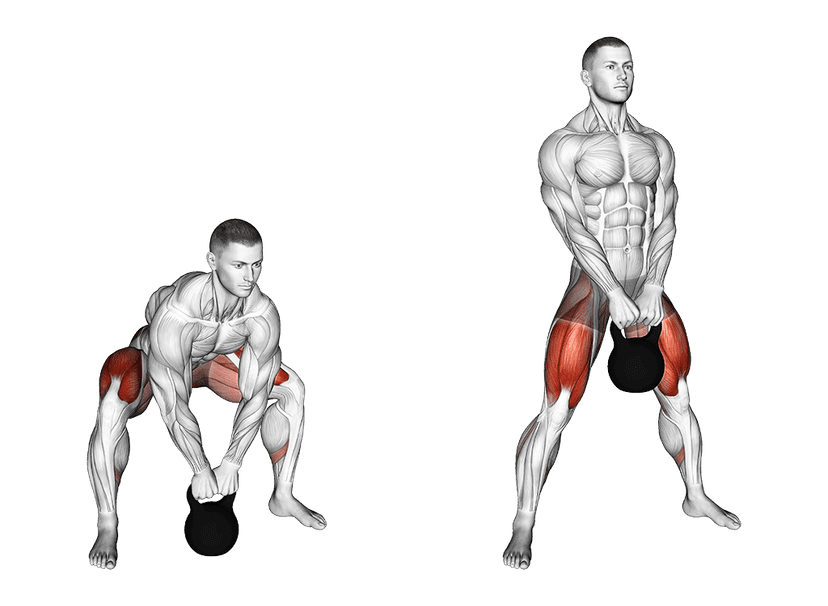
Kettlebell Sumo Squat: Complete Guide
The kettlebell sumo squat is a wide-stance squat variation that particularly targets the adductors and glutes. Your feet are placed much wider than shoulder width, toes pointing outward, and the kettlebell is held at arm's length between your legs. This positioning completely changes the dynamics of a standard squat and delivers a different stimulus for the lower body.
It is an exercise accessible to all levels. Beginners can start with bodyweight, and holding the kettlebell by the handle (goblet style) or by the horns is intuitive. For intermediate and advanced lifters, it is an excellent complement to standard bilateral squats for targeting the often neglected adductors.
Muscles targeted
- Adductors (adductor longus, brevis, magnus): heavily recruited by the wide foot placement
- Gluteus maximus: hip extension on the way up
- Quadriceps (vastus medialis, vastus lateralis, rectus femoris): knee extension
- Hamstrings: assist hip extension
- Core (abs, obliques): keeping the torso upright with the load between your legs
- Spinal erectors: spinal stabilization
The wide stance opens the hips and places the adductors in a greater stretch position. That is what sets the sumo squat apart from the standard squat: the adductors shift from secondary muscles to primary movers alongside the glutes.
Proper execution
Starting position
Place your feet at 1.5 to 2 times shoulder width. Toes point outward at roughly 30-45 degrees. Hold the kettlebell by the handle at arm's length in front of you, between your legs. Shoulders back, chest up, eyes forward. Brace your core before descending.
Eccentric phase (descent)
- Push your knees outward, in the direction of your toes.
- Descend by bending your knees and pushing your hips slightly back.
- Keep your torso as upright as possible (much more vertical than a standard squat).
- Lower until your thighs are parallel to the floor or slightly below.
- The kettlebell descends naturally between your legs without touching the floor.
- Inhale on the way down.
Concentric phase (ascent)
- Push the floor away with your heels and the outside of your feet.
- Squeeze your glutes and adductors on the way up.
- Your knees stay pushed outward throughout the entire ascent.
- Lock your hips at the top by contracting your glutes.
- Exhale on the way up.
Tip: imagine spreading the floor apart with your feet throughout every rep. This mental cue activates the abductors and stabilizes the knees.
Common mistakes
1. Knees caving inward (valgus) The knees collapse inward instead of tracking over the toes. This signals weak abductors or a stance that is too wide for your current mobility. Narrow your stance and actively think about pushing your knees out.
2. Torso leaning too far forward The sumo squat should be performed with a much more vertical torso than a standard squat. If you lean forward, the kettlebell pulls your back and the load shifts to your lower back. Think "chest up" and keep your eyes forward.
3. Feet turned out too far Feet angled beyond 45 degrees create excessive knee stress if your hip mobility does not support it. Your knees must be able to follow the direction of your toes without pain. Adjust the angle to your anatomy.
4. Insufficient depth Stopping above parallel reduces adductor and glute recruitment. Descend at least to parallel (thighs horizontal). If you lack mobility, perform dynamic adductor stretches before your session.
5. Bouncing at the bottom Using the stretch reflex at the bottom to bounce back up reduces time under tension and can stress the knees. Pause briefly at the bottom before rising.
Variations
Sumo squat pulse (beginner) At the bottom position, perform micro-movements of 5-10 cm before fully rising. Increases time under tension without extra load. Ideal as a finisher at the end of a session.
Sumo squat with heel elevation (intermediate) Place your heels on a small elevation (2-3 cm plate). Reduces the ankle mobility requirement and allows a more upright position. Targets the quadriceps more.
Double kettlebell sumo squat (intermediate to advanced) A kettlebell in each hand, arms extended between your legs. Allows you to increase the load without being limited by a single kettlebell's size. The two weights also enforce better alignment.
Tempo sumo squat (intermediate) Descend over 4-5 seconds, pause for 2 seconds at the bottom, rise over 2 seconds. Slow tempo increases time under tension and muscle recruitment without adding weight. Excellent for hypertrophy.
Programming
Placement in your session: Put the sumo squat as a primary exercise in your leg session or as a complement after a standard squat or deadlift to target the adductors.
Volume and intensity:
- Beginner: 3 x 12-15 reps, light kettlebell (8-12 kg) or bodyweight
- Intermediate: 4 x 10-12 reps, 16-24 kg kettlebell
- Advanced: 4 x 8-10 reps, heavy load or slow tempo
Frequency: 1-2 times per week. The adductors are often neglected and recover well, so you can train them twice a week without issue.
Starting weight: Begin with bodyweight to master the position. Add an 8 kg kettlebell, then progress in 4 kg increments. The right weight allows you to reach parallel with an upright torso and stable knees.
Key takeaways
- Wide stance: feet at 1.5-2 times shoulder width, toes at 30-45 degrees
- Knees out: they track over your toes at all times
- Upright torso: much more vertical than a standard squat
- Parallel minimum: go deep enough to recruit adductors and glutes
- Spread the floor: this mental cue activates the right muscles and protects the knees
