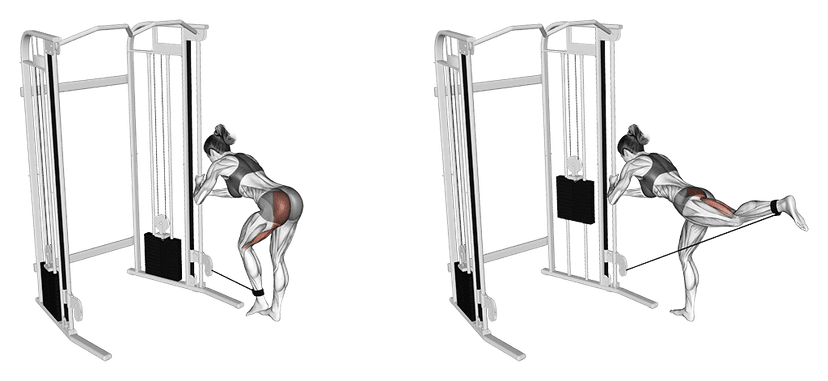
Cable Glute Kickback: Complete Guide
The cable glute kickback is one of the most effective isolation exercises for the glutes. Using a low pulley, you extend the hip against constant resistance that keeps tension on the gluteus maximus throughout the entire range of motion. You will find this exercise in virtually every glute-focused training program, and for good reason.
Unlike the squat or lunge that recruit many muscles simultaneously, the cable kickback lets you target the gluteus maximus in isolation. This makes it a valuable tool for bringing up lagging glutes or finishing a leg session with targeted work.
Muscles targeted
- Gluteus maximus: primary mover, responsible for hip extension
- Gluteus medius: stabilizes the pelvis during the unilateral movement
- Hamstrings (long head of biceps femoris): assist hip extension, especially at end range
- Core muscles (transverse abdominis, obliques): stabilize the torso to prevent rotation
The gluteus maximus is the largest muscle in the human body. Its primary role is hip extension (driving the thigh backward), which is exactly the movement the cable kickback replicates.
Proper execution
Starting position
Set the pulley to its lowest position. Attach an ankle strap to your working foot. Face the machine and hold the frame with both hands for stability. Stand on your support leg with a slight knee bend. Your working foot is slightly off the floor, hip in a neutral position.
Concentric phase (extension)
- Drive your working leg backward by contracting the glute. The movement originates at the hip, not the knee.
- Keep your back straight and your torso stable. Avoid arching your lower back to compensate.
- Raise your leg until your thigh is aligned with your torso or slightly past it. Do not try to go too high: beyond a certain point, your lower back compensates rather than your glute doing the work.
- Hold for one second at the top and squeeze the glute hard.
Eccentric phase (return)
- Bring your leg back to the starting position while controlling the movement over 2-3 seconds.
- Do not let the weight pull your leg forward. Resist the cable tension.
- Stop just before the weight stack rests to maintain continuous tension.
Breathing: exhale as you push the leg backward (effort), inhale on the return.
Common mistakes
1. Excessive lower back arching
This is the most common mistake. When you arch your back to lift your leg higher, you replace glute work with lumbar hyperextension. Keep your torso fixed and your back neutral. Range of motion must come solely from the hip.
2. Movement too fast with momentum
Swinging the leg with momentum uses inertia rather than glute strength. The kickback is an isolation exercise: every centimeter of movement must be controlled. Slow down and focus on the contraction.
3. Pelvis rotation
When working one leg, the pelvis tends to rotate toward the working side. This reduces gluteus maximus recruitment and loads the lower back asymmetrically. Keep your pelvis facing the machine, perfectly square.
4. Knee bending during extension
If you flex your knee to pull the cable backward, you turn the kickback into a leg curl. The knee stays in a fixed position (slightly bent) throughout the entire movement. Motion comes from the hip joint.
5. Load too heavy
This is not a strength exercise. Excessive load destroys technique and recruits compensators (lower back, hamstrings) instead of the glute. Use a moderate load that lets you feel every single rep.
Variations
Quadruped cable kickback (beginner)
Instead of standing, get on all fours facing the machine. This position stabilizes the pelvis and makes glute isolation easier. Excellent for beginners who struggle to keep their pelvis straight while standing.
Resistance band kickback (beginner to intermediate)
Replace the cable with a resistance band around your ankles. The resistance increases as the band stretches, maximizing tension at end range. Convenient for home workouts or warm-ups.
Lateral cable kickback (intermediate)
Instead of pushing the leg backward, push it to the side (abduction). This variation targets the gluteus medius, which is often weak and responsible for pelvic stability. Use a lighter load.
Standing kickback with isometric pause (intermediate to advanced)
Hold for 3-5 seconds at the top position on each rep. The isometric contraction recruits additional fibers and improves the mind-muscle connection with the glute.
Programming
Placement in your session: At the end of the session, after compound movements (squats, lunges, hip thrusts). The kickback is a finishing exercise that targets the glute when it is already pre-fatigued.
Volume and intensity:
- Beginner: 3 x 12-15 reps per leg, light load, focus on mind-muscle connection
- Intermediate: 3-4 x 10-12 reps per leg, load progression with controlled tempo
- Advanced: 4 x 10-15 reps per leg with intensification techniques (isometric pause, drop sets)
Frequency: 2-3 times per week if your glutes are a weak point. The glutes tolerate a high training frequency because they recover quickly.
Progression tip: Do not chase load on this exercise. Focus on contraction quality, tempo, and volume. Increase reps or sets rather than weight. When you feel every rep burning in the glute, you are on the right track.
Key takeaways
- Neutral back: no excessive arching, movement comes from the hip only
- Square pelvis: facing the machine, no rotation
- Voluntary contraction: squeeze the glute hard at the top
- Controlled tempo: slow and deliberate, no swinging
- Moderate load: prioritize mind-muscle connection over weight
