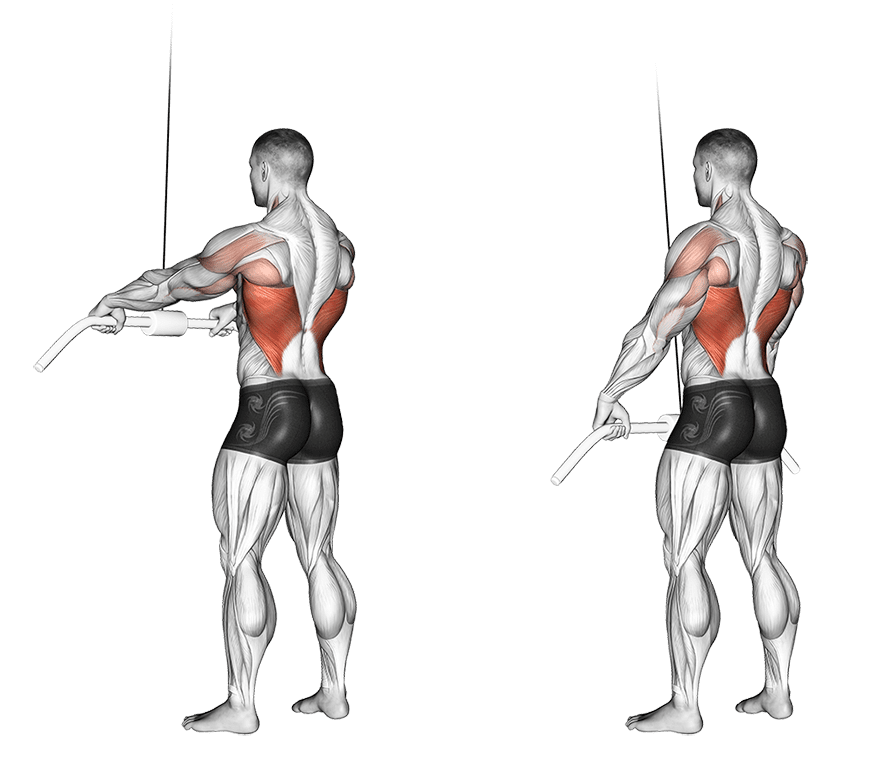
Standing Cable Pullover: Complete Guide
The standing cable pullover is an isolation exercise for the lats that deserves more attention than it receives. Unlike the lying dumbbell pullover, the standing cable version provides constant tension across the full range of motion and a working angle that isolates the lats without significantly involving the chest. It is one of the few exercises that lets you target the lats without the biceps being a limiting factor.
If you struggle to feel your lats working during rows or pull-ups, the standing cable pullover is an excellent teaching exercise. The mind-muscle connection develops quickly thanks to the isolation and continuous tension.
Muscles targeted
- Latissimus dorsi: primary mover, responsible for shoulder extension (bringing the arms down and back)
- Teres major: assists the lats in shoulder extension and humeral adduction
- Long head of the triceps: contributes to shoulder extension because it originates on the scapula
- Lower trapezius: scapular depression at end range
- Pectoralis minor: pulls the scapula forward and down
- Abdominals: stabilize the trunk against the pull of the cable
The lats do the bulk of the work. This is a single-joint movement: only the shoulder joint moves (the elbows stay nearly fixed). This simplicity is what makes the exercise so effective for isolating the lats.
Proper execution
Starting position
Attach a straight bar or rope to the high pulley. Stand facing the machine, about one step back. Feet shoulder-width apart, knees slightly bent. Lean your torso forward 15-30 degrees. Grip the bar overhand, arms extended in front of you at shoulder height or slightly above. Your elbows are slightly bent and will stay in that position throughout the movement.
Concentric phase (pull down)
- Without bending your elbows further, pull the bar down in an arc.
- The force comes from shoulder extension, not elbow flexion.
- Continue until your hands reach thigh level.
- Contract the lats for 1-2 seconds at the bottom position.
- Keep your torso tilted and stable throughout the movement.
Eccentric phase (return)
- Let the bar rise slowly in an arc.
- Control the movement over 2-3 seconds.
- Return until your arms are at shoulder height or slightly above.
- Feel the stretch in the lats at the top position.
Breathing: exhale while pulling down, inhale while returning up.
Common mistakes
1. Bending the elbows during the movement
If you bend your elbows while pulling, the exercise becomes a triceps pushdown. Your elbows must maintain the same flexion angle (15-20 degrees) from start to finish. Think about keeping your arms long.
2. Standing too close to the machine
Too close and the range of motion is reduced and the pull angle is not optimal. Step back to allow a full arc. You should feel a lat stretch at the top position.
3. Using bodyweight
Leaning forward to pull the load with bodyweight instead of lat strength is a common cheat. Your torso must stay at the same lean angle throughout the entire set.
4. Load too heavy
The standing pullover is an isolation exercise. The load is necessarily lighter than on a lat pulldown or row. If you cannot control the movement through the full range, reduce the weight.
5. Moving too fast
This is an exercise about feeling the muscle. Swinging the bar by speeding up the movement eliminates the continuous tension that makes this exercise effective. Keep a slow, controlled tempo.
Variations
Standing rope pullover (intermediate)
The rope lets you spread your hands apart at the end of the movement for a more intense lat contraction. The neutral grip is also more natural for some lifters. Excellent as a finisher.
Single-arm standing pullover (intermediate)
Use a single handle and work one arm at a time. Range of motion increases and you can focus on the contraction on each side. Ideal for correcting an imbalance.
Kneeling cable pullover (beginner to intermediate)
Kneel facing the high pulley. This position eliminates the temptation to cheat with bodyweight and stabilizes the lower body. The lat contraction is purer.
Lying bench cable pullover (advanced)
Lie on a bench perpendicular to a low pulley, head toward the machine. The movement combines the range of motion of a dumbbell pullover with the constant tension of a cable. Reserved for lifters who have mastered the standing version.
Programming
Placement in your session: Last or second-to-last exercise in your back session. The standing pullover is an isolation movement, not a compound lift. Use it to finish burning the lats after compound movements.
Volume and intensity:
- Beginner: 3 x 12-15 reps, light load, connection focus
- Intermediate: 3-4 x 10-12 reps, moderate load
- Advanced: 4 x 10-15 reps with slow tempo (3-4 second eccentric) or drop sets
Frequency: 1-2 times per week. It is an excellent exercise to place at the end of every back session for a maximal pump.
Starting weight: Begin with 10-15 kg. The goal is to feel the lats working on every rep. If you mostly feel your triceps, reduce the weight further and focus on the arcing movement with long arms.
Key takeaways
- Fixed elbows: the elbow flexion angle does not change during the movement
- Arc path: the movement traces an arc, not a straight line
- Continuous tension: take advantage of the cable, control every phase
- Isolation: this is an exercise for feeling the lats, not for loading heavy
- Stable torso: same lean angle from start to finish
