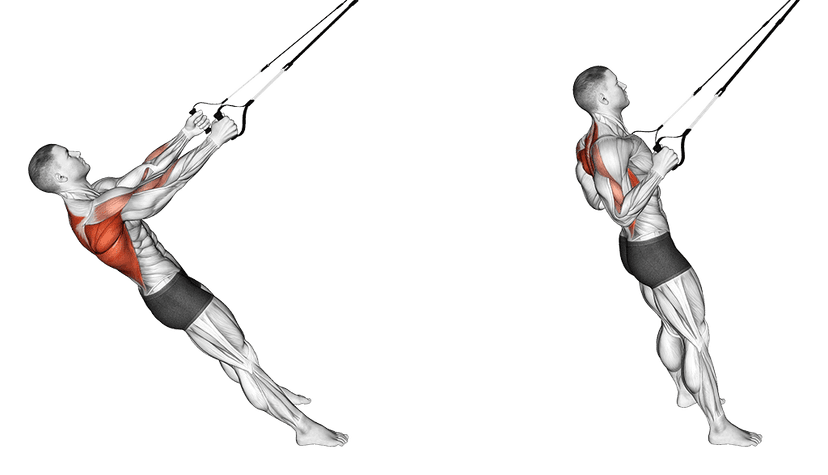
TRX Inverted Row: Complete Guide
The TRX inverted row (or suspension strap row) is a bodyweight exercise that targets the entire back. It uses gravity and your body angle as resistance: the more you lean back (body closer to horizontal), the harder the exercise becomes. It is an extremely versatile movement that adapts to all levels, from complete beginner to advanced lifter.
The TRX offers a unique advantage over machines and free weights: the instability of the straps forces the shoulder and core stabilizers to work constantly. It is a functional exercise par excellence, particularly useful for improving posture and shoulder health.
Muscles targeted
- Latissimus dorsi: primary mover, pulls the body toward the handles
- Mid and lower trapezius: scapular retraction, shoulder blade stabilization
- Rhomboids: pull the shoulder blades toward the spine
- Posterior deltoid: significant contribution when the elbows travel backward
- Biceps and brachialis: elbow flexion
- Rotator cuff: stabilizes the shoulder throughout the movement
- Transverse abdominis and obliques: bracing to keep the body rigid
- Glutes and hamstrings: maintain body alignment
The instability of the straps recruits shoulder stabilizers far more than a row machine or a guided bar row. This is as much a therapeutic exercise as a performance one.
Proper execution
Starting position
Attach the TRX straps to a solid anchor point (pull-up bar, beam, wall mount). Grip the handles with a neutral grip (palms facing each other). Walk your feet forward to lean your body back. Arms extended, body rigid and aligned from head to heels. The closer your feet are to the anchor point (more horizontal body), the harder it is.
Concentric phase (pull)
- Initiate the movement by squeezing your shoulder blades.
- Pull your body toward the handles, keeping your elbows at 45 degrees from your torso.
- Bring your chest level with the handles.
- Contract the lats hard at the top of the movement for 1 second.
- Keep the body rigid: no hip flexion, no head jutting forward.
Eccentric phase (descent)
- Lower yourself under control by extending your arms.
- Let your shoulder blades spread apart for a full stretch.
- Keep your body in a straight line throughout the descent.
- Recommended tempo: 1-2 seconds pulling, 2-3 seconds descending.
Breathing: exhale while pulling, inhale while descending.
Common mistakes
1. Hips sagging
Like in a plank, sagging hips indicate a lack of core bracing. Squeeze your glutes and abs to keep the body rigid. If your hips sag, stand more upright (feet farther from the anchor point).
2. Head jutting forward first
The chin reaching forward to meet the handles is a compensation. Your entire torso should rise, not just your head. Keep your gaze straight ahead and pull with the back.
3. Elbows flaring too wide
Elbows at 90 degrees from the body overload the shoulders. Keep your elbows at roughly 45 degrees from the torso for an optimal balance between lat recruitment and joint safety.
4. Incomplete range of motion
Cutting the movement short at the top (not bringing the chest to the handles) or at the bottom (not fully extending the arms) reduces effectiveness. Full range of motion is what makes this exercise so effective for posture.
5. Straps swinging
If the straps oscillate during the movement, you are not controlling the path. Pull in a straight line, smoothly. The straps should remain stable.
Variations
Feet-elevated inverted row (advanced)
Place your feet on a bench or box. The body is more horizontal, which significantly increases the load. Reserved for lifters who can perform 15 clean reps in the standard position.
Supinated-grip inverted row (intermediate)
Turn your palms toward you (supination). Biceps recruitment increases and the lat working angle changes slightly. Excellent for varying the stimulus.
Single-arm inverted row (advanced)
Pull with one arm by holding both handles in one hand or using a single strap. Difficulty skyrockets because the anti-rotation component is enormous. Reserved for experienced lifters.
Isometric-hold inverted row (intermediate)
Hold the top position for 3-5 seconds before lowering. Time under tension increases and lat contraction is maximal. Reduce the number of reps.
Programming
Placement in your session: As a warm-up to activate the back and shoulder stabilizers, or as a primary exercise if you train with bodyweight. In a gym setting, place it mid-session after heavy movements.
Volume and intensity:
- Beginner: 3 x 8-10 reps, body angle at 45-60 degrees
- Intermediate: 3-4 x 10-12 reps, angle at 30-45 degrees
- Advanced: 4 x 12-15 reps with feet elevated or isometric holds
Frequency: 2-3 times per week. The inverted row is easy on the joints and recovers quickly. It can serve as a warm-up for every upper body session.
Progression: Intensity is adjusted by changing body angle. The more horizontal you are, the harder it is. When you can do 15 clean reps at a given angle, walk your feet 10-15 cm closer to the anchor point.
Key takeaways
- Rigid body: head-shoulders-hips-heels alignment with no hip flexion
- Shoulder blades first: scapular retraction initiates the movement
- Adjustable angle: difficulty is controlled by foot position
- Total control: no swinging, no jerking, no compensating
- Versatility: warm-up, primary exercise, or finisher depending on context
