Barbell Shrug: Complete Guide
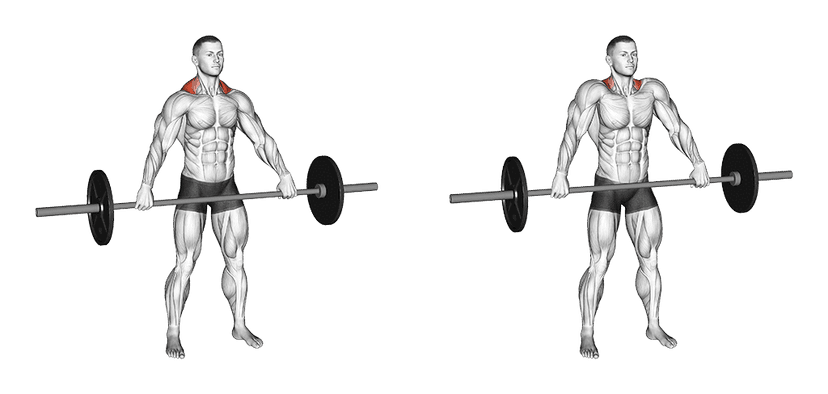
The barbell shrug is the gold standard exercise for developing the upper trapezius. These muscles connecting the neck to the shoulders create an impression of power and thickness in the upper body. The movement looks simple, but poor execution wastes your effort and can create neck tension.
Targeted Muscles
- Upper trapezius: primary mover, shoulder elevation (this is what builds the mass)
- Mid trapezius: scapular retraction at the end of the movement
- Levator scapulae: assists in scapular elevation
- Rhomboids: scapular stabilization
- Forearms: grip strength, often the limiting factor
The upper trapezius does 90% of the work. If you mainly feel your forearms or shoulders, there is a technique or grip problem.
Proper Execution
Starting Position
- Bar in a rack or on supports at mid-thigh height.
- Overhand grip (palms facing you), slightly wider than shoulder width.
- Arms extended, shoulders down. The bar rests against your thighs.
- Straight back, chest up, eyes looking straight ahead (not up).
- Knees very slightly bent to avoid hyperextension.
Concentric Phase (Elevation)
- Raise your shoulders as high as possible, as if trying to touch your ears.
- The movement is strictly vertical. No rolling, no rotation.
- Keep your arms straight from start to finish. The arms do not bend.
- At the top, squeeze the traps hard for 1 to 2 seconds.
Eccentric Phase (Lowering)
Lower slowly over 2 to 3 seconds. Let your shoulders drop fully to stretch the traps. Do not bounce at the bottom.
Breathing
Inhale at the bottom, exhale while raising your shoulders. On heavy loads, brace and hold your breath during the concentric phase.
Common Mistakes
1. Rolling the shoulders This is the most persistent myth. Rolling your shoulders in a circle (forward or backward) adds no benefit. It overloads the acromioclavicular joint and creates unnecessary friction. The movement is vertical: up and down, period.
2. Bending the elbows Bending your arms turns the shrug into a disguised upright row and shifts the load from the traps to the delts and biceps. Your arms stay straight like cables.
3. Insufficient range of motion Only going halfway up deprives your traps of their peak contraction. Not lowering fully prevents the stretch. Full range of motion is mandatory, even if it means reducing the weight.
4. Tilting the head forward Dropping your chin during the shrug compresses the cervical vertebrae. Keep your eyes straight ahead with a neutral neck throughout the movement.
5. Momentum and bouncing Bending the knees to propel the bar is cheating. It overloads the cervical spine under momentum and reduces trap tension. Strict, controlled movement with no jerking.
Variations
Dumbbell Shrug (Beginner) Dumbbells allow a more natural arm position (along the body instead of in front). Less strain on the lower back. Ideal for beginners or people with lower back issues.
Barbell Shrug with Isometric Hold (Intermediate) Hold the contraction at the top for 3 to 5 seconds. Drastically increases time under tension and congestion. Reduce the weight by 30% compared to your usual load.
Behind-the-Back Shrug on Smith Machine (Advanced) Bar behind you on the Smith machine. Changes the pulling angle and targets the mid traps more. An unusual but highly effective movement for upper back thickness.
Farmer's Walk (Intermediate to Advanced) Walk with heavy loads in each hand. The traps work under constant isometric tension. Bonus: grip, core, stability. A complete functional exercise that builds steel traps.
Programming
Strength (4-5x6-8 reps) At the start of a shoulder session or at the end of a back session. Rest 2 minutes. Heavy load, strict form, 1-second hold at the top.
Hypertrophy (3-4x10-15 reps) Moderate load, controlled tempo 2-2-3 (2s up, 2s hold, 3s down). Rest 60 to 90 seconds. Volume and time under tension matter more than weight.
Finisher (2-3x20-25 reps) Light load, fast but controlled reps. The goal is maximum congestion. Can be done as a drop set: 3 sets without rest, reducing the weight by 20% each time.
Frequency: 1 to 2 times per week. Traps recover fast but are also indirectly stimulated by deadlifts, rows, and overhead presses. Adjust based on your total volume.
Key Takeaways
- Vertical movement only: up and down. Never roll.
- Arms straight from start to finish. Arms are cables, not levers.
- Go as high as possible, lower completely.
- Squeeze for 1 to 2 seconds at the top to maximize recruitment.
- If your grip fails before your traps, use lifting straps.
