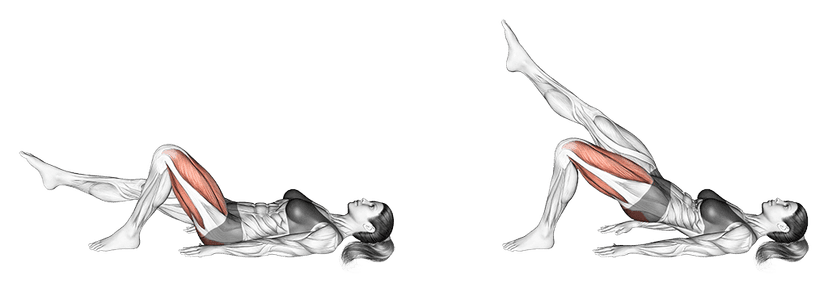
Single Leg Glute Bridge: Complete Guide
The single leg glute bridge is the unilateral version of the classic glute bridge. By working one side at a time, you double the intensity on each glute, correct muscular imbalances, and improve pelvic stability. It is an underrated exercise that deserves a spot in any lower body strengthening program.
Many lifters jump straight from the bilateral glute bridge to the hip thrust without ever training unilaterally. That is a mistake. Single leg work reveals hidden weaknesses, forces the gluteus medius to stabilize, and builds a solid foundation for loaded movements.
Muscles targeted
- Gluteus maximus: primary mover, works twice as hard as in the bilateral version
- Gluteus medius: lateral pelvic stabilization, a crucial role in unilateral work
- Hamstrings: assist hip extension
- Transverse abdominis and obliques: anti-rotation trunk stabilization
- Quadratus lumborum: lateral spinal stabilization
The gluteus maximus of the working leg handles all the pushing. The gluteus medius prevents the pelvis from dropping on the opposite side. The abdominals prevent trunk rotation.
Proper execution
Starting position
Lie on your back, knees bent, feet flat on the floor. Lift one leg: either knee bent at 90 degrees (easier) or leg extended toward the ceiling (harder). Arms at your sides, palms down for stability.
Concentric phase (ascent)
- Drive through the heel of the working leg while contracting the glute.
- Lift your hips until your body forms a straight line from shoulder to working knee.
- The pelvis must stay perfectly level. No lateral tilt.
- Hold the contraction for 1-2 seconds at the top.
Eccentric phase (descent)
- Lower slowly over 2-3 seconds.
- Keep the free leg in the air throughout the entire set.
- Lightly tap the floor without resting between reps.
- Complete all reps on one side before switching.
Breathing: exhale on the way up, inhale on the way down.
Common mistakes
1. Pelvic tilt
This is the number one mistake. When the pelvis drops on the free leg side, the gluteus medius of the working leg is not stabilizing enough. Imagine balancing a glass of water on your pelvis: it should not spill. Reduce the range of motion if needed.
2. Trunk rotation
The torso rotates toward the working leg to compensate for the imbalance. Keep your shoulders flat on the floor and brace your abs. Your hips should point straight at the ceiling.
3. Hamstring compensation
If your hamstrings burn before your glutes, your foot is too far away. Bring your heel closer so that your shin is nearly vertical at the top. Think about pushing your hips up, not pulling with the back of your thigh.
4. Excessive range of motion
In unilateral work, the temptation is to push the hips as high as possible. But beyond the shoulder-hip-knee line, you enter lumbar hyperextension. Stop at alignment.
Variations
Foot-elevated single leg glute bridge (intermediate)
Place the working foot on a step, bench, or 20-30 cm box. The elevation increases the range of motion and intensifies glute and hamstring work. Make sure your surface is stable.
Banded single leg glute bridge (intermediate)
Place a resistance band above the knees. Even in unilateral work, the band forces the gluteus medius to keep the knee in line. Double benefit: vertical push plus lateral stabilization.
Weighted single leg glute bridge (intermediate to advanced)
Place a dumbbell or plate on the hip crease of the working side. Hold the weight with both hands. Gradually increase the load when bodyweight becomes too easy.
Isometric single leg glute bridge (beginner)
Hold the top position for 10-20 seconds per side. Ideal for developing pelvic stability and learning to engage the gluteus medius. Start with this variation if the full movement feels too unstable.
Programming
Placement in your session: As activation before squats or lunges. As an accessory after your heavy bilateral movements. Or as a finisher to exhaust each glute individually.
Volume and intensity:
- Beginner: 3 x 10-12 reps per side at bodyweight
- Intermediate: 3-4 x 10-15 reps per side with band or elevated foot
- Advanced: 4 x 8-12 reps per side with added weight
Frequency: 2-3 times per week. The exercise is less taxing on the nervous system than heavy bilateral movements, but the total volume per glute is high.
Golden rule: Always start with your weaker side. Perform the same number of reps on both sides, even if the stronger side could do more. The goal is to close the gap.
Key takeaways
- Level pelvis: zero lateral tilt is the top technical priority
- Heel close: shin nearly vertical to target the glutes
- Weak side first: always start with the less strong side
- Squeeze at the top: 1-2 seconds of maximal contraction
- Progression: bodyweight then band then elevated then weighted
