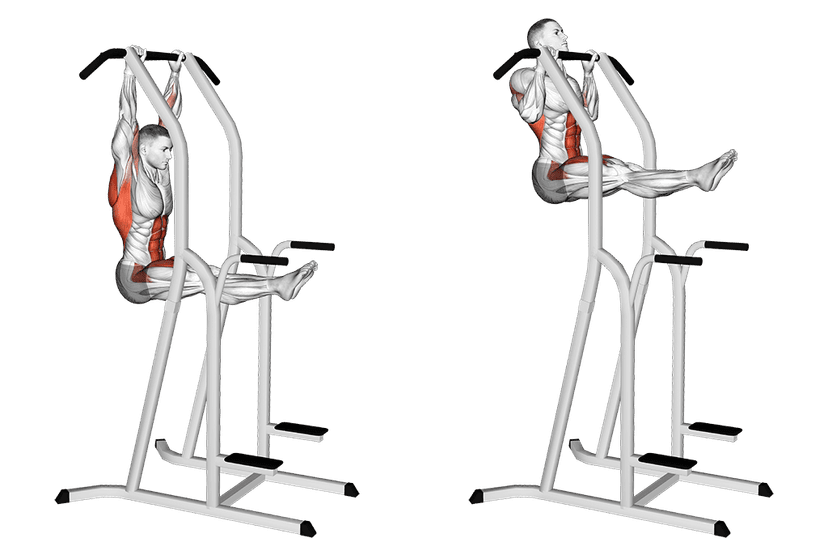
L-Sit Pull-Up: Complete Guide
The L-sit pull-up combines two demanding exercises into one movement. You pull your body toward the bar while holding your legs horizontal in front of you. This dual effort massively recruits the back, abdominals, and hip flexors. It is an advanced exercise that requires both pulling strength and a solid core. If you want a movement that builds a powerful back and iron-clad abs, the L-sit pull-up is for you.
Muscles targeted
- Latissimus dorsi: primary mover, responsible for arm adduction and extension
- Mid and lower trapezius: scapular retraction during the pull
- Rhomboids: work with the traps to squeeze the shoulder blades together
- Biceps and brachialis: elbow flexion, pulling assistance
- Rectus abdominis: isometric hold keeping the legs horizontal
- Hip flexors (psoas, rectus femoris): leg elevation and hold
- Quadriceps: knee lockout in extension
The lats provide the pulling force. But it is the abdominal chain and hip flexors that make this exercise unique. If your core gives out, your legs drop and the exercise loses its purpose.
Proper execution
Starting position
Hang from a pull-up bar with an overhand grip (palms facing away), hands at shoulder width or slightly wider. Raise your straight legs in front of you until they are parallel to the floor. Lock your knees. Your body forms a perfect L shape when viewed from the side. Brace your abs hard and activate your hip flexors to hold this position before you start pulling.
Concentric phase (ascent)
- From the L position, pull yourself toward the bar by initiating the movement with your shoulder blades (scapular depression and retraction).
- Continue pulling until your chin clears the bar.
- Keep your legs strictly horizontal throughout the ascent. This is the hardest part.
- Exhale as you pull.
Eccentric phase (descent)
- Lower yourself under control, 2-3 seconds minimum.
- Keep your legs in the L position during the descent. Do not let them drop.
- Return to the starting position with arms extended, legs still horizontal.
- Inhale during the descent.
Breathing: exhale on the way up, inhale on the way down. The isometric ab hold makes breathing challenging. Keep a short, steady rhythm.
Common mistakes
1. Legs dropping during the pull This is the number one mistake. If your legs fall below horizontal when you pull, your core is not strong enough. Work on a static L-sit hang for 15-20 seconds first before attempting the pull-ups.
2. Using momentum to get up Kipping turns the exercise into a ballistic movement and removes the abdominal work. The L-sit pull-up is done strict, period. If you need to swing, reduce the load or go back to regular pull-ups.
3. Bent knees Bent knees shorten the lever arm and significantly reduce difficulty. It is an acceptable regression for learning, but the goal remains fully extended legs.
4. Missing scapular retraction Pulling without engaging the shoulder blades overloads the biceps and forearms. Initiate each rep by pulling your shoulder blades down and back before bending the elbows.
5. Uncontrolled descent Dropping on the eccentric destroys the L position and wastes half the benefit. Every descent must be controlled.
Variations
L-sit hang (beginner) Simply hold the L position while hanging without pulling. Goal: 3 x 15-20 seconds. This builds the core endurance and grip strength you need.
Bent-knee L-sit pull-up (intermediate) Same movement but with knees bent at 90 degrees. The shorter lever arm makes the hold easier. A good progression step.
Weighted L-sit pull-up (advanced) Add a weight vest or hold a plate between your feet. Reserved for athletes who can perform 8-10 clean bodyweight L-sit reps.
L-sit to typewriter pull-up (advanced) At the top position, move laterally from one hand to the other while holding the L-sit. An extreme exercise for strength and coordination.
Programming
Placement in your session: At the start of your back session when you are fresh. The core and coordination demands require maximum freshness.
Volume and intensity:
- Intermediate: 3-4 x 3-5 reps, 2-3 minutes rest
- Advanced: 4 x 6-8 reps, 2 minutes rest
- Progression: start with 3 x max reps. When you reach 3 x 8, add weight
Frequency: 1-2 times per week. The exercise is very demanding on the abs and hip flexors. Allow a minimum of 72 hours of recovery.
Prerequisites: You should be able to perform at least 8-10 strict pull-ups and hold an L-sit hang for 15 seconds before tackling this exercise.
Key takeaways
- Horizontal legs: the L must be maintained from start to finish of every rep
- Zero momentum: strict movement only, no kipping
- Scapular retraction: initiate the pull with the shoulder blades
- Controlled descent: 2-3 seconds minimum on the eccentric
- Progression: master the static L-sit before adding the pull
