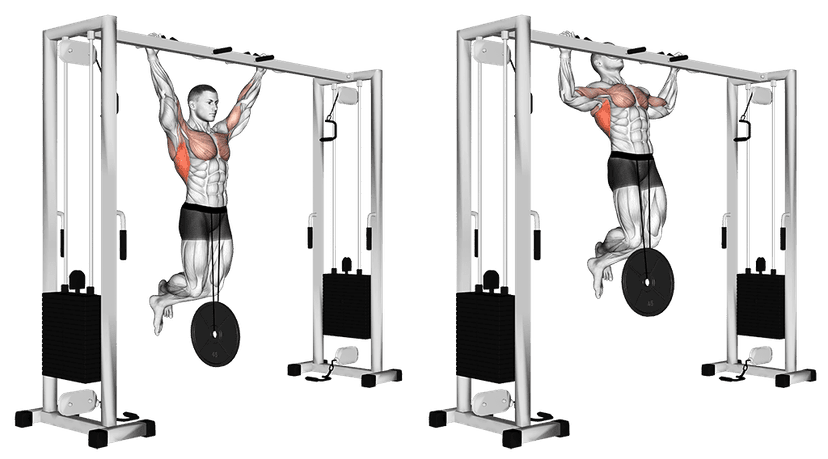
Weighted Pull-Up: Complete Guide
The weighted pull-up is the natural progression when bodyweight pull-ups become too easy. You attach extra weight to your body and pull. The concept is simple, the results are spectacular. No other back exercise combines strength, hypertrophy, and functional performance as effectively. If you want a wide, thick back, the weighted pull-up is your best ally.
Muscles targeted
- Latissimus dorsi: primary mover, pulls the body up despite the added load
- Mid and lower trapezius: scapular retraction and depression under load
- Rhomboids: squeeze the shoulder blades against resistance
- Biceps and brachialis: elbow flexion under heavy load
- Forearms (finger flexors): grip challenged by the additional weight
- Teres major: assists the lats in arm adduction
- Abdominals: trunk stabilization to prevent swinging
The lats are the dominant muscle. Progressive overload through added weight makes this a top-tier exercise for back hypertrophy, as the mechanical stimulus far exceeds that of regular pull-ups.
Proper execution
Setting up the weight
Three main options: a dip belt (most common), a weight vest, or a dumbbell held between your feet or thighs. The dip belt is the best choice because it allows simple progressive loading and does not restrict movement. Attach the weight, position it between your legs, and check that it does not swing.
Starting position
Grip the bar overhand, hands at shoulder width or slightly wider. Hang with arms extended, shoulders active (not shrugged up to your ears). The weight hangs between your legs. Brace your abs to stabilize your trunk and limit swinging.
Concentric phase (ascent)
- Initiate the movement with scapular depression: pull your shoulder blades down.
- Pull yourself toward the bar by driving your elbows toward your hips.
- Rise until your chin clears the bar.
- Keep your trunk stable, no swinging or kipping.
- Exhale as you pull.
Eccentric phase (descent)
- Lower yourself under control, 2-3 seconds. This is crucial with added weight: an uncontrolled descent can injure your shoulders.
- Return to full arm extension, shoulders active.
- Stabilize the weight before the next rep. No bouncing at the bottom.
- Inhale during the descent.
Breathing: exhale on the way up, inhale on the way down.
Common mistakes
1. Adding weight too fast The most frequent mistake. Adding 10-20 kg at once deteriorates your technique and overloads your joints. Progress in increments of 2.5-5 kg maximum. The rule: if you cannot do 5 clean reps, it is too heavy.
2. Kipping or swinging Added weight amplifies every parasitic movement. Swinging with 20 kg on a dip belt creates enormous forces on the shoulders. The weighted pull-up is a strict exercise; every rep must be controlled.
3. Incomplete range of motion Doing half reps with added weight serves no purpose. Extend your arms fully at the bottom, get your chin above the bar at the top. If you cannot cover the full range, reduce the weight.
4. Grip failing before the back If your hands give out before your back is fatigued, your forearms are the weak link. Use straps for your heavy sets and train grip separately (dead hangs, farmer walks).
5. Neglecting the eccentric Dropping under the weight is a shortcut to injury. The controlled eccentric is responsible for a large portion of hypertrophy. Slow down the descent.
Variations
Weighted chin-up (intermediate) Underhand grip with added weight. Recruits the biceps and lower lats more. Be careful not to overload the wrists.
Wide-grip weighted pull-up (advanced) Hands well beyond shoulder width. Targets back width more. Requires greater grip strength.
Weighted pull-up with pause (advanced) Hold for 2 seconds at the top with your chin above the bar. Eliminates momentum and increases time under tension at peak contraction.
Weighted negative (intermediate) Jump or use a partner to get to the top, then lower yourself in 5-6 seconds with the weight. Excellent for building the eccentric strength needed for the full weighted pull-up.
Programming
Placement in your session: First exercise in your back session. The weighted pull-up demands maximum neural and muscular freshness.
Volume and intensity:
- Intermediate: 4 x 5-6 reps, 70-80% capacity, 2-3 minutes rest
- Advanced: 5 x 3-5 reps for strength, or 4 x 6-8 reps for hypertrophy
- Deload: every 4-6 weeks, return to bodyweight pull-ups for one week
Frequency: 1-2 times per week. Weighted pull-ups are taxing on the nervous system. Two sessions per week is a maximum for most trainees.
Typical progression: Start with +5 kg. When you complete 4 x 6 clean reps, add 2.5 kg. Repeat. An intermediate trainee can expect to pull with +20-40 kg within a year of consistent progression.
Key takeaways
- Gradual progression: add 2.5-5 kg at a time, no more
- Always strict: zero momentum, zero kipping, zero swinging
- Full range of motion: arms extended at the bottom, chin above the bar at the top
- Controlled eccentric: 2-3 seconds minimum on the descent
- Prerequisite: 10-12 clean bodyweight pull-ups before adding weight
