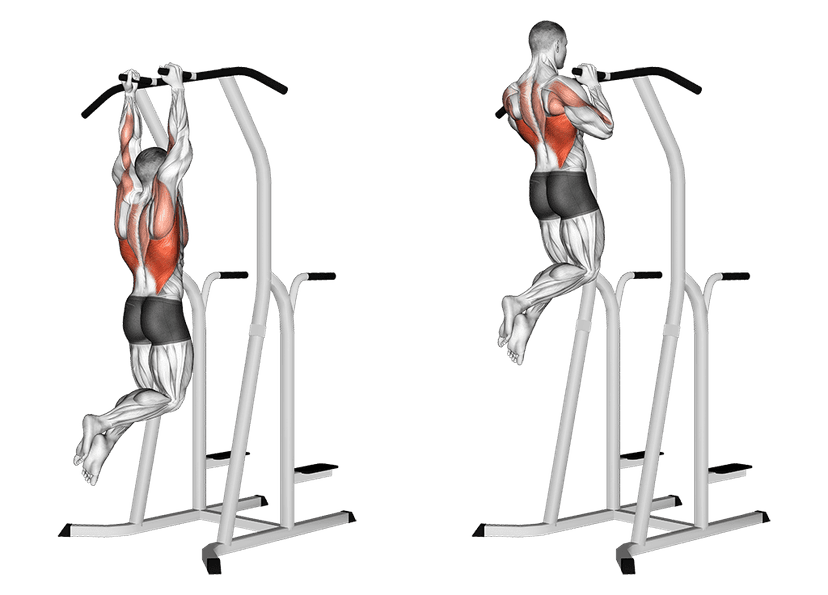
Neutral Grip Pull-Up: Complete Guide
The neutral grip pull-up is often underestimated. Yet it is one of the most comfortable and effective pull-up variations for developing the back. Your palms face each other, your wrists sit in a natural position, and your shoulders experience less stress than with an overhand or underhand grip. If you have shoulder or elbow pain with regular pull-ups, the neutral grip might be your solution.
Muscles targeted
- Latissimus dorsi: primary mover, works through the full range of motion
- Brachialis: strongly recruited thanks to the neutral grip (more so than the biceps)
- Biceps brachii: elbow flexion in neutral position
- Mid and lower trapezius: scapular retraction during the pull
- Rhomboids: squeeze the shoulder blades together
- Teres major: assists the lats in arm adduction
- Posterior deltoid: shoulder stabilization
The hallmark of the neutral grip is increased brachialis recruitment. This muscle sits beneath the biceps and contributes significantly to elbow flexion when the palms face each other. The result: your arms work differently than with an overhand or underhand grip.
Proper execution
Starting position
Grip the parallel handles of the bar (or a specialty bar with neutral grips). Palms face each other, hands at shoulder width or slightly narrower. Hang with arms extended, shoulders active (pull your shoulder blades down so you are not hanging passively on ligaments). Cross your feet or keep your legs slightly in front of you to stabilize your body.
Concentric phase (ascent)
- Initiate the movement with scapular depression.
- Pull yourself up by driving your elbows down and back.
- Rise until your chin clears the handles.
- Squeeze your shoulder blades at the top to maximize back contraction.
- Exhale as you pull.
Eccentric phase (descent)
- Lower yourself under control, 2-3 seconds.
- Fully extend your arms at the bottom without losing shoulder activation.
- No bouncing or swinging between reps.
- Inhale during the descent.
Breathing: exhale on the way up, inhale on the way down.
Common mistakes
1. Passive hanging at the bottom Hanging with arms extended and shoulders shrugged up to your ears overloads shoulder ligaments and tendons. Always keep your shoulders active: pull them down even at the bottom position.
2. Shortened range of motion Not fully extending at the bottom or not pulling high enough at the top. The neutral grip allows a generous natural range of motion. Use every inch of the movement.
3. Elbows flaring out With a neutral grip, your elbows should stay relatively close to your body and drive toward your hips. Flaring them sideways changes the movement and reduces effectiveness on the back.
4. Using momentum Swinging your legs to build speed is tempting, especially near the end of a set. Resist: every rep must be controlled. If you cannot pull cleanly, end the set.
Variations
Assisted neutral grip pull-up (beginner) Use a resistance band under your feet or an assisted pull-up machine. The neutral grip is often the first grip a beginner masters thanks to its advantageous biomechanics.
Weighted neutral grip pull-up (advanced) Add weight via a dip belt. The neutral grip handles heavy loads well because the wrist position is natural.
Close neutral grip pull-up (intermediate) Use a V-bar or closely spaced handles (10-15 cm apart). Targets the brachialis and mid-back more.
Neutral grip pull-up with pause (intermediate) Hold for 2 seconds at the top position. Reinforces the contraction at the peak of the movement and increases time under tension.
Programming
Placement in your session: First or second exercise in your back session. If you start with weighted overhand pull-ups, the neutral grip makes an excellent second movement.
Volume and intensity:
- Beginner: 3 x 5-8 reps (assisted if needed), 2 minutes rest
- Intermediate: 4 x 8-10 reps, 90 seconds rest
- Advanced: 4 x 8-12 weighted reps, 2 minutes rest
Frequency: 2-3 times per week. The neutral grip is easy on the joints, allowing a higher frequency than other pull-up variations.
Combining with other grips: Alternate grips throughout the week (overhand Monday, neutral Wednesday, underhand Friday). This ensures balanced development of the back and arms.
Key takeaways
- Palms facing each other: natural position that is easy on the wrists and shoulders
- Active shoulders: scapular depression at the bottom of the movement
- Elbows toward the hips: keep them close to the body
- Full range of motion: arms extended at the bottom, chin above the handles at the top
- Versatility: accessible to beginners, scalable for advanced lifters
