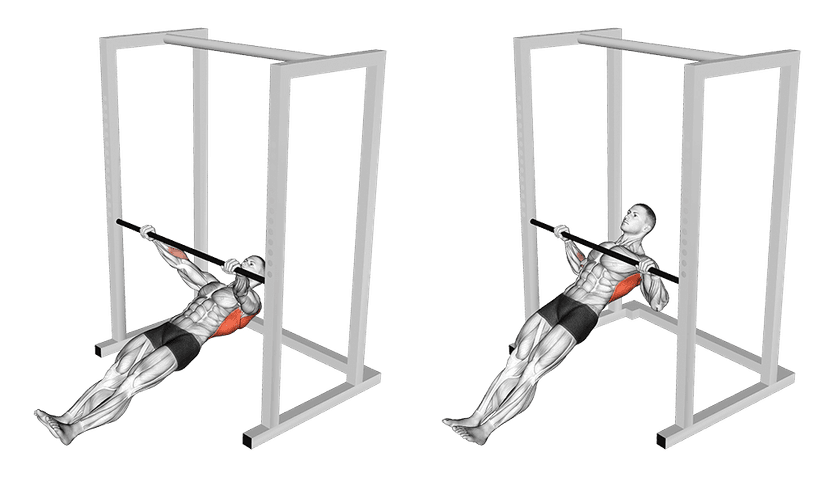
Australian Pull-Ups (Inverted Rows): Complete Guide
Australian pull-ups, also called inverted rows, are one of the best exercises for learning to pull with the back. You position yourself under a bar at hip height, hang face up, and pull your chest toward the bar. It is the mirror image of the push-up: if the push-up is a horizontal push, the Australian pull-up is a horizontal pull. Accessible at all levels, it is remarkably effective for building a solid back foundation.
Muscles targeted
- Latissimus dorsi: primary mover in horizontal pulling
- Mid trapezius: scapular retraction, brings the shoulder blades together
- Rhomboids: work with the traps for scapular stability
- Posterior deltoid: horizontal arm extension
- Biceps and brachialis: elbow flexion
- Spinal erectors: keep the body in a rigid position
- Hamstrings and glutes: hip stabilization in the inverted plank position
Unlike vertical pull-ups that target back width, Australian pull-ups emphasize back thickness: the mid traps, rhomboids, and posterior deltoid are heavily recruited.
Proper execution
Starting position
Set a bar in a rack or use a Smith machine at roughly hip height. Lie under the bar, face up. Grip the bar overhand, hands at shoulder width. Extend your legs in front of you, heels on the floor. Your body forms a straight line from shoulders to feet, like an inverted plank. Squeeze your glutes and abs to maintain this line.
Concentric phase (ascent)
- Pull your chest toward the bar by squeezing your shoulder blades together.
- Your elbows stay at 45-60 degrees from your torso (not pinned to your sides, not flared to 90 degrees).
- Rise until the bar touches your lower chest.
- At the top, imagine pinching a pencil between your shoulder blades.
- Exhale as you pull.
Eccentric phase (descent)
- Lower yourself under control, 2 seconds minimum.
- Fully extend your arms at the bottom.
- Maintain the plank position throughout the descent.
- Inhale during the descent.
Breathing: exhale as you pull, inhale on the way down.
Common mistakes
1. Hips sagging If your hips drop toward the floor, you lose body tension and back engagement decreases. Your body must stay rigid like a plank. Keep your glutes and abs contracted at all times.
2. Pulling with the arms instead of the back If your biceps burn but you feel nothing in your back, you are pulling with the arms. The fix: think about driving your elbows backward rather than bending your arms. Initiate the movement with scapular retraction.
3. Head jutting forward Craning your neck toward the bar to "cheat" the height is common. Keep your neck neutral, eyes toward the ceiling. Your chest should touch the bar, not your chin.
4. Incomplete range of motion Not pulling high enough or not fully extending at the bottom. Every rep starts with arms straight and ends with the bar against the chest. That is what separates an effective rep from a useless half rep.
5. Feet too close to the bar The closer your feet are beneath the bar, the easier the exercise (more vertical angle). For standard difficulty, your feet should be far enough away that your body forms a 30-45 degree angle with the floor.
Variations
Feet-elevated inverted row (intermediate) Place your feet on a bench or box. The increased angle puts more load on the back. This is the natural progression when the standard version gets easy.
Underhand inverted row (intermediate) Palms facing you. Recruits the biceps more and slightly changes the pulling angle on the back. A good alternative for variety.
Single-arm inverted row (advanced) Pull with one arm, the other arm resting along your body or on your chest. Extremely demanding for the back and trunk stability.
Inverted row with pause (intermediate) Hold for 2-3 seconds at the top with your chest against the bar. Forces scapular contraction and teaches proper retraction.
Programming
Placement in your session: An excellent second or third exercise after vertical pulls or heavy rows. Can also serve as a main exercise for beginners.
Volume and intensity:
- Beginner: 3 x 8-12 reps (feet under the bar to reduce difficulty), 90 seconds rest
- Intermediate: 4 x 10-15 reps, feet on the floor, 60-90 seconds rest
- Advanced: 4 x 8-12 reps with feet elevated or a weight vest, 90 seconds rest
Frequency: 2-4 times per week. The exercise is easy on the joints and recovers fast. Ideal for extra pulling volume.
Recommended pairing: Superset with push-ups for balanced push-pull work. 4 x 12 inverted rows + 4 x 12 push-ups, 60 seconds rest. Simple, effective, fast.
Key takeaways
- Rigid body: glutes and abs engaged, straight line from shoulders to feet
- Pull with the back: initiate with scapular retraction, not the arms
- Chest to bar: every rep reaches full contact
- Adjustable difficulty: change the angle (feet closer or farther) to scale difficulty
- Versatility: beginner or advanced, there is always an angle that fits your level
