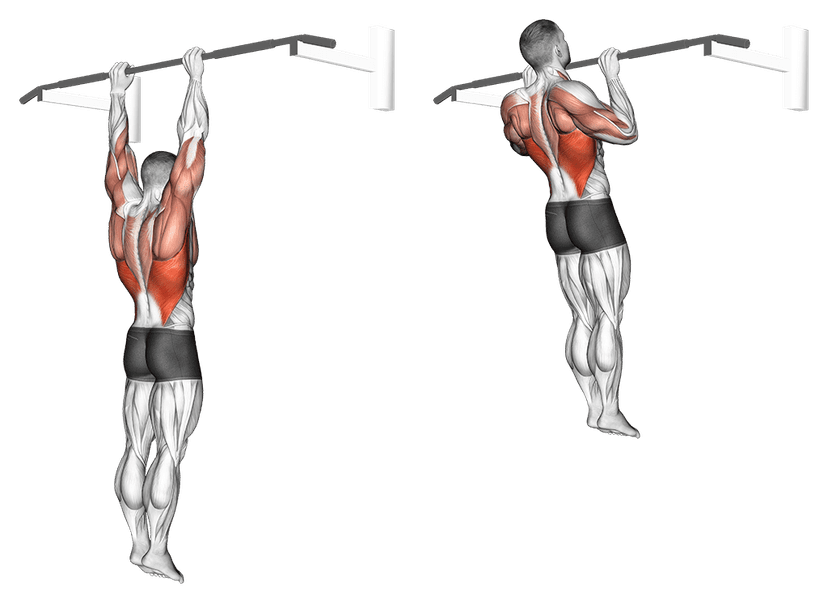
Pull-ups (Overhand Grip): complete guide
Overhand pull-ups are one of the most effective movements for building a wide, thick back. If you want that V-taper and serious lat development, pull-ups are non-negotiable. When done correctly, they engage the entire posterior chain and are one of the best tests of relative body strength.
Muscles targeted
The latissimus dorsi is the primary mover -- the muscle responsible for the wide, flared look of the back. Secondary muscles include the teres major and teres minor, the rhomboids and lower trapezius, the biceps brachii and brachioradialis, and the serratus anterior. Your abs, lower back, and glutes work isometrically to stabilize the body.
Proper execution
Starting position: overhand grip (palms facing away), slightly wider than shoulder width. Arms fully extended, body hanging. Before you pull, depress and retract your shoulder blades -- initiate from the lats, not the arms.
Pulling phase: think "elbows to hips," not "bend the arms." Drive your elbows down and back until your chin clears the bar. Exhale as you pull.
Lowering phase: lower yourself in 2-3 seconds, keeping tension in the lats. Return to full arm extension at the bottom without letting your shoulder blades shrug up.
Common mistakes
Pulling with the arms: the biceps fatigue before the lats get a proper workout. Fix: focus on the cue "elbows to hips."
Incomplete range of motion: not descending to full extension or not pulling high enough shortchanges the muscle. Full extension at the bottom, chin above the bar at the top.
Body swinging: if you need momentum to get up, reduce the load. Use a resistance band for assistance.
Upper traps shrugging: shoulders rising toward the ears unloads the lats. Depress and retract your shoulder blades before every rep.
Variations
Chin-ups (underhand grip): increases bicep contribution, generally easier for most people. A great starting point.
Neutral-grip pull-ups: reduces stress on the elbows and wrists. A good middle ground between overhand and underhand.
Australian pull-ups (inverted rows): excellent for beginners or as a high-rep finisher at the end of a session.
Weighted pull-ups: once you can do 3 clean sets of 10 reps, add load with a dipping belt and drop back to 6-8 reps.
Programming
Place pull-ups first in your back session. Recommended volume:
- Beginner: 3 sets x 5-8 reps (use a resistance band if needed)
- Intermediate: 4 sets x 6-10 reps
- Advanced: 4-5 sets x 8-12 reps with progressive overload
Frequency: a maximum of 2 times per week.
Key takeaways
- Set your shoulder blades before you pull: the movement starts with scapular depression
- Think "elbows to hips" to force the lats to do the work
- Full range of motion: complete extension at the bottom, chin above the bar at the top
- Slow on the way down (2-3 seconds) to maximize hypertrophy
- Progress to weighted pull-ups once 3 x 10 becomes comfortable
