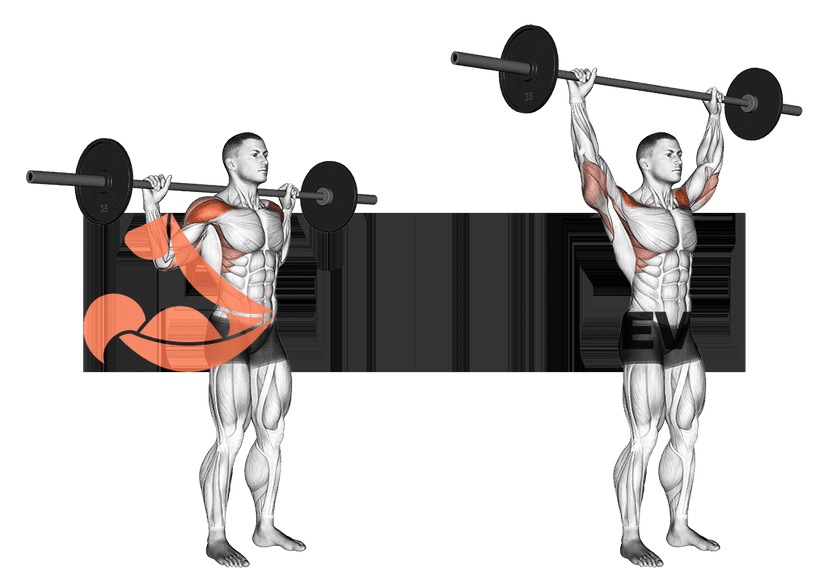
Behind-the-Neck Press: Complete Guide
The behind-the-neck press is a classic shoulder exercise, long considered a staple in weight rooms worldwide. It involves pressing a barbell behind the head instead of in front. This positioning changes muscle recruitment and places particular emphasis on the lateral deltoid, making it a unique tool in the shoulder exercise arsenal.
This exercise divides the fitness community: some consider it risky, others find it irreplaceable for shoulder development. The truth lies somewhere in between. Performed with strict technique and sufficient mobility, the behind-the-neck press is a powerful tool. Performed poorly or with insufficient mobility, it can indeed cause problems.
Targeted Muscles
- Lateral deltoid (middle head): greater recruitment compared to the front version
- Anterior deltoid: major contribution to the press
- Posterior deltoid: more involvement than in a front press
- Triceps: elbow extension, lockout at the top
- Upper and middle trapezius: assistance at the end of the movement
- Serratus anterior: scapula rotation
The main advantage of the behind-the-neck press is the increased lateral deltoid recruitment compared to the front press. If your goal is shoulder width, this movement has a targeted edge.
Proper Execution
Mobility Prerequisite
Before attempting the behind-the-neck press, check your mobility. Simple test: extend your arms overhead with elbows fully straight, then move them slightly behind your head. If you cannot do this without arching your back or feeling pain, the behind-the-neck press is not for you right now. Work on your thoracic and scapular mobility first.
Starting Position
Sit on a bench with a back pad (recommended for lumbar support). Feet flat on the floor. Grip the bar with an overhand grip, hands slightly wider than shoulder width. Unrack the bar and bring it behind your head, at ear level.
Concentric Phase (Pressing)
- Press the bar upward while keeping your elbows under the bar (not forward).
- Rise to near-full arm extension.
- The bar follows a vertical path, slightly behind the head.
- Exhale during the press.
Eccentric Phase (Lowering)
- Lower the bar under control behind your head.
- Stop the descent when the bar reaches ear level or the top of the neck. NEVER lower the bar to the traps.
- Elbows point toward the floor, not backward.
- Inhale during the descent.
- Tempo: 2 to 3 seconds down, absolute control.
Common Mistakes
1. Lowering the bar too far This is the most dangerous mistake. The bar should not go below ear level. Going lower places the shoulder in extreme external rotation under load, a high-risk position for the rotator cuff and joint capsule.
2. Lacking mobility Forcing the movement without the necessary thoracic and scapular mobility is a recipe for injury. If your elbows drift backward instead of pointing down, you lack the required mobility.
3. Using too heavy a load The behind-the-neck press is not an exercise for chasing records. The behind-the-head position reduces mechanical leverage. Use 20 to 30 percent less than your front press and focus on quality.
4. Excessive lower back arching An over-arched back changes the movement and overloads the lumbar spine. Use a bench with a back pad and maintain a neutral spine.
5. Aggressively locking out the elbows Aggressive elbow hyperextension under load is risky. Extend your arms without snapping the joints.
Variations
Smith Machine Behind-the-Neck Press (Beginner) The guided bar path secures the movement and lets you focus on muscle contraction. A good choice for learning the motor pattern before moving to a free barbell.
Standing Behind-the-Neck Press (Intermediate to Advanced) Standing execution without back support. Your core must stabilize the entire body, increasing bracing demands. Reserved for lifters with excellent mobility and motor control.
Partial Behind-the-Neck Press (Beginner to Intermediate) Reduce the range of motion by only lowering the bar halfway. This lets you benefit from lateral deltoid recruitment while limiting joint stress. An excellent compromise for those lacking mobility.
Dumbbell Behind-the-Neck Press (Intermediate) Replace the barbell with dumbbells. Your wrists and shoulders naturally find their optimal angle. Less joint constraint and correction of left-right imbalances.
Program Integration
The behind-the-neck press can replace or complement the front press in your shoulder workout. Place it at the start of the session when your joints are warm but your muscles are fresh.
- Hypertrophy goal: 3 to 4 sets of 8 to 12 reps
- Technique goal: 3 sets of 10 to 15 reps with a light load
- Frequency: once per week is enough (the exercise is demanding on joints)
Mandatory warm-up: 5 minutes of shoulder rotations, stick dislocates, and 2 light sets before loading. Never skip the warm-up on this exercise.
Key Takeaways
- Mobility first: do not attempt this exercise without sufficient mobility
- Never lower the bar below ear level
- Load 20 to 30 percent lighter than the front press
- Bench with back support recommended for lumbar safety
- Joint warm-up mandatory before every session
- Stop immediately if you feel shoulder pain
