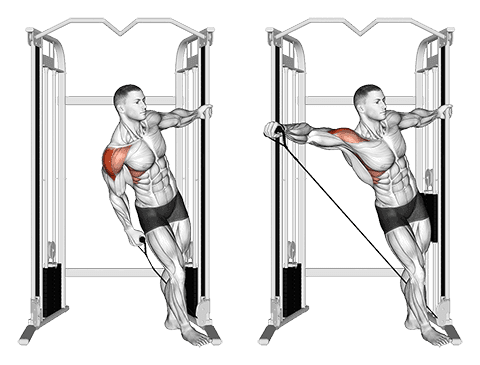
Cable Lateral Raise: Complete Guide
The cable lateral raise is a powerful isolation exercise for targeting the lateral deltoid. Unlike the dumbbell version, the cable maintains constant tension throughout the entire range of motion. No dead zone at the bottom, no slack at any point. Your shoulders work from the first inch to the last.
This exercise is a top choice for building round, wide shoulders. It suits beginners and advanced lifters alike who want to sharpen their deltoid definition.
Targeted Muscles
- Lateral deltoid (middle head): primary mover, responsible for arm abduction
- Anterior deltoid: slight assistance, especially at the start of the movement
- Upper trapezius: kicks in if the arm goes above shoulder height
- Supraspinatus: initiates abduction through the first few degrees
- Forearm and wrist: stabilize the handle
The lateral deltoid does the bulk of the work. If your traps burn before your shoulders, you are going too high or shrugging to compensate.
Proper Execution
Starting Position
Stand next to the low pulley with the cable running behind or in front of your legs, depending on preference. Grab the handle with the hand opposite the pulley (right hand if the pulley is on your left). Stand tall, feet hip-width apart, slight bend in the knees. Arm at your side, elbow slightly bent (10 to 15 degrees). You can rest your free hand on the machine frame for stability.
Concentric Phase (Lifting)
- Raise your arm laterally while keeping the elbow slightly bent.
- Lift until your arm reaches shoulder height (no higher).
- Imagine pouring water from a pitcher: the pinky rises slightly above the thumb.
- Exhale during the lift.
Eccentric Phase (Lowering)
- Lower your arm under control over 2 to 3 seconds.
- Do not let the weight drop. Master the cable tension from start to finish.
- Inhale during the descent.
- Stop just before the plates touch to maintain tension.
Recommended tempo: 1 second up, 2 to 3 seconds down.
Common Mistakes
1. Raising the arm above shoulder line Going past shoulder height shifts work to the traps and creates a risk of subacromial impingement. Stop when your arm is parallel to the floor.
2. Using body momentum Swinging your torso to lift the load is cheating. The cable should move because your deltoid contracts, not because your body rocks. If you need momentum, lower the weight.
3. Locking the elbow in full extension A perfectly straight arm overloads the elbow joint and reduces tension on the deltoid. Always keep a slight bend.
4. Shrugging the shoulder during the movement If your shoulder rides up toward your ear, your traps are taking over. Focus on keeping your shoulders low and pulled back throughout the set.
5. Going too fast on the eccentric The pulley pulls the weight down. If you let the cable pull you back without resisting, you lose half the benefit. Control the descent.
Variations
Two-Handed Cable Lateral Raise (Beginner) Stand facing the cable station, one handle in each hand with cables crossed. Both arms rise together. Less load possible, but balanced work guaranteed.
Seated Cable Lateral Raise (Intermediate) Sit on a bench beside the pulley. This position eliminates any possibility of cheating with your torso. Ideal for strict work.
High-Pulley Lateral Raise (Intermediate) The cable comes from above. The resistance angle changes the tension profile entirely: peak contraction is at the bottom of the movement. An interesting complement for varying stimuli.
Lateral Raise with Isometric Pause (Advanced) Hold for 2 seconds at the top with your arm parallel to the floor. The burn is intense and muscle fiber recruitment is maximal.
Program Integration
Place cable lateral raises after your compound shoulder movements (overhead press, dumbbell press). This isolation exercise works best with moderate to high rep ranges.
- Hypertrophy goal: 3 to 4 sets of 12 to 15 reps per side
- Muscular endurance goal: 3 sets of 15 to 20 reps per side
- Frequency: twice per week with at least 48 hours of rest between shoulder sessions
This exercise fits perfectly in a shoulder session or a push session (chest, shoulders, triceps). You can also pair it in a superset with front raises for complete deltoid work.
Key Takeaways
- Constant tension thanks to the cable: zero dead zone
- Arm parallel to the floor at the top, no higher
- Slight elbow bend, shoulder down
- Control the descent for at least 2 to 3 seconds
- Moderate load and flawless technique before adding weight
- Work each side evenly to prevent asymmetries
