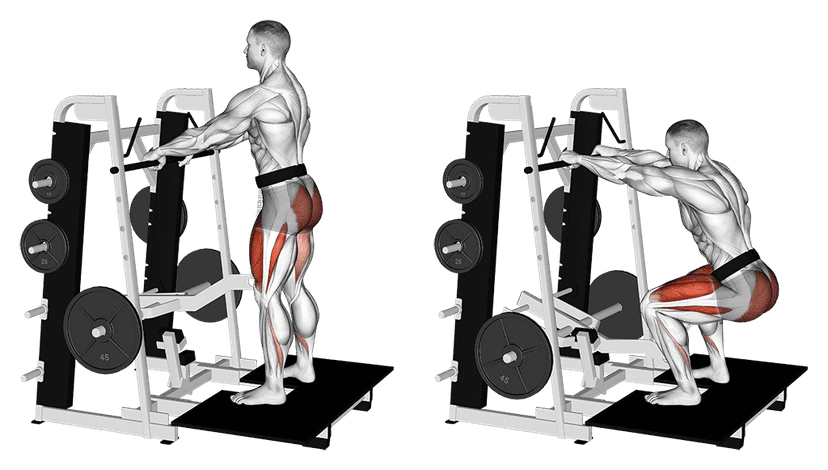
Belt Squat: Complete Guide
The belt squat is a leg exercise where the load hangs from a belt around your hips, eliminating all spinal compression. It is a valuable tool for anyone who wants to squat heavy without stressing the back, or for adding leg volume without accumulating spinal fatigue. Once reserved for powerlifting gyms, the belt squat is becoming more common thanks to dedicated machines.
Muscles Targeted
Primary muscles:
- Quadriceps: drive knee extension and work hard because the torso stays vertical
- Glutes (gluteus maximus and medius): fire below parallel and drive hip extension
- Adductors: stabilize the knees and assist the ascent
Secondary muscles:
- Hamstrings: assist the glutes in hip extension
- Calves: stabilize the ankle
Key difference: unlike the back squat, the spinal erectors and abs are barely involved. This is both an advantage (zero spinal fatigue) and a drawback (less overall functional carryover).
Proper Execution
- Setup: strap the belt squat belt around your hips (not your waist). The load hangs between your legs. On a dedicated machine, place your feet on the platform, shoulder-width or slightly wider, toes pointed out 20-30 degrees.
- Starting position: hold the machine handles (or a stable support) for balance. Torso upright, eyes forward, shoulders back. Unrack the load.
- The descent: push your hips back and down. Keep your torso as vertical as possible. Take 2-3 seconds to descend under control. Aim to go below parallel.
- Bottom position: knees are open, tracking over the feet. Hips are below the knees. Hold a brief pause if desired.
- The ascent: push the platform away with your feet, squeeze the glutes at the top. Lock out the hips without hyperextending the back.
- Breathing: inhale before the descent, hold during the descent, exhale on the way up. Same as a regular squat, but abdominal pressure is less critical since there is no spinal load.
Common Mistakes
Leaning too far forward Even without a bar on the back, some people lean forward out of habit. This reduces quad activation and puts the hips in a poor position. Fix: keep the chest up, use the handles for balance only.
Stance too narrow A narrow stance limits depth and puts more stress on the knees. Fix: feet at least shoulder-width, toes turned out.
Hips rising first If the hips rise before the shoulders, the movement loses its vertical path. Fix: think about pushing the floor evenly and rising straight up.
Pulling yourself up with the handles The handles are for balance, not propulsion. If you pull with your arms, you cheat and reduce leg work. Fix: light grip, just for stability.
Variations
Belt squat with dumbbell and blocks (beginner, no machine): stand on two flat benches or blocks with a gap between them. Attach a dumbbell to a dip belt. Squat between the blocks. Budget-friendly option if your gym has no machine.
Belt squat march (intermediate): instead of squatting, take steps forward and back on the machine platform. Great for working the quads with a different stimulus.
Belt squat with pause (intermediate to advanced): 2-3 second pause at the bottom. Eliminates the stretch reflex and increases quad time under tension.
Single-leg belt squat (advanced): squat on one leg with the other placed slightly behind. Fixes imbalances and increases effective load per leg.
Programming
Placement: as a secondary exercise after squats or deadlifts, or as a primary exercise if you want to spare your back.
Volume and intensity:
- Hypertrophy: 3-4 sets of 8-15 reps, 60-90 s rest
- Strength: 4 x 5-8 reps, 2-3 min rest
- Volume / finisher: 2-3 sets of 15-25 reps
Frequency: 1 to 3 times per week. The absence of spinal fatigue allows a higher frequency than the back squat.
Ideal use cases:
- Herniated disc or lower back pain: the belt squat lets you keep training legs heavy
- Deload week: replace the back squat to unload the spine
- Double leg day: add volume without overloading the back
- Deadlift complement: avoid stacking two heavy spinal-loading exercises on the same day
Key Takeaways
- Zero spinal compression: the main advantage of the belt squat
- The load hangs from the hips, not the back
- Keep the torso vertical and use handles for balance, not pulling
- Excellent complement to the back squat, not a full replacement
- Allows you to add leg volume without accumulating back fatigue
