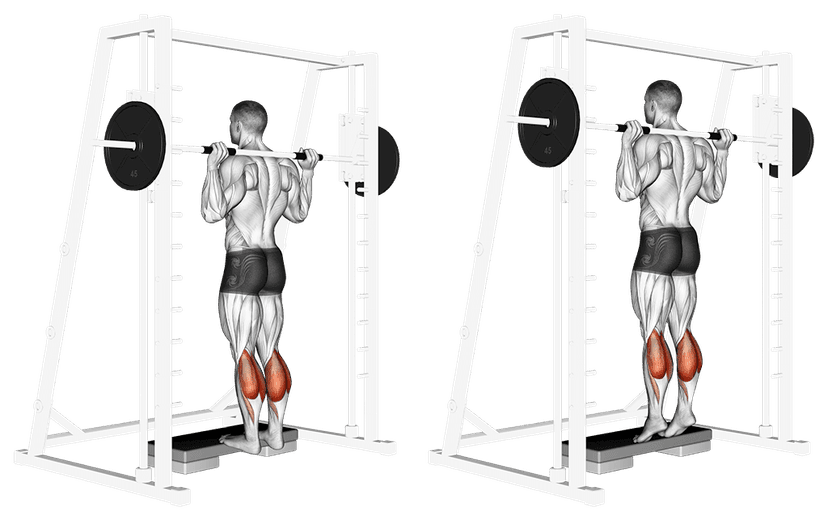
Smith Machine Calf Raise: Complete Guide
The Smith machine is not just for guided squats. It is an excellent tool for working your calves while standing with a heavy load and no balance concerns. The Smith machine calf raise combines the stability of a machine with the natural standing calf raise movement. You place a block under your feet, load the bar on your shoulders, and rise onto your toes. Simple, effective, and underrated.
For those who do not have access to a dedicated standing calf raise machine, the Smith machine is the best alternative. It offers a safe vertical path and the ability to add weight progressively with precision.
Muscles targeted
- Gastrocnemius (medial and lateral heads): primary mover, strongly recruited thanks to the standing position (knee extended)
- Soleus: secondary contributor, more active if the knees are slightly bent
- Intrinsic foot muscles: arch stabilization
- Spinal erectors and abdominals: core bracing under the load
The standing position with extended knees maximizes gastrocnemius recruitment. This is the superficial calf muscle that creates visible volume from the side.
Proper execution
Starting position
Place a block (step platform, 20 kg plate, or a wooden board 5-10 cm high) under the Smith machine bar. Position the bar on your upper traps, just like a squat. Step onto the block with the balls of your feet. Your heels hang off the edge. Feet hip-width apart. Unrack the bar by standing tall. Body straight, eyes forward.
Eccentric phase (lowering)
- Let your heels drop slowly below the level of the block.
- Lower until you feel a full calf stretch.
- Control the descent over 2-3 seconds. No jerky movement.
Concentric phase (rise)
- Push through the balls of your feet to rise as high as possible.
- Squeeze your calves hard at the top.
- Hold the contraction for 1-2 seconds before lowering.
- Keep your body straight, no leaning forward or backward.
Breathing: exhale on the way up, inhale on the way down.
Common mistakes
1. No block under your feet Without a block, you lose the entire stretch phase. The block allows your heels to drop below toe level, which is essential for working the full range of motion. Use a stable surface at least 5 cm high.
2. Bending the knees If your knees flex on each rep, you recruit the quads instead of the calves. Keep your knees fixed, very slightly bent (not locked into hyperextension).
3. Going too fast Cranking out rapid reps and bouncing at the bottom is tempting but counterproductive. The Achilles tendon absorbs energy instead of the muscle fibers. Slow down, especially on the eccentric.
4. Bar positioned too high The bar sitting too high on the neck compresses the cervical vertebrae. Place it on your upper traps, just like a regular squat. Use a bar pad if needed.
5. Unstable block A weight plate sliding under your feet is dangerous. Make sure your block is stable and non-slip. A fitness step or a wooden block are the best choices.
Variations
Parallel feet, hip width (beginner) The standard position. Works the entire gastrocnemius evenly. Start here to master the movement.
Toes pointed outward (intermediate) Targets the medial head more. Useful for developing the inner calf sweep visible from the front.
Single-leg Smith machine calf raise (intermediate to advanced) One foot on the block, the other in the air. Doubles the intensity per calf and corrects asymmetries. Hold the bar for balance.
Slow tempo 4-0-2-0 (intermediate) 4 seconds down, no pause at the bottom, 2 seconds up, no pause at the top. Drastically increases time under tension without adding weight.
Programming
Placement in your session: At the end of your leg session or as a secondary exercise. You can also pair it in a superset with seated calf raises to target the gastrocnemius and soleus in the same block.
Volume and intensity:
- Beginner: 3 x 12-15 reps, light load, focus on range and control
- Intermediate: 4 x 10-15 reps, moderate to heavy load
- Advanced: 4-5 x 8-15 reps, drop sets or 15-20 second stretch pauses on the last set
Frequency: 2-3 times per week. Calves are endurance muscles used to carrying your bodyweight all day. They need frequent and intense stimulation to adapt.
Progression: Add 2.5-5 kg per week as long as you maintain full range of motion. As soon as range decreases, hold the weight steady and work on execution quality.
Key takeaways
- Block is mandatory: without it, no full stretch and therefore no maximum stimulation
- Knees stay fixed: the movement occurs only at the ankle
- Squeeze at the top: 1-2 seconds of contraction to maximize recruitment
- Slow eccentric: 2-3 seconds on the way down for time under tension
- Stable block: choose a solid, non-slip support
