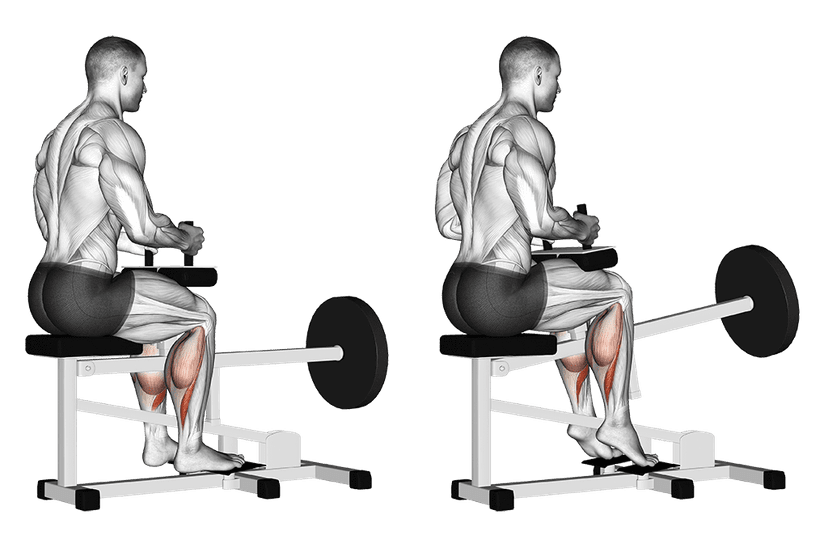
Seated Calf Raise: Complete Guide
The seated calf raise is the go-to exercise for targeting the soleus, the deep calf muscle that is often neglected. While standing variations favor the gastrocnemius, the seated position (knee bent at 90 degrees) shortens the gastrocnemius and forces the soleus to take over. If you want complete calves that look thick from the front and shaped from the side, the seated calf raise is just as important as the standing version.
Many lifters focus only on standing calf raises and wonder why their calves lack thickness. The answer is straightforward: the soleus accounts for roughly 60% of total calf volume. Ignoring it means leaving growth on the table.
Muscles targeted
- Soleus: primary mover, deep and wide calf muscle, strongly recruited when the knee is bent
- Gastrocnemius: reduced contribution because the muscle is shortened with the knee at 90 degrees
- Peroneus longus: assists with lateral ankle stabilization
- Tibialis posterior: arch stabilization
- Intrinsic foot muscles: arch support under load
The soleus is predominantly made of slow-twitch fibers (type I), which means it responds well to longer sets and high time under tension. This is why higher rep ranges (15-25) work particularly well for this exercise.
Proper execution
Starting position
Sit on the seated calf raise machine. Place the balls of your feet on the platform, heels hanging off. Adjust the pad so it rests firmly on your thighs, just above the knees. Your knees are at a 90-degree angle. Release the safety.
Concentric phase (rise)
- Push through the balls of your feet to lift the weight by rising onto your toes.
- Rise as high as possible and squeeze your calves hard.
- Hold the contraction for 1-2 seconds at the top.
Eccentric phase (lowering)
- Lower slowly, letting your heels drop below the platform level.
- Descend until you feel a deep stretch in the soleus (lower in the calf than a gastrocnemius stretch).
- Recommended tempo: 1-2 seconds up, 1-2 second squeeze at the top, 2-3 seconds down.
Breathing: exhale on the way up, inhale on the way down.
Common mistakes
1. Pad positioned incorrectly If the pad is too high on the thigh, it creates an inefficient lever and may slide. If it is too low (on the knees), it compresses the joint. Place it just above the kneecap.
2. Insufficient range of motion Once again, range of motion is the key. Calves are accustomed to short movements (walking, running). To force them to adapt, impose a full range: maximum stretch at the bottom, maximum contraction at the top.
3. Using your hands to push Pressing down on your thighs with your hands to help lift the weight is cheating. Your hands are only for balance or releasing the safety. All the work comes from the calves.
4. Too heavy, too short This is the classic calf trap. You load massive weight and perform micro-movements. Drop the load by 30%, work through the full range, and you will see a real difference within weeks.
5. Bouncing at the bottom Using Achilles tendon elasticity at the bottom of the movement reduces soleus tension. Pause for 1 second in the stretched position to eliminate the stretch reflex.
Variations
Parallel feet, hip width (beginner) The standard position. Targets the soleus evenly. Ideal for learning the movement and building the mind-muscle connection.
Toes pointed outward (intermediate) Slightly shifts recruitment toward the inner portion of the soleus. Switch positions every 3-4 weeks to vary the stimulus.
Stretch pause 15-30 seconds (intermediate to advanced) On the last rep of the last set, lower to a maximum stretch and hold for 15-30 seconds. This technique creates intense mechanical stress that stimulates hypertrophy.
Seated calf raise with a dumbbell (beginner) If you do not have a machine, sit on a bench, place a dumbbell on your knees (with a towel for comfort), and rise onto your toes. Less convenient but functional.
Programming
Placement in your session: After standing calf raises (gastrocnemius first, soleus second) or in a superset with a standing calf exercise for complete work in one block.
Volume and intensity:
- Beginner: 3 x 15-20 reps, light to moderate load
- Intermediate: 4 x 12-20 reps, moderate load
- Advanced: 4-5 x 15-25 reps, drop sets or stretch pauses on the last set
Frequency: 2-3 times per week. Combine with standing calf raises for complete development. Alternate days: one day standing first, another day seated first.
Typical load: The soleus is strong. Most intermediates work with 40-80 kg (90-175 lb) on the machine. Do not be surprised if you can load more than on standing calf raises.
Key takeaways
- Knee at 90 degrees: this position targets the soleus, not the gastrocnemius
- Full range of motion: deep stretch at the bottom, maximum contraction at the top
- Higher reps: the soleus responds well to longer sets (15-25 reps)
- Pad in the right spot: just above the kneecap, not on it
- Complementary to standing: both exercises together cover the entire calf
