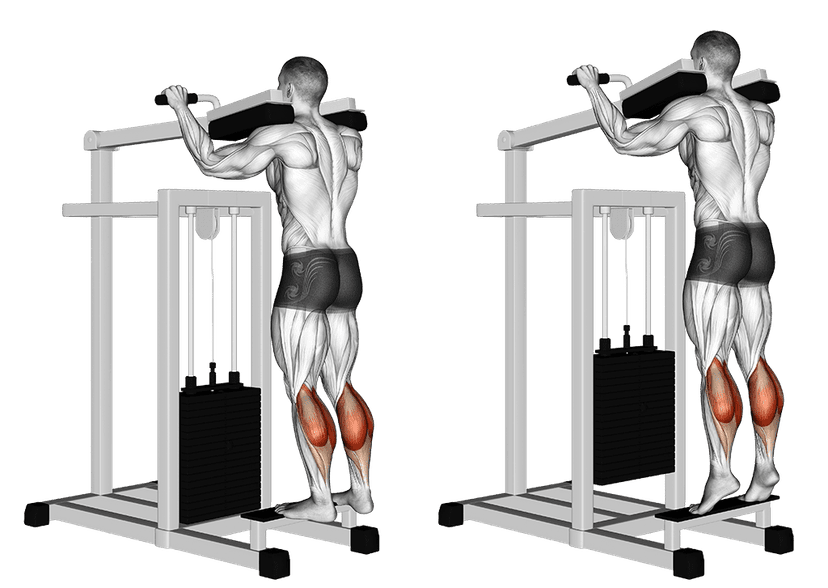
Standing Calf Raise Machine: Complete Guide
The standing calf raise machine is the benchmark movement for developing the gastrocnemius, the superficial muscle that gives the calf its characteristic diamond shape. The dedicated machine offers a guided path, comfortable shoulder pads, and a built-in platform for working through a full range of motion. It is the most direct and effective exercise for targeting the calves while standing.
If your gym has a standing calf raise machine, it should be your first choice for this exercise. No other variation combines comfort, safety, and effectiveness as well for loading the gastrocnemius.
Muscles targeted
- Gastrocnemius (medial and lateral heads): primary mover, strongly activated in the standing position (knee extended)
- Soleus: secondary contributor, active in support of the gastrocnemius
- Peroneus longus and brevis: lateral ankle stabilization
- Tibialis posterior: arch stabilization
- Abdominals and spinal erectors: postural bracing under load
The gastrocnemius is a bi-articular muscle (it crosses both the knee and the ankle). In a standing position with extended knees, it is in its optimal working position. This configuration allows maximum recruitment.
Proper execution
Starting position
Position yourself under the machine pads, shoulders firmly set. Step onto the platform with the balls of your feet, heels hanging off. Feet hip-width apart, toes pointing straight ahead. Unrack the weight by standing fully upright. Body straight, eyes forward.
Concentric phase (rise)
- Rise onto the balls of your feet by pushing through the forefoot.
- Rise as high as possible, seeking maximum calf contraction.
- Hold the squeeze for 1-2 seconds at the top.
- Do not lean forward: keep your torso upright.
Eccentric phase (lowering)
- Lower slowly, letting your heels drop below the platform level.
- Control the descent over 2-3 seconds.
- Lower until you feel a complete stretch in the calves.
- Do not bounce at the bottom. Pause briefly in the stretched position.
Breathing: exhale on the way up, inhale on the way down.
Common mistakes
1. Incomplete range of motion The most widespread error. Half reps with heavy weight are less effective than full reps with lighter weight. Every rep should go from maximum stretch to maximum contraction.
2. Shoulders misaligned under the pads If the pads sit too far forward or back, the load is unbalanced. Center the pads on the fleshy part of your upper traps. Adjust the machine height if needed.
3. Bending the knees Bending the knees recruits the quads and reduces gastrocnemius work. Your knees stay extended (without hyperextension lockout) throughout the movement.
4. Bouncing with fast tempo Rapid reps exploit Achilles tendon elasticity. Slow the eccentric to 2-3 seconds and eliminate the bounce at the bottom to maximize muscular tension.
5. Leaning forward Leaning transfers part of the load to the lower back. Stay upright, hips under shoulders, so all force goes through the calves.
Variations
Toes pointed outward (intermediate) Point your toes roughly 30 degrees outward. Recruits more of the medial gastrocnemius head. Useful for the inner calf sweep visible from the front.
Toes pointed inward (intermediate) Point your toes slightly inward. Targets the lateral head. Use moderate weight as the position is less natural.
Single-leg (intermediate to advanced) One foot on the platform. Doubles the intensity and allows you to correct imbalances between calves. Hold the machine with your free hand for balance.
Triple drop set (advanced) Perform 10-12 reps, reduce the weight by 20%, do 10-12 reps, reduce again by 20%, do as many reps as possible. Your calves will burn, but this is a powerful technique for forcing growth.
Programming
Placement in your session: At the end of your leg session, or at the beginning if calves are a priority weak point. Some coaches recommend starting with calves when they are fresh to give them priority.
Volume and intensity:
- Beginner: 3 x 12-15 reps, moderate load, technique focus
- Intermediate: 4 x 10-15 reps, moderate to heavy load
- Advanced: 4-5 x 8-15 reps, intensification techniques (drop sets, rest-pause, stretch pauses)
Frequency: 2-3 times per week. Calves handle high frequency because they recover quickly. Combine with seated calf raises to cover both the gastrocnemius and soleus.
Progression: Calves progress slowly. Add 2.5 kg (5 lb) when you complete all sets with perfect range of motion. Never sacrifice range for weight.
Key takeaways
- Full range of motion: the number one factor for calf growth
- Knees extended: maximizes gastrocnemius recruitment
- Squeeze at the top: 1-2 seconds of contraction on every rep
- Controlled eccentric: 2-3 seconds on the way down, no bouncing
- Patience: calves are slow to respond, consistency pays off in the long run
