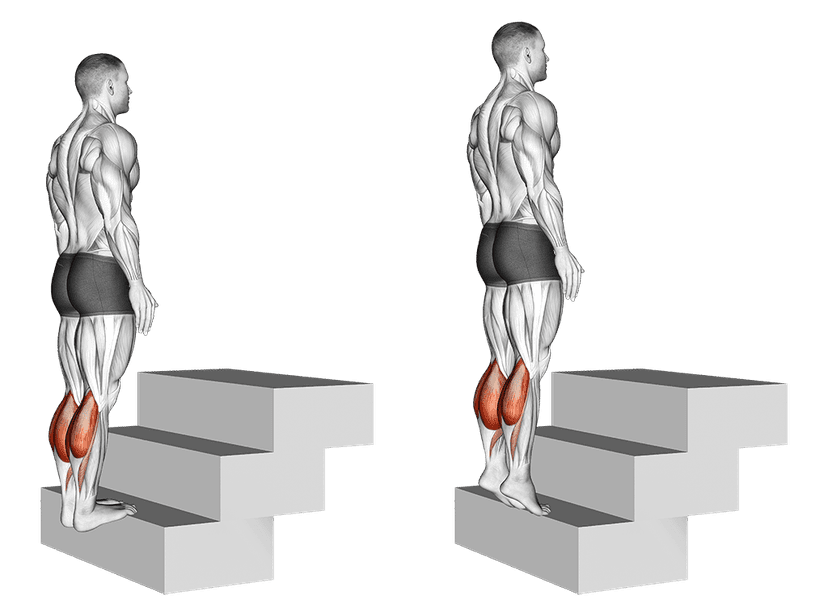
Standing Calf Raise on Step: Complete Guide
You do not need a machine to train your calves. A simple stair step, a fitness step, or the edge of a curb is enough to perform one of the most effective calf exercises that exist. The standing calf raise on a step offers a range of motion superior to most machines, costs nothing, and can be done absolutely anywhere. It is the perfect exercise for those who train at home, while traveling, or as a supplement to a gym program.
The beauty of this exercise lies in its simplicity. An elevated surface and your own bodyweight are enough to get started. With a dumbbell or a loaded backpack, you can progress for months.
Muscles targeted
- Gastrocnemius (medial and lateral heads): primary mover, maximally recruited in a standing position with extended knees
- Soleus: constant secondary contributor
- Intrinsic foot muscles: active arch stabilization
- Tibialis posterior and peroneals: ankle stabilization without the security of a machine
- Core (abdominals, erectors): balance and bracing, especially in the single-leg version
Without a machine to guide the movement, stabilizer muscles work harder. This is beneficial for ankle health and proprioception, but it demands more focus.
Proper execution
Starting position
Place the balls of your feet on the edge of a step, a fitness platform, or any stable elevated surface. Your heels hang off the edge. Feet hip-width apart, toes pointing straight ahead. Hold onto a wall, railing, or stable support for balance. Body straight, knees extended without locking.
Eccentric phase (lowering)
- Let your heels drop slowly below the step level.
- Lower as far as your flexibility allows. You should feel a deep stretch in your calves.
- Control the descent over 2-3 seconds. No free-falling.
Concentric phase (rise)
- Push through the balls of your feet to rise as high as possible onto your toes.
- Squeeze your calves hard at the top.
- Hold the contraction for 1-2 seconds.
- Keep your body straight and stable.
Breathing: inhale on the way down, exhale on the way up.
Common mistakes
1. Unstable or too narrow surface The edge of a step can be slippery or too thin. Make sure the surface is non-slip and wide enough to support the balls of both feet. A fitness step is the safest option at home.
2. Losing balance Without a machine for stability, the risk of losing balance is real. Always hold onto a stable support. Do not let go of the support to "make the exercise harder." The goal is to work the calves, not to test your balance.
3. Short range of motion out of habit When doing bodyweight calf raises, the temptation is to crank out hundreds of micro-reps. Fifteen full range reps are better than fifty partial ones.
4. Knees bending Especially toward the end of a set when the calves are burning. Keeping your knees straight maintains the gastrocnemius as the primary mover. If your knees start bending, it is a sign of fatigue: end the set.
5. Leaning into the support Pushing too hard against the wall or railing unloads part of the weight from your calves. The support is for balance only. Your hands touch it lightly without transferring weight.
Variations
Single-leg on a step (intermediate) One foot on the step, the other in the air. Doubles the intensity with no extra equipment. This is the natural progression when bilateral bodyweight becomes too easy.
With a dumbbell (intermediate) Hold a dumbbell in the hand on the same side as the working foot (single-leg) or one in each hand (bilateral). Increase the load progressively.
With a loaded backpack (beginner to intermediate) Fill a backpack with books or water bottles. An ideal solution for home training without gym equipment. You can easily add or remove weight.
Extreme tempo 5-3-3-0 (intermediate to advanced) 5 seconds down, 3-second pause in the stretch, 3 seconds up, straight into the next rep. 8-10 reps at this tempo equal roughly 90 seconds of time under tension. Your calves will not thank you, but they will grow.
Programming
Placement in your session: Anywhere. That is the flexibility of this exercise. At the end of a gym leg session, as the main exercise at home, or even in a 5-minute morning micro-session.
Volume and intensity:
- Beginner (bilateral bodyweight): 3 x 15-20 reps, focus on range
- Intermediate (single-leg or loaded): 4 x 12-15 reps per leg
- Advanced (loaded with slow tempo): 4-5 x 8-12 reps, controlled tempo 3-0-2-1
Frequency: Up to 4-5 times per week if you are working with bodyweight only. Calves are built for daily use. With added load, 2-3 times per week is sufficient.
Progression:
- Bilateral bodyweight (weeks 1-4)
- Single-leg bodyweight (weeks 5-8)
- Single-leg with a light dumbbell (weeks 9-12)
- Single-leg with increasing load (weeks 13+)
Key takeaways
- Stable surface: non-slip step, platform, or solid curb
- Support for balance: wall, railing, or pole, with light hand contact
- Maximum range of motion: take advantage of no bar blocking you to go deeper than on a machine
- Single-leg progression: switch to one foot when bilateral is too easy
- Accessibility: this exercise can be done anywhere, no excuse to skip calf training
