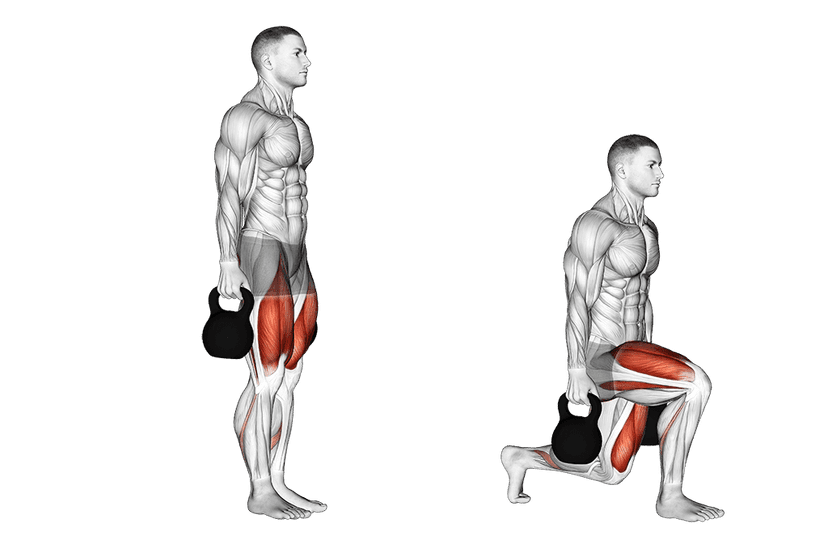
Kettlebell Lunges: Complete Guide
Kettlebell lunges combine the best of two worlds: the unilateral work of lunges and the stabilization challenge imposed by the kettlebell. The low center of gravity, the unique handle, and the ability to hold the kettlebell in goblet, rack, or suitcase position make it an ideal tool for lunges that are far more engaging than bodyweight alone.
If you want to develop powerful quads and glutes while improving your balance and coordination, kettlebell lunges are a formidable choice. They fit seamlessly into a metabolic circuit or a traditional strength session.
Muscles targeted
- Quadriceps: primary mover for knee extension, especially on the front leg
- Gluteus maximus: hip extension during the ascent
- Hamstrings: stabilization and braking during the eccentric phase
- Adductors: lateral stabilization of the working leg
- Gluteus medius: pelvic balance during the movement
- Core (transverse abdominis, obliques): anti-rotation stabilization, especially with a unilateral hold
The quad-to-glute ratio depends on your step length. Short step: more quads. Long step: more glutes and hamstrings.
Proper execution
Starting position
Stand with feet at hip width. Hold the kettlebell in goblet position (both hands on the horns, against your chest) for the most stable version. Stand tall, shoulders back, eyes forward. Brace your core.
Eccentric phase (descent)
- Step forward about 60-80 cm (length varies with your height).
- Descend by bending both knees simultaneously.
- The front knee aligns above the ankle (not past the toes for beginners).
- The back knee drops toward the floor without touching it (stop at 2-3 cm).
- The torso stays upright throughout the descent.
Concentric phase (ascent)
- Drive through the heel of the front leg to rise.
- Return the front foot to the starting position (alternating lunges) or continue on the same leg.
- Exhale during the push.
- Keep the kettlebell stable against your chest, without letting it tilt forward.
Breathing: inhale on the descent, exhale on the ascent.
Common mistakes
1. Front knee traveling too far forward
A knee that drifts well past the toes puts excessive pressure on the joint. Take a longer step and think about descending vertically rather than moving forward. The front shin should stay close to vertical.
2. Torso leaning forward
The kettlebell pulls the torso forward, especially as fatigue sets in. Keep your chest high, shoulders back, and gaze straight ahead. The goblet position naturally helps maintain an upright torso.
3. Narrow lateral stance
Placing the front foot directly in line with the other foot (as if on a tightrope) destabilizes the movement. Keep a lateral gap of 10-15 cm between your feet for a stable base.
4. Front knee caving inward
Knee valgus (the knee collapsing inward) signals weakness in the abductors and gluteus medius. Think about pushing the knee outward toward the little toe throughout the descent.
5. Pushing off the toes
Driving from the forefoot to rise overloads the kneecap and reduces glute activation. Dig the heel into the floor for the ascent.
Variations
Rack position kettlebell lunges (intermediate)
Hold the kettlebell in rack position (elbow at your side, fist under your chin, kettlebell resting against the forearm). The asymmetric load forces the core to work against rotation and lateral tilt. Alternate sides between sets.
Reverse kettlebell lunges (beginner to intermediate)
Instead of stepping forward, step backward. Reverse lunges are easier to balance and place less stress on the front knee. An excellent variation if forward lunges bother your knees.
Walking kettlebell lunges (intermediate)
Chain lunges by stepping forward each rep, as if walking. More dynamic, this variation builds coordination and propulsion. It requires space and good control.
Double kettlebell suitcase lunges (intermediate to advanced)
One kettlebell in each hand, arms at your sides. Allows heavier loading and heavily challenges grip and traps. The balance demand is lower than goblet position because the center of gravity sits lower.
Programming
Placement in your session: After squats or leg press as a complementary unilateral exercise. As the first exercise if you prioritize balance and stabilization work.
Volume and intensity:
- Beginner: 3 x 10 reps per leg, light kettlebell (8-12 kg), technique focus
- Intermediate: 3-4 x 12 reps per leg, 12-20 kg
- Advanced: 4 x 10-12 reps per leg, 20 kg+ or double kettlebells
Frequency: 1-3 times per week. Lunges are demanding on muscle recovery because of the significant eccentric component. Allow 48-72 hours between sessions.
Choosing the weight: Start with an 8 kg kettlebell in goblet position. You should be able to complete all reps with an upright torso and stable knee. Only increase when technique is flawless.
Key takeaways
- Sufficiently long step: front shin nearly vertical, knee above the ankle
- Upright torso: chest high, shoulders back
- Drive through the heel: not the toes, to activate the glutes
- Stable pelvis: no lateral tilt or rotation
- Lateral gap: 10-15 cm between feet for stability
