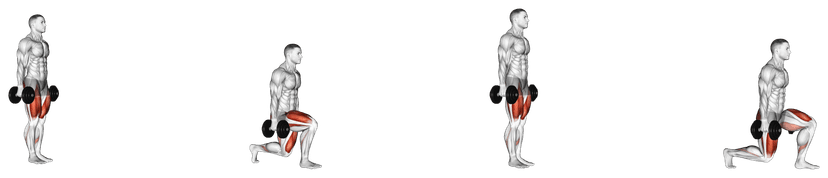
Walking Lunges: Complete Guide
Walking lunges are an essential unilateral exercise for balanced, functional legs. Unlike bilateral squats, each leg works independently, revealing and correcting strength imbalances between left and right. Beyond muscle building, walking lunges develop balance, coordination, and stability, qualities that transfer directly to sports and daily life.
Muscles Targeted
Primary muscles:
- Quadriceps (front leg): handle deceleration on the descent and drive knee extension on the way up
- Glutes (gluteus maximus of the front leg): main driver of hip extension to return to standing
- Hamstrings (front leg): assist the glutes and stabilize the knee
Secondary muscles:
- Adductors: provide lateral stability for the knee and hip
- Glute medius: stabilizes the pelvis to prevent lateral sway
- Calves (back leg): push off the ground to initiate the next step
- Abs and obliques: brace the trunk to maintain balance
- Spinal erectors: keep the spine upright under load
The front leg does roughly 80% of the work. The back leg assists and stabilizes.
Proper Execution
- Starting position: stand with feet together or hip-width apart. If using dumbbells, one in each hand, arms at your sides. With a barbell, position it as you would for a back squat.
- The step forward: take a large step forward (roughly 60-80 cm depending on your height). The front foot lands flat. The back foot stays on its toes.
- The descent: bend both knees simultaneously. The back knee drops toward the floor without touching it (stop 2-3 cm above). The front knee stays aligned with the front foot, without excessively passing the toes.
- Bottom position: both knees form angles close to 90 degrees. The torso stays vertical, chest open. Weight is distributed between the front foot (mostly) and the back toes.
- The ascent and next step: push through the front foot (heel first) to rise. Bring the back foot forward, pass through standing, then immediately step forward onto the other leg.
- Breathing: inhale during the descent, exhale during the ascent and step.
Common Mistakes
Front knee shooting too far past the toes A slight pass is normal. Excessive forward travel overloads the kneecap and patellar tendon. Fix: take a longer step. The longer the step, the more the glutes work and the less the knee travels forward.
Step too short A short step turns the lunge into a pure quad exercise and overloads the knee. Fix: aim for a step long enough that the front shin stays nearly vertical at the bottom.
Losing lateral balance The feet land on the same line (like walking a tightrope). Fix: keep hip-width between your feet. Think of walking on two rails, not a single wire.
Torso leaning forward The chest drops to compensate for lack of strength or mobility. Fix: keep the chest up, eyes forward. Reduce the load if needed.
Back knee slamming the floor Hitting the ground on every rep creates impact on the rear kneecap. Fix: stop 2-3 cm above the floor, under control. If you cannot manage that, the load is too heavy.
Variations
Static lunges / split squats (beginner): same movement but without walking. You alternate legs in place. Easier for balance, ideal for learning the pattern.
Reverse lunges (beginner to intermediate): instead of stepping forward, you step back. Less stress on the front knee, easier to balance. Excellent for people with sensitive knees.
Walking lunges with dumbbells (intermediate): one dumbbell in each hand. The most common gym version. Allows progressive loading without needing a rack.
Walking lunges with barbell (advanced): bar on the traps like a back squat. Allows heavy loading but demands excellent balance and solid bracing.
Programming
Placement: as a secondary exercise after squats or deadlifts, or as a primary exercise on days when you want to spare the spine.
Volume and intensity:
- Beginner: 3 x 8-10 reps per leg, bodyweight or light dumbbells
- Intermediate: 3-4 x 10-12 reps per leg, moderate dumbbells
- Advanced: 4 x 12-15 reps per leg, heavy dumbbells or barbell
- Finisher: 2 x 20 reps per leg, bodyweight, fast tempo
Frequency: 1 to 2 times per week. Walking lunges create significant soreness (especially the first few times) due to the strong eccentric component on the front leg.
Effective combinations:
- After squats: 3 x 10 per leg to add unilateral volume
- Superset with hip thrusts: glutes from every angle
- Circuit: alternate walking lunges, squat jumps, air squats for a cardio/legs combo
Key Takeaways
- Take a long enough step so the front shin stays nearly vertical
- Keep hip-width between your feet (two rails, not a tightrope)
- The back knee drops to 2-3 cm above the floor, without touching
- The torso stays vertical, chest up, eyes forward
- Each leg works independently: the ideal tool for fixing imbalances
