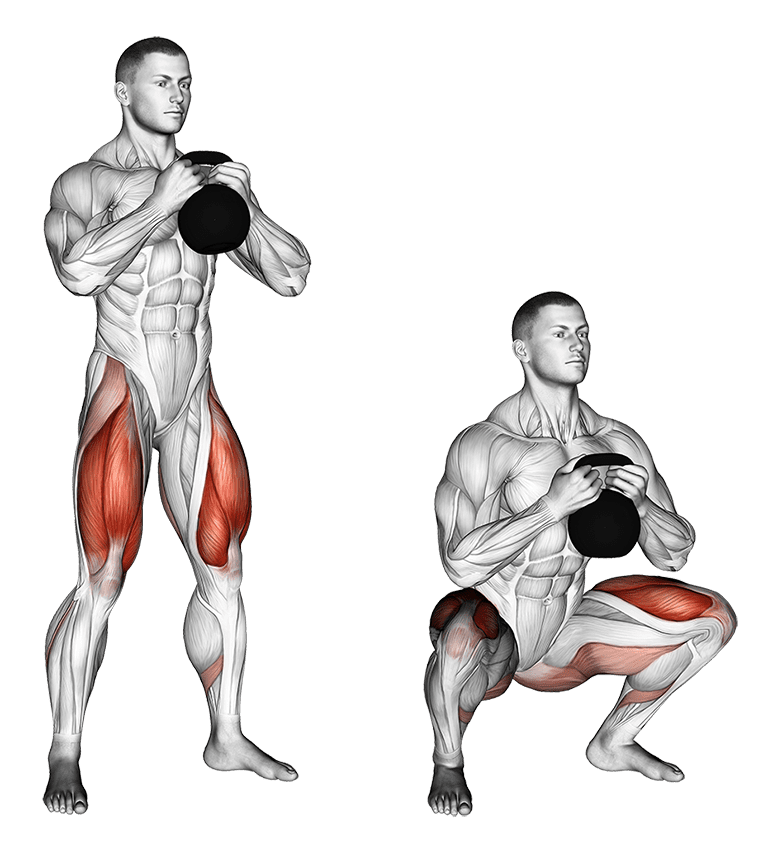
Goblet Squat: Complete Guide
The goblet squat is one of the best exercises for learning how to squat properly. By holding a dumbbell or kettlebell against your chest, you naturally force your torso to stay upright and your knees to push out. It is an accessible, effective, and underrated movement that belongs in any program, from beginner to advanced.
Muscles Targeted
Primary muscles:
- Quadriceps: drive knee extension and work hard due to the upright torso position
- Glutes (gluteus maximus and medius): fire strongly at the bottom of the movement and drive hip extension
- Adductors: stabilize the knees and control leg width
Secondary muscles:
- Hamstrings: assist the glutes and stabilize the knee
- Spinal erectors: keep the back straight under load
- Anterior deltoids and biceps: hold the weight in position against the chest
- Abs: brace the trunk throughout the movement
The front-loaded position increases quad demand compared to a traditional back squat.
Proper Execution
- Gripping the weight: hold a dumbbell vertically by one end, both hands cupped under the top plate. The dumbbell rests against your sternum. With a kettlebell, hold the horns (handle) with both hands, bell facing up.
- Foot position: feet slightly wider than shoulder-width, toes pointed out 30-45 degrees. Wider than a standard back squat.
- The descent: push your hips back and down. Your elbows drop between your knees. Keep your torso as vertical as possible, chest open. Take 2-3 seconds to descend.
- Bottom position: go as low as your mobility allows, ideally hips below knees. Your elbows touch or graze the inside of your knees, naturally pushing them outward.
- The ascent: drive the floor away with your feet, squeeze the glutes, and rise with your chest up. Exhale on the way up.
- Breathing: inhale on the way down, exhale on the way up. For heavier loads, inhale and brace before the descent, exhale past the sticking point.
Common Mistakes
Letting the weight drift away from the body If the dumbbell drops or moves away from your chest, your lower back takes all the load. Fix: keep your elbows tight, the weight glued to your sternum.
Knees caving in Same issue as the back squat, amplified by weak adductors. Fix: use your elbows to push your knees out at the bottom. This is one of the biggest advantages of the goblet squat.
Torso collapsing forward If you lean too much, the weight is likely too heavy or your quads are weak. Fix: reduce the load and focus on keeping the chest up.
Heels rising Same cause as the back squat: insufficient ankle mobility. Fix: widen your stance, point your toes out more, or place small plates under your heels.
Variations
Goblet squat with pause (beginner to intermediate): hold the bottom position for 2-3 seconds. Excellent for improving mobility and bottom-position strength.
Goblet squat to box (beginner): descend until you lightly touch a box or bench. Helps calibrate depth and builds confidence.
Banded goblet squat (intermediate): place a resistance band above the knees. Forces the abductors to work harder to keep the knees from caving.
Heavy goblet squat in short sets (advanced): use the heaviest dumbbell you can hold correctly, 3-5 reps. The limiting factor is often grip and arms, not legs.
Programming
Placement: as a warm-up before heavy squats, or as a primary exercise for beginners.
Volume and intensity:
- Beginner: 3 x 10-15 reps, moderate load, technique focus
- Intermediate: 4 x 8-12 reps, progressive overload
- Advanced: 3 x 5-8 reps heavy, or 2-3 x 15-20 reps as a finisher
Frequency: 2 to 3 times per week without issue. The goblet squat is far less taxing on the nervous system than a heavy back squat.
Ideal uses:
- Warm-up: 2 x 10 with light weight before leg day
- Push/Pull/Legs: secondary exercise after barbell squats
- Full body: primary leg exercise if you do not have access to a squat rack
Key Takeaways
- The weight stays glued to your sternum, elbows tight
- Elbows drop between the knees and push them outward
- It is the best exercise for learning to squat properly
- Excellent as a warm-up before heavy squats
- The limiting factor is often grip strength, not your legs
