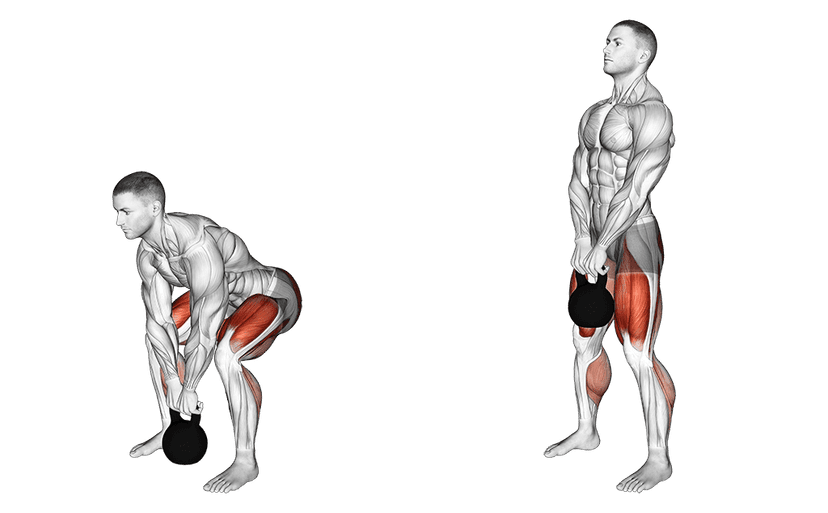
Kettlebell Deadlift: Complete Guide
The kettlebell deadlift is the gateway to the barbell deadlift. More accessible than its barbell counterpart, it teaches the hip hinge movement pattern progressively and safely. The load sits between your legs (not in front like a barbell), which places the line of force closer to your center of gravity and reduces lower back stress. Whether you are a complete beginner or an experienced lifter looking for a technical warm-up, the kettlebell deadlift deserves a spot in your toolbox.
It is also a valuable therapeutic exercise. Many coaches use it to reteach the hip flexion-extension pattern to people who are afraid to bend over after a back injury. The light load and ergonomic position rebuild confidence before progressing to the barbell.
Muscles targeted
- Hamstrings: primary driver of hip extension from the bottom position
- Glutes: powerful hip extension, especially in the second half of the movement
- Spinal erectors: isometric maintenance of a neutral spine
- Quadriceps: knee extension, with a bigger contribution than in a conventional barbell deadlift due to the lower load position
- Traps and rhomboids: scapular retraction to prevent back rounding
- Abs: bracing to protect the spine under load
- Forearms: grip on the handle
Like all deadlifts, this is a posterior-chain-dominant movement. But the kettlebell position between the legs recruits the quads more than a conventional barbell deadlift.
Proper execution
Starting position
Place the kettlebell on the floor between your feet. Feet shoulder width or slightly wider, toes turned out 15-30 degrees. The handle should sit in line with your ankles. Push your hips back (hip hinge) and bend your knees slightly to grab the handle with both hands. Flat back, chest open, eyes directed at the floor about 2 meters ahead.
Concentric phase (ascent)
- Root your feet into the floor by driving through the heels.
- Push your hips forward while standing up. The back and hips rise at the same rate.
- Squeeze your glutes at the top to lock out hip extension.
- At the top, your body forms a straight line. The kettlebell hangs between your legs, arms straight.
Eccentric phase (descent)
- Initiate the descent by pushing your hips back (not by bending the knees first).
- Let the kettlebell descend between your legs, controlling the movement with the hamstrings.
- Keep the chest open and shoulder blades pinched throughout the descent.
- The kettlebell touches the floor. Pause briefly before the next rep.
Breathing: inhale at the top (lockout), hold your breath during the descent and the start of the ascent (light Valsalva), exhale at the end of the ascent.
Common mistakes
1. Rounding the back
The classic deadlift mistake. A rounded back under load is a recipe for disc injury. Before each rep, pull your shoulder blades back, open your chest, and think about "showing your logo." If you cannot keep a flat back, the load is too heavy or you lack hip mobility.
2. Bending the knees first
The deadlift starts with the hips pushing back, not with the knees bending. If your knees travel forward first, you are turning the movement into a squat. Think about pushing your glutes toward the wall behind you to initiate the descent.
3. Pulling with the back
The back holds position; it does not pull. The force comes from the hips and legs. If your lower back is the first muscle to fatigue, you are lifting with the back instead of driving with the hips. Focus on hip extension.
4. Looking up
Lifting your head to look forward in the bottom position creates cervical hyperextension. Your gaze follows the spine: at the bottom, look at the floor 2 meters ahead. At the top, look straight ahead.
5. Kettlebell too far in front
If the kettlebell is too far forward, your center of gravity shifts forward and your lower back takes all the load. The handle should be in line with your ankles at the start.
Variations
Kettlebell sumo deadlift (beginner)
Wider stance, toes turned out more. Reduces range of motion and recruits the adductors more. Easier for people with limited hip mobility.
Single-leg kettlebell deadlift (intermediate)
Deadlift on one leg with the other extended behind you. Excellent for balance, hip stability, and correcting imbalances. The kettlebell is held on the side opposite the working leg.
Double kettlebell deadlift (intermediate to advanced)
Two kettlebells, one on each side. Allows significantly heavier loading. The kettlebells sit outside the feet, not between the legs.
Kettlebell suitcase deadlift (intermediate)
A single kettlebell held at the side, like a suitcase. Intense anti-lateral work for the obliques and quadratus lumborum. Excellent accessory exercise for trunk stability.
Programming
Placement in your session: As a specific warm-up before heavy barbell deadlifts, or as the main hip hinge exercise for beginners. Can also serve as an activation movement at the start of a leg session.
Volume and intensity:
- Beginner: 3 x 10-12 reps, 12-16 kg kettlebell (women) / 16-24 kg (men)
- Intermediate: 4 x 8-10 reps, 16-24 kg / 24-32 kg
- Advanced: 5 x 5-8 reps heavy, or as warm-up 2 x 10 before barbell deadlifts
Frequency: 2-3 times per week. The kettlebell deadlift is less taxing than the barbell version and recovers faster. It is an excellent exercise for active recovery days.
Starting weight: Most beginner males can start with 16 or 20 kg, women with 12 or 16 kg. The movement is less technical than the swing, so you can add weight a bit faster. But technique remains the priority.
Key takeaways
- Hip hinge: push the hips back before bending the knees
- Flat back: shoulder blades pinched, chest open from start to finish
- Hip power: drive with the glutes, do not pull with the back
- Kettlebell close to the body: the load stays between the legs, aligned with the ankles
- Progression: ideal stepping stone to the barbell deadlift
