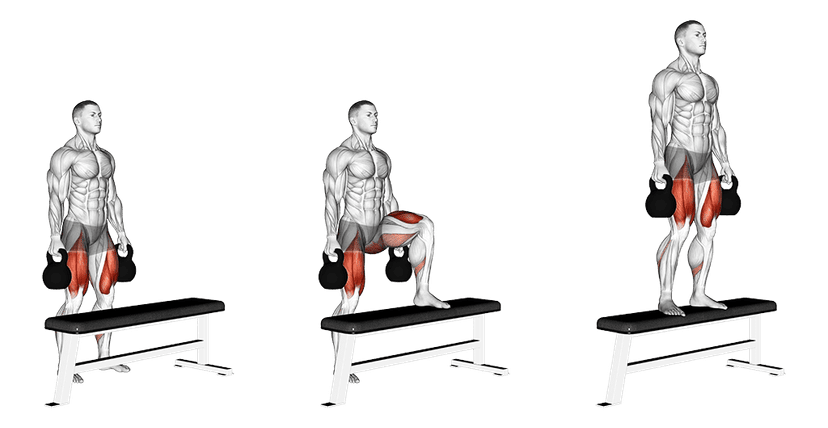
Kettlebell Step Ups: Complete Guide
Kettlebell step ups are an often underestimated unilateral leg exercise. The concept is simple: step onto a box or bench while holding a kettlebell for added resistance. But behind that simplicity lies deep work for the quadriceps, glutes, and knee stability. It is one of the best exercises for building single-leg functional strength, the kind you use with every step, every staircase, every sprint.
Unlike bilateral squats, the step up isolates each leg and reveals strength imbalances. If your knee wobbles on the way up or you need to push hard with your back leg to help, you have found your weakness. And that is exactly what you need to work on.
Muscles targeted
- Quadriceps (vastus medialis, vastus lateralis, rectus femoris): primary mover for knee extension
- Gluteus maximus: hip extension, especially with a higher step
- Gluteus medius: lateral pelvic stabilization
- Hamstrings: assist hip extension
- Adductors: knee stabilization
- Core (abs, obliques): balance maintenance with asymmetric loading
The higher the step, the more the glutes work. A low step (30-35 cm) targets the quadriceps more. A high step (40-50 cm) heavily recruits the gluteus maximus. Choose the height based on your goal.
Proper execution
Starting position
Stand facing a stable step (bench, box, platform). Hold a kettlebell in one hand (opposite side to the working leg for anti-lateral core work) or a kettlebell in each hand. Shoulders back, chest up, eyes forward.
Concentric phase (stepping up)
- Place the entire foot of your working leg on the step. Your heel must not hang off the edge.
- Push through the heel of the foot on the step to rise.
- Rise under control until the leg on the step is fully extended.
- The back foot does NOT push to help you up. All force comes from the leg on the step.
- At the top, both feet are on the step and you are standing tall.
- Exhale on the way up.
Eccentric phase (stepping down)
- Lower yourself under control with the same leg that pushed (the trailing leg descends first).
- Place the back foot on the floor gently, no dropping.
- Keep the working foot on the step for all reps on the same side.
- Inhale on the way down.
Tip: lean your torso slightly forward (10-15 degrees) to better recruit the glutes and reduce knee stress.
Common mistakes
1. Pushing off with the back leg This is the most common error. The foot on the floor gives a push to assist the step up. That defeats the unilateral purpose. To check: if you cannot step up without your back foot leaving the ground naturally, the step is too high or the weight is too heavy.
2. Knee caving inward (valgus) The working knee collapses inward during the ascent. This signals weak gluteus medius. Think about "pushing your knee outward" as you step up. Reduce the weight and work the gluteus medius in isolation (abductions, clamshells).
3. Step too high A step that is too high forces compensation from the lower back or the trailing leg. The ideal step height places your thigh parallel to the floor or slightly below when your foot is on it. Start with 30-35 cm and increase gradually.
4. Excessive speed Moving up and down too fast reduces time under tension and increases the risk of falling. Control the ascent over 2 seconds and the descent over 2-3 seconds. The step up is an exercise in control, not speed.
Variations
Lateral step up (intermediate) Instead of facing the step, stand beside it. Step up laterally with the leg closest to the step. Recruits more adductors and gluteus medius. Excellent for athletes in lateral-movement sports (racket sports, team sports).
Step up with knee drive (beginner to intermediate) At the top of the step up, drive the free knee toward your chest before stepping down. Adds balance work and hip flexion. A great preparatory exercise for running.
Deficit step up (advanced) Stand on the step and lower one foot toward the floor without touching, then rise back up. The range of motion is greater than the standard step up. Excellent for end-range quadriceps strength.
Rack-position kettlebell step up (intermediate) Hold one or two kettlebells in the rack position (against your shoulders). The higher center of gravity increases the balance challenge and core engagement.
Programming
Placement in your session: Put step ups after your bilateral squats or deadlifts as a unilateral accessory exercise. They also work as a primary exercise if you do not have access to a squat rack.
Volume and intensity:
- Beginner: 3 x 10 reps per leg, bodyweight or light kettlebell (8-12 kg)
- Intermediate: 3-4 x 8-10 reps per leg, 16-24 kg kettlebell
- Advanced: 4 x 6-8 reps per leg, heavy loads or higher step
Frequency: 1-2 times per week in your leg sessions. Alternate with lunges or split squats to vary the unilateral stimulus.
Step height: Start with 30 cm. Increase by 5 cm when you can perform 3 x 10 clean reps. Do not exceed the height where your thigh is parallel to the floor, unless your mobility allows it without compensation.
Key takeaways
- Zero push from the back foot: all force comes from the leg on the step
- Knee alignment: push the knee outward to prevent valgus
- Appropriate height: too high means compensation, too low means not enough glute work
- Control: 2 seconds up, 2-3 seconds down
- Unilateral: always start with the weaker leg
