Kettlebell Swing: Complete Guide
The kettlebell swing is the foundational movement of kettlebell training. Explosive, dynamic, and brutally effective, it combines strength work and cardiovascular conditioning in a single motion. Looking for an exercise that burns calories, strengthens your posterior chain, and improves athletic power? The swing checks every box. It is also one of the rare movements that allows high-volume work without grinding your joints, provided you master the technique.
An important note before we go further: we are talking about the "hardstyle" swing, where the kettlebell rises to shoulder height through hip propulsion. Not the "American" swing where the load goes overhead, which places unnecessary stress on the shoulders for most trainees.
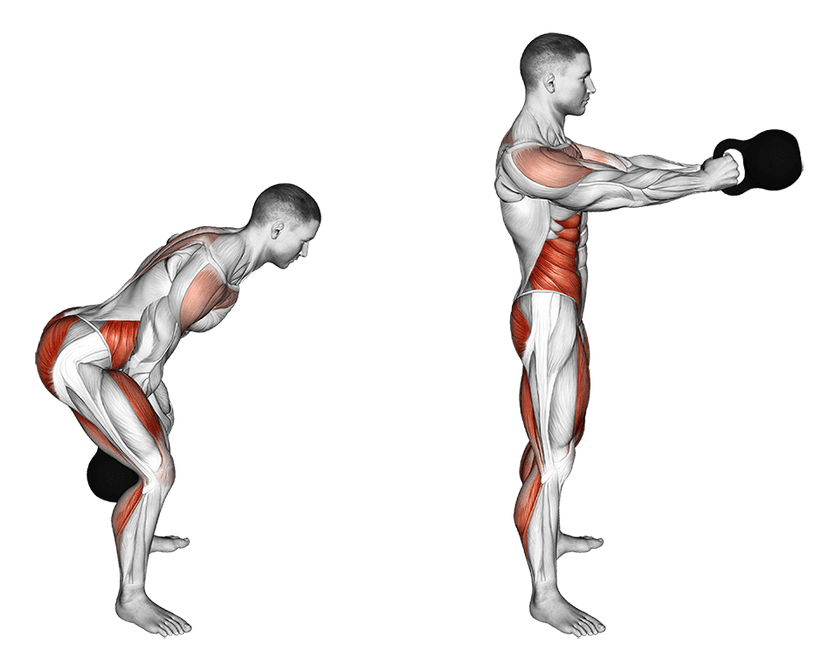
Muscles targeted
- Hamstrings: primary drivers of the hip hinge, they decelerate the descent and power the ascent
- Glutes: explosive hip extension, the true power generator of the swing
- Spinal erectors: maintain a neutral spine under dynamic loading
- Abs and obliques: anti-extension bracing to prevent hyperextension at the top
- Lats: connection between the arms and trunk, stabilization of the kettlebell
- Forearms and grip: grip endurance challenged during long sets
The swing is primarily a posterior chain exercise. If your quads burn more than your glutes, you are probably squatting the kettlebell instead of truly hinging.
Proper execution
Starting position
Place the kettlebell on the floor about 30 cm in front of you. Feet slightly wider than shoulder width, toes turned out 15-30 degrees. Hinge at the hips by pushing them back, flat back, eyes forward. Grip the handle with both hands, arms straight.
The hiking pass
The movement does not start from a standing position. Pull the kettlebell toward you and thread it between your legs like a football center snap. Your forearms touch the inside of your thighs. This is the loaded position.
Concentric phase (propulsion)
- Squeeze your glutes hard to drive your hips forward.
- Your arms stay straight and relaxed: they are cables, not engines. The kettlebell rises through hip power, not by pulling with the shoulders.
- At the top, your body forms a straight line: ankles, knees, hips, and shoulders aligned. Squeeze your glutes and brace your abs as if you were about to take a punch.
- The kettlebell reaches shoulder height (no higher).
Eccentric phase (return)
- Let the kettlebell descend, guiding with your arms.
- Push your hips back at the last moment, when your forearms approach your groin.
- Absorb the energy with your hamstrings and glutes.
- Flow immediately into the next rep with no pause.
Breathing: exhale on the drive (hip snap), inhale on the return (backswing).
Common mistakes
1. Squatting instead of hinging
This is the number one mistake. The swing is a hip hinge, not a squat. Your knees bend slightly, but the movement comes from the hips pushing back. If your knees travel past your toes and your thighs drop to horizontal, you are squatting. Think about pushing your glutes toward the wall behind you.
2. Pulling with the arms
The kettlebell rises through hip power, period. If your shoulders or biceps burn, you are lifting with the upper body. Your arms are passive. Imagine holding a rope tied to your hips: when the hips drive forward, the rope (and the load) goes up.
3. Hyperextension at the top
Arching excessively backward at the top overloads the lower back. Your body must form a straight line. Brace your abs and squeeze your glutes at the top to lock the position. Do not let the kettlebell pull you backward.
4. Losing control at the bottom
Letting the kettlebell pull the shoulders forward and rounding the back at the bottom is dangerous for the lumbar spine. Keep your shoulders packed (engage the lats) and maintain a neutral spine throughout.
5. Starting from a standing position
Beginning the swing by lifting the kettlebell from the floor while standing creates a weak and potentially dangerous first rep. Always use the hiking pass to generate momentum from the very first rep.
Variations
One-arm swing (intermediate)
Same technique, one hand. Increases anti-rotation demand on the trunk and grip challenge. Alternate hands each set or every 5-10 reps. Excellent for correcting lateral imbalances.
Hand-to-hand swing (intermediate)
Release and catch the kettlebell at the top to switch hands. Develops coordination, grip, and agility. Start with a light load until you master the timing.
Dead stop swing (beginner)
Set the kettlebell down between every rep. Eliminates momentum and forces you to generate power from zero each time. Perfect for learning hip hinge mechanics without worrying about timing.
Banded swing (advanced)
Add a resistance band anchored to the floor and looped around the kettlebell. Accommodating resistance increases difficulty at the top of the movement, where the classic swing becomes easy. Reserved for experienced trainees.
Programming
Placement in your session: At the beginning as activation (3-5 light sets), or as a metabolic finisher after strength work. The swing also works as a standalone for short, intense sessions.
Volume and intensity:
- Beginner: 3-5 x 10-15 reps, 8-12 kg kettlebell (women) / 12-16 kg (men)
- Intermediate: 5-10 x 15-20 reps, 12-16 kg / 20-24 kg
- Advanced: 10,000 swing protocol (Dan John), EMOM 10-20 reps/minute
Frequency: The swing can be performed 3-5 times per week thanks to its low eccentric stress. Soreness is rare after a few weeks of adaptation. It is the ideal exercise for conditioning days.
Starting weight: Choose a kettlebell that allows you to perform 20 clean reps. Most beginner males start at 16 kg, women at 8-12 kg. Increase the load when 20 reps become easy with perfect technique.
Key takeaways
- Hip hinge, not squat: the movement comes from the hips, not the knees
- Passive arms: power is generated by the glutes and hamstrings
- Straight line at the top: glutes squeezed, abs braced, no arching
- Hiking pass: always start and finish with the kettlebell between the legs
- Explosive breathing: exhale on the hip snap, inhale on the return
