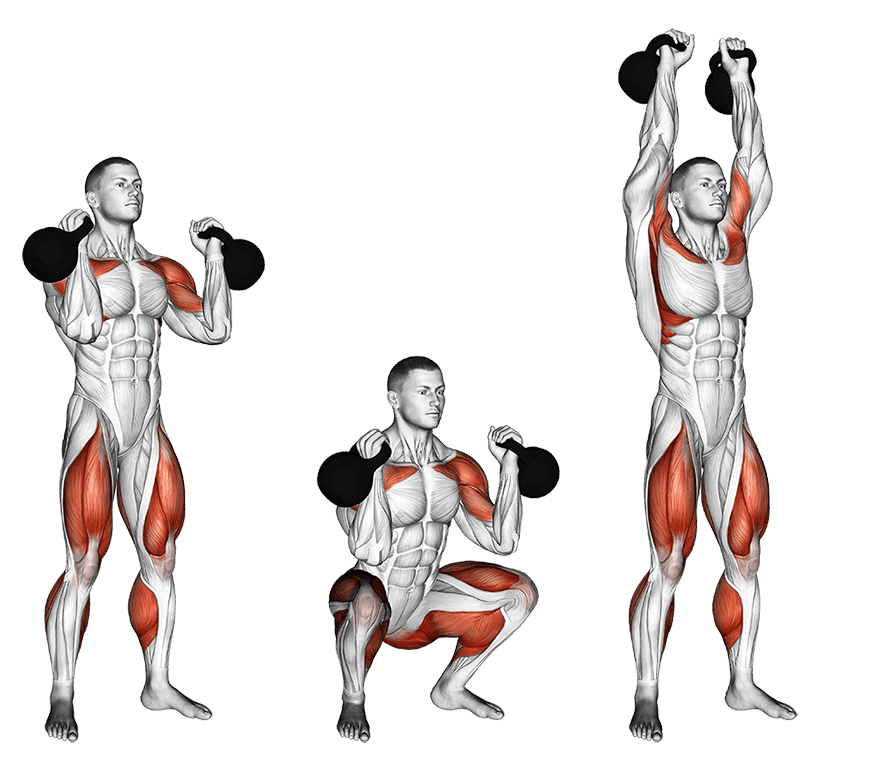
Kettlebell Thruster: Complete Guide
The kettlebell thruster is a compound movement that chains a squat and an overhead press into a single fluid rep. It is one of the most complete exercises you can perform with a kettlebell: it works the lower body, upper body, and cardiovascular system at the same time. Popularized by CrossFit and metabolic circuits, the thruster is a must for anyone who wants to burn calories, build functional strength, and improve endurance.
One movement, zero downtime. That is what makes the thruster so effective and so brutal. As reps accumulate, your heart rate climbs rapidly and every muscle in your body contributes. If you only have 15 minutes to train, the thruster is your best friend.
Muscles targeted
- Quadriceps: primary mover in the squat phase, knee extension
- Gluteus maximus: hip extension on the way up from the squat
- Deltoids (anterior and lateral): overhead push
- Triceps: elbow extension during the press phase
- Trapezius: stabilization in the overhead position
- Full core (abs, obliques, erectors): force transfer between lower and upper body
- Hamstrings and calves: assistance during the squat
The thruster is a total-body exercise. The magic lies in the force transfer: the leg drive from the squat propels the kettlebell upward, and the shoulders finish the job. That synergy is what allows you to move more weight than with a strict isolated press.
Proper execution
Starting position
Stand with feet shoulder-width apart. Hold a kettlebell in the rack position (against your shoulder, elbow tight to your body, wrist straight, the kettlebell resting on your forearm and biceps). You can also use two kettlebells, one in each hand in rack. Chest up, core braced.
Phase 1: Squat
- Descend into a squat by pushing your hips back and bending your knees.
- Your knees track over your toes and your torso stays as upright as possible.
- Descend at least to parallel (thighs horizontal). Deeper if your mobility allows.
- The kettlebell(s) stay in rack position, elbows tight to the body.
- Inhale on the way down.
Phase 2: Explosive ascent and press
- Rise from the squat by driving hard through your heels with explosive intent.
- Use the momentum from the ascent to propel the kettlebell overhead.
- The press is a natural continuation of the squat, not a separate movement. The legs provide the drive, the shoulders finish.
- At the top, your arm is locked out, biceps near your ear, wrist straight.
- Exhale during the ascent and press.
Phase 3: Return to rack
- Bring the kettlebell back to rack by absorbing the weight with a slight knee bend.
- Flow directly into the next squat without stopping.
Breathing: inhale on the way down into the squat, exhale on the way up and through the press. Never hold your breath during long sets.
Common mistakes
1. Separating the squat and the press The thruster is one continuous movement. If you squat, stand up fully, then press, you lose all the efficiency of force transfer. The press begins the moment you leave the squat. It is one wave of motion.
2. Shallow squat A half squat reduces leg recruitment and forces the shoulders to do too much work. Descend at least to parallel to generate enough leg drive.
3. Back hyperextension at the top The lower back arches when the kettlebell is overhead. Brace your abs and squeeze your glutes at the top to lock your pelvis in neutral. Your ribs stay closed.
4. Bent wrists in rack The wrists bend under the kettlebell in rack position. Your wrists must stay straight and aligned. The kettlebell rests on the heel of your palm and your forearm, not on your fingers.
5. Forgetting to breathe During long sets, holding your breath tanks your performance fast. Establish a clear breathing rhythm: inhale going down, exhale going up. Breathing is your fuel.
Variations
Single kettlebell thruster (beginner) One kettlebell in one hand. Easier to master and adds an anti-rotation challenge for the core. Alternate sides every set or at mid-set.
Double kettlebell thruster (intermediate to advanced) Two kettlebells in rack, one in each hand. Heavier symmetric loading, more intense work for the shoulders and core. This is the most demanding version.
Deep squat thruster (intermediate) Descend into a full squat (ass to grass) before driving up. Increases the range of motion, glute recruitment, and difficulty. Requires good ankle and hip mobility.
EMOM thruster (all levels) Every minute on the minute protocol: perform a set number of thrusters at the start of each minute, rest for the remainder. Example: 5 thrusters per minute for 10 minutes. Excellent for metabolic conditioning.
Programming
Placement in your session: The thruster can serve as a primary exercise at the start of a session (strength) or as a metabolic finisher at the end (endurance). In a circuit, it fits perfectly as the centerpiece.
Volume and intensity:
- Beginner: 3 x 8-10 reps (single kettlebell), 90-second rest
- Intermediate: 4 x 10-12 reps, or 10-minute EMOM (5 reps/min)
- Advanced: 5 x 8-10 reps (double kettlebell), or Tabata 20s/10s x 8 rounds
Frequency: 2-3 times per week. The thruster is versatile: use it in a strength session (heavy, low reps) or a cardio session (light, high reps).
Starting weight: 8-12 kg for women, 12-16 kg for men with a single kettlebell. The right weight lets you chain 10 reps without breaking the fluidity of the movement.
Key takeaways
- One single movement: the squat and press form one continuous wave, not two separate exercises
- Legs provide the drive: go deep enough in the squat to generate momentum
- Lockout at the top: arm extended, wrist straight, abs braced
- Breathing: inhale at the bottom, exhale at the top, never hold your breath
- Versatile: strength, endurance, fat loss, the thruster does it all
