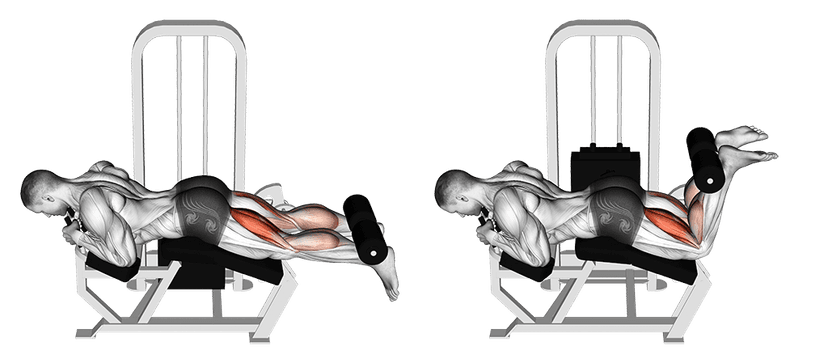
Lying Leg Curl: Complete Guide
The lying leg curl is the ultimate isolation exercise for the hamstrings. Lying face down on the machine, you flex your knees against resistance to directly target the back of your thighs. It looks simple, but it requires precise execution to maximize muscle recruitment and avoid compensations.
The hamstrings are often neglected in favor of the quadriceps, creating a dangerous imbalance for the knees and athletic performance. The lying leg curl is the direct solution to correct this deficit and build solid hamstrings.
Muscles targeted
- Hamstrings (biceps femoris, semitendinosus, semimembranosus): primary movers, responsible for knee flexion
- Biceps femoris (short head): the only hamstring portion that does not assist hip extension, only knee flexion
- Gastrocnemius (calves): assists knee flexion, especially when feet are dorsiflexed
- Popliteus: a small deep knee muscle that initiates flexion
The lying leg curl is unique because it isolates knee flexion without involving hip extension. This makes it the ideal complement to the Romanian deadlift, which targets the hamstrings through hip extension.
Proper execution
Starting position
Lie face down on the machine. Adjust the ankle pad so it sits just above your Achilles tendon (not on the calf, not on the heel). Your knees should be right at the edge of the bench or slightly past it to allow free flexion. Grip the handles firmly. Your hips are pressed flat against the bench.
Concentric phase (flexion)
- Flex your knees by pulling your heels toward your glutes.
- Actively contract your hamstrings throughout the entire movement.
- Curl until your shins are at least perpendicular to the floor (90 degrees of flexion), or beyond if the machine allows.
- Hold for one second at the top and squeeze hard.
Eccentric phase (extension)
- Lower the weight under control over 2-3 seconds.
- Do not let the load drop: the eccentric phase is just as important as the concentric for hamstring hypertrophy.
- Return to near-full knee extension without completely releasing tension.
Breathing: exhale on the curl (effort), inhale on the return.
Common mistakes
1. Hips lifting off the bench
When the load is too heavy, the hips rise to compensate. This shifts part of the work to the glutes and lower back, reducing hamstring isolation. Pin your hips to the bench and reduce the weight if needed.
2. Movement too fast and uncontrolled
Swinging the weight with momentum is tempting but counterproductive. The hamstrings respond better to a controlled tempo with a pronounced contraction at the top. Slow down, especially on the eccentric.
3. Pad positioned incorrectly
If the pad sits too high on the calf, the gastrocnemius takes over. If it is too low on the heel, it is uncomfortable and range of motion is reduced. Place it just above the Achilles tendon.
4. Feet in plantarflexion (pointed)
Pointing your toes puts the gastrocnemius in a shortened position and reduces its ability to assist the movement. Keep your feet in a neutral position or slightly dorsiflexed to maximize hamstring engagement.
5. Full extension without tension
Letting the weight rest between reps kills continuous tension. Maintain a slight bend at the bottom to keep the hamstrings under load throughout the set.
Variations
Single-leg lying curl (intermediate)
Work one leg at a time to correct imbalances. Use 50-60% of your bilateral load. This variation often reveals that one leg is significantly stronger than the other.
Isometric pause curl (intermediate)
Hold for 3-5 seconds at the top position (heels near glutes). The isometric contraction recruits additional muscle fibers and improves the neuromuscular connection.
Accentuated eccentric curl (advanced)
Lift the weight with both legs, lower with one. The heavy eccentric phase creates more microdamage and stimulates hypertrophy. An advanced technique that requires a solid strength base.
Drop set lying curl (intermediate to advanced)
Perform your set to failure, reduce the load by 20-30%, and continue. Repeat 2-3 times. The hamstrings respond particularly well to intensification techniques.
Programming
Placement in your session: After compound movements (squats, Romanian deadlifts, leg press). The lying leg curl is an isolation exercise that does not require neural freshness to be effective.
Volume and intensity:
- Beginner: 3 x 12-15 reps, light load, focus on the contraction
- Intermediate: 3-4 x 10-12 reps, load progression with controlled tempo
- Advanced: 4 x 8-12 reps with intensification techniques
Frequency: 1-2 times per week. The hamstrings recover well and can be trained frequently. Include the lying leg curl in every leg or Pull session.
Progression tip: Hamstrings progress more slowly in load than quadriceps. Focus on contraction quality and tempo rather than weight. Add 2.5-5 kg when you comfortably reach the top of your rep range.
Key takeaways
- Hips pinned: your hips must never lift off the bench
- Controlled tempo: 2-3 seconds on the eccentric, pause at the top
- Pad positioned correctly: just above the Achilles tendon, not on the calf
- Continuous tension: never fully release at the bottom of the movement
- Voluntary contraction: squeeze your hamstrings hard at the top position
