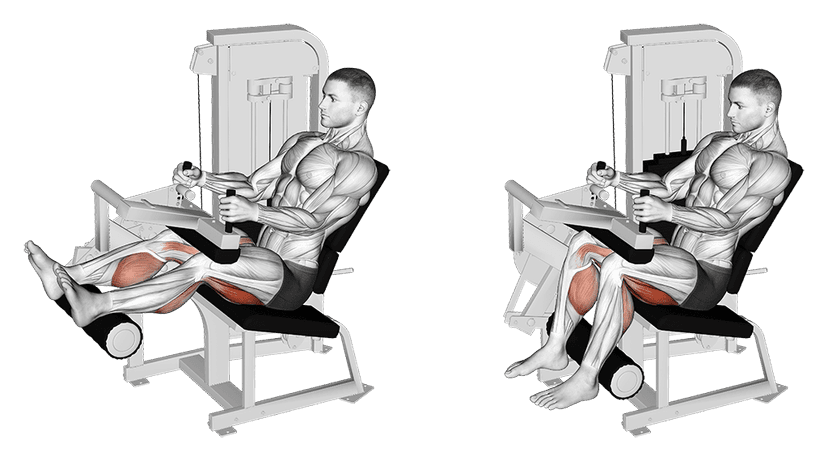
Seated Leg Curl: Complete Guide
The seated leg curl is the go-to isolation exercise for hamstrings. Unlike the lying leg curl, the seated position places the hamstrings in a stretched position at the hip, increasing mechanical tension and promoting muscle growth. If you want thick, well-defined hamstrings, this exercise belongs in your routine.
Targeted Muscles
- Hamstrings: primary mover, all three heads activated
- Biceps femoris (long head): outer portion of the back of the thigh - Semitendinosus: inner portion - Semimembranosus: deep, inner portion
- Gastrocnemius (calves): secondary contribution since they cross the knee joint
- Popliteus: small stabilizer muscle behind the knee
The seated position is superior to the lying curl for the long head of the biceps femoris because hip flexion stretches it further. This is a major advantage for hypertrophy.
Proper Execution
Machine Setup
- Sit down and adjust the backrest so your knees slightly overhang the edge of the seat. The machine's axis of rotation should align with your knees.
- The upper pad (stabilizer) rests just above your knees without crushing your kneecaps.
- The lower pad (resistance) sits on the lower calf, just above the Achilles tendon.
Concentric Phase (Curling)
- Contract your hamstrings to pull the pad backward and downward.
- Flex your knees through the full range of motion, trying to bring your heels toward your glutes.
- Squeeze hard in the flexed position for 1 second.
- Exhale during the curl.
Eccentric Phase (Returning)
- Let the pad rise slowly (3 seconds minimum).
- Never fully release the tension: stop just before complete knee extension.
- Inhale during this phase.
Common Mistakes
1. Backrest Too Far Back (Hip Too Open) Danger: hamstrings are in a shortened position, reducing useful range and tension. Fix: move the backrest forward so your hip is at roughly 90 degrees or slightly more.
2. Using Momentum by Pulling with the Upper Body Danger: total loss of isolation, hamstrings only work halfway. Fix: keep your back against the pad, hands on the handles. Only your knees should move.
3. Incomplete Range of Motion Danger: you miss the most productive part of the movement (peak contraction). Fix: curl fully, heels toward glutes. If you cannot, reduce the weight.
4. Full Extension Between Reps Danger: lost tension and knee joint stress in hyperextension. Fix: keep 5 to 10 degrees of flexion between reps to maintain tension.
Variations
Single-Leg Seated Curl (Intermediate) One foot at a time. Essential for correcting left-right imbalances. Hamstrings are often asymmetric. Use 40 to 45% of your bilateral load.
Slow Tempo Seated Curl (Intermediate) Tempo 4-2-4: 4 seconds curling, 2 seconds hold, 4 seconds return. The constant tension is extreme. Reduce the weight by 30 to 40%.
Lying Leg Curl (Beginner to Intermediate) Alternative if your gym does not have a seated leg curl. The lying position reduces hamstring stretch at the hip, making it slightly less effective for the long head. Still a solid exercise.
Nordic Curl (Advanced) Bodyweight exercise where you resist gravity eccentrically. Extremely intense, excellent for injury prevention. Introduce it progressively.
Programming
Placement: as an isolation exercise after compound movements (deadlifts, squats). Can also be placed at the start of a session for pre-activation.
- Hypertrophy (10 to 12 reps): 3 to 4 sets, 10 to 12 reps, 60 to 90 seconds rest
- Endurance / finisher (15 to 20 reps): 2 to 3 sets, 15 to 20 reps, 45 to 60 seconds rest
- Pre-activation (12 to 15 reps): 2 light sets before Romanian deadlifts
Frequency: 1 to 2 times per week. Hamstrings recover relatively fast, so you can train them twice if total weekly volume stays reasonable (8 to 12 sets per week total).
Key Takeaways
- Set the machine so the rotation axis aligns with your knees
- Take advantage of the seated position: it stretches the hamstrings and maximizes tension
- Squeeze hard at peak contraction, 1 second pause minimum
- Slow and controlled descent (3 seconds), never fully release
- Combine with a hip-dominant movement (RDL, deadlift) for complete hamstring development
