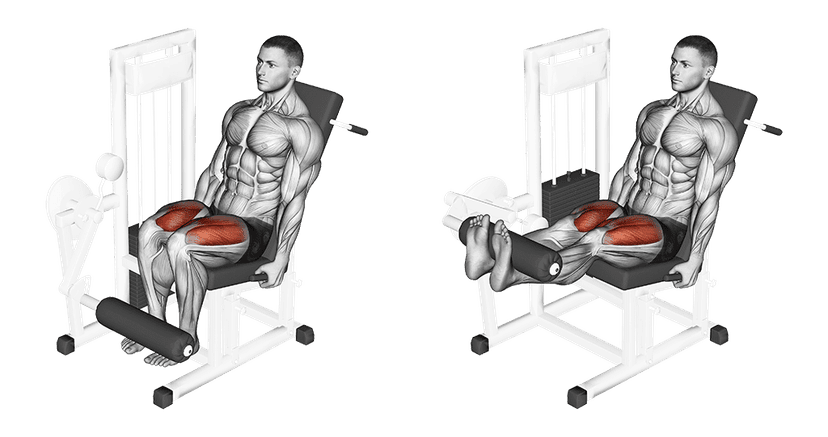
Leg Extension: Complete Guide
The leg extension is the ultimate isolation exercise for quadriceps. Simple machine, single-joint movement: you are working pure knee extension and nothing else. It is the ideal tool for finishing a leg session, pre-fatiguing your quads before squats, or targeting a specific quadriceps weakness.
Targeted Muscles
- Quadriceps: the only working muscle. All four heads are activated:
- Rectus femoris: the biarticular head crossing both hip and knee - Vastus lateralis: outer thigh, creates width - Vastus medialis: inner thigh, the famous "teardrop" above the knee - Vastus intermedius: deep head, underneath the rectus femoris
No other muscle contributes significantly. This is what makes the leg extension a pure isolation exercise.
Proper Execution
Machine Setup
- Sit down and adjust the backrest so your knees align with the machine's axis of rotation. This is the single most important adjustment.
- The ankle pad should rest just above your feet, on the lower part of your shin.
- Set the starting position so your knees are at roughly 90 degrees.
Concentric Phase (Lifting)
- Contract your quads to lift the pad.
- Raise until near-full knee extension. No need to slam into lockout.
- Hold a one-second squeeze at the top while contracting hard.
- Exhale on the way up.
Eccentric Phase (Lowering)
- Lower slowly (2 to 3 seconds minimum).
- Control the weight, no free-falling.
- Stop the descent at roughly 90 degrees of flexion.
- Inhale on the way down.
Recommended tempo: 2-1-3-0 (2 seconds up, 1 second hold at top, 3 seconds down, immediate transition).
Common Mistakes
1. Knee Axis Misaligned with the Machine Danger: joint shearing forces. If your knee is in front of or behind the rotation axis, forces are not distributed correctly. Fix: spend 30 seconds adjusting the backrest before every session.
2. Using Momentum to Lift the Weight Danger: lost quad tension and ligament stress. Fix: start each rep from a dead stop. If you need to cheat, it is too heavy.
3. Butt Lifting Off the Seat Danger: lumbar compression and loss of control. Fix: grip the side handles and keep your pelvis pinned.
4. Lowering Too Fast Danger: losing 50% of the exercise's benefit. The eccentric phase is where the most muscle growth occurs. Fix: enforce a strict 3-second tempo on the way down.
Variations
Partial Top-Range Leg Extension (Beginner) Work only the last 45 degrees of extension. Reduces joint stress while targeting the vastus medialis (the teardrop). Ideal for rehab or warm-up.
Single-Leg Extension (Intermediate) One foot at a time. Corrects strength imbalances between legs. Use roughly 40 to 45% of your bilateral load.
Leg Extension with Isometric Hold (Intermediate to Advanced) Hold 3 to 5 seconds at the top of each rep. The constant tension is brutal for muscle growth. Reduce the weight by 20 to 30%.
Leg Extension Drop Set (Advanced) Chain 3 decreasing loads with no rest. For example: 10 reps at 60 kg, immediately 10 reps at 40 kg, then 10 reps at 25 kg. A devastating finishing technique.
Programming
Placement: at the end of a leg session (after compound lifts) or as a pre-fatigue before squats.
- Hypertrophy (10 to 15 reps): 3 to 4 sets, 10 to 15 reps, 60 to 90 seconds rest
- Endurance / finisher (15 to 25 reps): 2 to 3 sets, 15 to 25 reps, 45 to 60 seconds rest
- Pre-fatigue (12 to 15 reps): 2 light sets before squats or leg press
The leg extension is not a heavy strength exercise. Favor moderate to high rep ranges with perfect control.
Frequency: 1 to 2 times per week, depending on total quad volume.
Key Takeaways
- Align your knee axis with the machine, this is priority number one
- Control the descent (3 seconds minimum), that is where growth happens
- Squeeze hard at the top with a one-second pause
- Do not go too heavy: this is isolation, not brute strength
- Best used as a finisher or pre-fatigue, not a primary exercise
