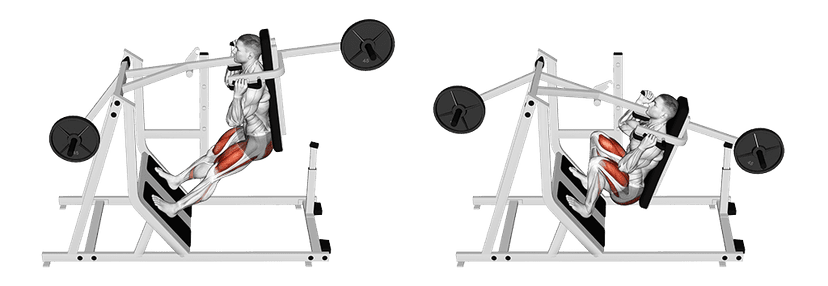
Pendulum Squat Machine: Complete Guide
The pendulum squat is a strength machine that has surged in popularity in recent years for a simple reason: it allows you to work the quadriceps with extreme intensity while protecting your back. Its arc-shaped movement replicates a natural squat path, with a resistance angle that maximizes quad tension in the bottom portion of the movement.
If you want to isolate your quads without the demands of a free squat or a traditional hack squat, the pendulum squat is a formidable tool. Its counterweight system and pivoting platform deliver a unique feel that no other machine replicates.
Muscles targeted
- Quadriceps (all four heads): primary movers, worked through the full range of motion with peak tension at the bottom
- Gluteus maximus: activated at the bottom position and during the initial push upward
- Adductors: stabilize the knees, especially in a wide stance
- Hamstrings: slight synergistic contribution
The pendulum squat is first and foremost a quadriceps exercise. The arc-shaped path maintains constant tension on the muscle, without the slack phases found on other machines. This is what makes it so effective for thigh hypertrophy.
Proper execution
Starting position
Step onto the machine platform and position your shoulders under the pads. Your back rests against the pad. Place your feet in the middle of the platform, shoulder-width apart or slightly narrower. Toes point slightly outward. Grip the handles for stability.
Eccentric phase (descent)
- Unlock the machine by releasing the safety catch.
- Descend while controlling the movement. The platform pivots under your feet as the pad follows you through the arc.
- Go as low as your mobility allows, ideally until your thighs are parallel to the floor or below.
- Keep your back firmly pressed against the pad. Your knees naturally travel past your toes; this is normal on this machine.
Concentric phase (ascent)
- Push through the entire foot surface to rise.
- Exhale during the push.
- Do not fully lock out your knees at the top. Maintain tension.
- Recommended tempo: 3 seconds down, 1-second pause at the bottom, 2 seconds up.
Breathing: inhale on the descent, exhale on the push. Brace your breath under heavy loads (Valsalva maneuver).
Common mistakes
1. Dropping too fast without control
The pendulum squat provides a guided path, but that does not mean you can let gravity take over. A fast, uncontrolled descent overloads the knees at the bottom and reduces time under tension. Control every centimeter.
2. Feet too far forward on the platform
If your feet are placed too far forward, your heels may lift at the bottom and stress concentrates on the knees. Keep your feet in the middle of the platform.
3. Shoulders lifting off the pads
Your shoulders must stay in constant contact with the pads. If they lift, the load is too heavy or you are compensating with your upper body.
4. Partial range of motion
Stopping halfway robs your quads of the most productive portion of the movement (the bottom position). Use a full range of motion or reduce the load.
Variations
Narrow and low foot placement (intermediate)
Bring your feet closer together and place them low on the platform. This position emphasizes vastus medialis and rectus femoris recruitment. Knee flexion range is maximized.
Wide stance (intermediate)
Set your feet wider than shoulder width with toes turned out 30-45 degrees. The adductors and glutes are recruited more, while still delivering excellent quad work.
Slow tempo 4-1-2 (intermediate to advanced)
4-second descent, 1-second pause at the bottom, 2-second ascent. Time under tension increases dramatically and you can achieve a powerful hypertrophy stimulus with 30-40% less weight.
Drop set (advanced)
Perform your set to failure, then immediately strip a plate from each side and continue. Repeat 2-3 times. The pendulum squat is ideal for drop sets because the guided movement allows you to continue safely even under extreme fatigue.
Programming
Placement in your session: As a second or third exercise after squats or hack squats. It can also serve as a primary movement if you want to spare your back.
Volume and intensity:
- Beginner: 3 x 12-15 reps, light load, learning the arc path
- Intermediate: 3-4 x 8-12 reps, steady load progression
- Advanced: 4 x 8-12 reps with intensification techniques (drop sets, rest-pause, slow tempo)
Frequency: 1-2 times per week. The pendulum squat generates a lot of local fatigue in the quads. Allow 48-72 hours of recovery before training legs again.
Progression tip: Start with a light load to get familiar with the arc-shaped path. The sensation differs from a standard squat. Add weight progressively once the movement feels smooth.
Key takeaways
- Constant tension: the arc-shaped path keeps the quads under tension throughout
- Back pinned: maintain contact with the pad from start to finish
- Full range of motion: descend at least to parallel to unlock the machine's full potential
- Proper foot placement: in the middle of the platform for balanced recruitment
- Control the load: a guided path does not replace muscular control
