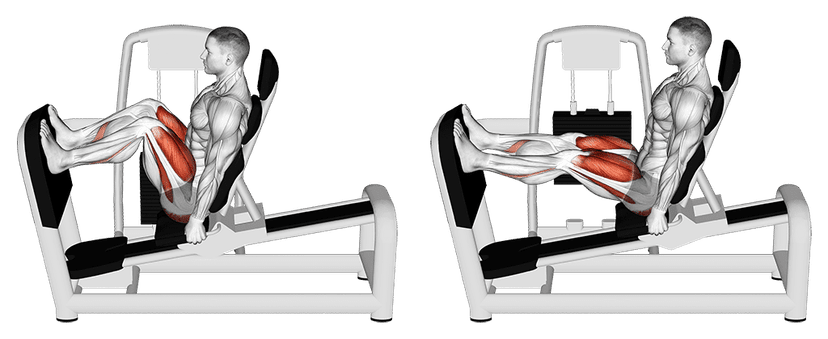
Horizontal Leg Press: Complete Guide
The horizontal leg press is one of the most popular machines in any gym. It allows you to work the quadriceps, glutes, and hamstrings with heavy loads without the stabilization demands of a free squat. If you want to build your legs safely while pushing serious weight, this machine is a solid choice.
Unlike the 45-degree incline leg press, the horizontal version places your back flat against a pad while your feet push a platform that slides in front of you. This setup reduces stress on the lower back and lets you focus purely on the push.
Muscles targeted
- Quadriceps (vastus lateralis, vastus medialis, rectus femoris): primary movers, responsible for knee extension
- Gluteus maximus: activated at the bottom of the eccentric and the start of the push, especially with feet placed high on the platform
- Hamstrings: secondary contribution, more involved when feet are high and wide
- Adductors: stabilize the knees and assist the push, especially in a wide stance
Foot placement significantly changes muscle recruitment. Low and narrow feet prioritize the quadriceps. High and wide feet shift emphasis toward the glutes and hamstrings.
Proper execution
Starting position
Sit on the machine with your back firmly pressed against the pad. Your glutes must stay in contact with the seat throughout the entire movement. Place your feet in the center of the platform, shoulder-width apart. Toes slightly pointed outward (about 15-20 degrees). Grab the side handles to stabilize your upper body.
Eccentric phase (descent)
- Unlock the platform by releasing the safety catches.
- Let the platform come toward you while controlling the movement.
- Descend until your thighs form a 90-degree angle with your shins. Do not go too deep to prevent your pelvis from tilting (posterior pelvic tilt).
- Keep your knees aligned with your toes: no valgus (knees caving inward).
Concentric phase (push)
- Push the platform by pressing through the entire surface of your foot. Do not push only with your toes.
- Exhale during the push.
- Do not fully lock out your knees at the top to maintain muscle tension and protect the joint.
- Recommended tempo: 2-3 seconds down, 1-2 seconds up.
Breathing: inhale on the descent, exhale on the push.
Common mistakes
1. Hips lifting off the seat
This is the most dangerous mistake. When you descend too deep, your pelvis tilts posteriorly and your lower back rounds. This creates enormous pressure on the lumbar discs. Stop the descent before your glutes lift off the seat.
2. Knee valgus
Knees caving inward during the push overloads the ligaments. Focus on pushing your knees outward, in the direction of your toes. If you cannot control the valgus, reduce the load.
3. Pushing through the toes
Pushing only with the front of your foot shifts stress to the knees and reduces glute activation. Distribute the force across the entire foot surface, heel included.
4. Full knee lockout
Straightening your legs completely at the top removes tension from the muscles and can hyperextend the knee. Maintain a slight bend at the top position.
5. Partial range of motion
Loading very heavy but only moving 10 centimeters does nothing for hypertrophy. Use a full range of motion (at least 90 degrees of flexion) with a load you can control.
Variations
High and wide stance (intermediate)
Place your feet at the top of the platform, wider than shoulder width. This position increases glute and hamstring recruitment. Knee flexion range is reduced, which lowers joint stress.
Low and narrow stance (intermediate)
Place your feet at the bottom of the platform, close together or hip-width apart. This position targets the quadriceps more, particularly the vastus medialis (the teardrop above the knee). Note: knee stress is higher in this position.
Single-leg press (intermediate to advanced)
Work one leg at a time to correct strength imbalances between sides. Use roughly 60% of the load you would use bilaterally. Stabilize your pelvis carefully to avoid rotating.
Slow tempo press (beginner to intermediate)
4-second descent, 2-second pause at the bottom, 2-second push. The slow tempo increases time under tension and reduces the load needed to stimulate the muscles. Excellent for sensitive joints.
Programming
Placement in your session: As a second or third exercise after squats or the incline leg press. It can also serve as a primary exercise if you have lower back limitations that prevent squatting.
Volume and intensity:
- Beginner: 3 x 12-15 reps, moderate load, focus on range of motion and control
- Intermediate: 4 x 8-12 reps, steady load progression
- Advanced: 4 x 6-10 reps with intensification techniques (drop sets, rest-pause)
Frequency: 1-2 times per week in a leg or Push session. The quadriceps tolerate high training volume well.
Progression tip: Start with a load you can control for 15 clean reps. Add 5-10 kg per week as long as your form stays flawless.
Key takeaways
- Back against the pad: your glutes must never lift off the seat
- Knees aligned: push your knees outward, in line with your toes
- Flat feet: distribute force across the entire foot surface
- Full range of motion: at least 90 degrees of flexion for effective work
- Foot placement: adjust position based on your muscle-building goals
