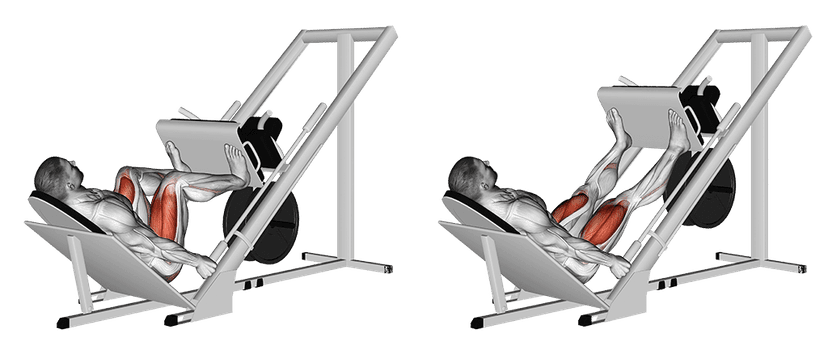
45-Degree Leg Press: Complete Guide
The 45-degree leg press is the most common leg machine in any gym. It lets you load heavy in complete safety, with a guided path that limits injury risk. It is an essential exercise for building massive quads and powerful glutes, whether you are a beginner or an experienced lifter.
The concept is simple: you sit on an inclined seat and push a weight-loaded platform that slides on rails set at 45 degrees. Gravity plays a direct role in the resistance, making this exercise particularly effective for progressive overload.
Muscles targeted
- Quadriceps (vastus lateralis, vastus medialis, rectus femoris, vastus intermedius): primary movers, responsible for knee extension
- Gluteus maximus: strongly activated at the bottom of the movement and during the initial push
- Hamstrings: secondary role, more involved with feet placed high
- Adductors: stabilize the movement and assist the push, especially in a wide stance
- Calves (soleus): slight activation to stabilize the ankle
The 45-degree leg press is one of the few machine exercises that recruits this much muscle mass in a single movement. Foot placement gives you precise control over which muscles are targeted.
Proper execution
Starting position
Settle into the seat with your back and glutes firmly pressed against the pad. Your lower back must remain in contact with the pad throughout the entire movement. Place your feet in the middle of the platform, shoulder-width apart, toes slightly pointed outward. Grip the side handles firmly.
Eccentric phase (descent)
- Unlock the platform by pushing with your legs and releasing the safety catches.
- Lower the platform while controlling the load. Your knees travel toward your chest.
- Descend until your thighs form a 90-degree angle with your shins. Some lifters go deeper based on their mobility, but always monitor your pelvis position.
- Keep your knees tracking over your feet. Do not let them cave inward.
Concentric phase (push)
- Push the platform by pressing firmly through your heels and midfoot.
- Exhale during the push.
- Rise to near-full knee extension without complete lockout.
- Recommended tempo: 2-3 seconds down, a 1-second pause at the bottom, 1-2 seconds up.
Breathing: inhale on the descent, exhale on the push. For heavy loads, use the Valsalva maneuver (held breath) through the hardest part of the rep.
Common mistakes
1. Going too deep with posterior pelvic tilt
When you descend too far, your pelvis tilts posteriorly: your lower back rounds and lifts off the pad. This is the leading cause of disc herniation on the leg press. Stop the descent as soon as you feel your glutes lifting off the seat.
2. Knee valgus
Knees moving inward during the push overloads the cruciate ligaments and medial meniscus. Keep your knees pushed outward, aligned with your toes. If that is impossible at your current load, reduce the weight.
3. Pushing only through the toes
Pushing with the front of the foot increases shear force on the knees and reduces glute engagement. Press through the entire foot surface, especially the heels.
4. Bouncing at the bottom
Using tissue elasticity to bounce at the bottom increases injury risk and reduces time under tension. Control the descent and pause briefly at the bottom position.
5. Ego loading with partial range of motion
Stacking plates only to move a few centimeters feeds the ego but does not build muscle. Use a full range of motion with a load you can handle.
Variations
High and wide stance for glutes (intermediate)
Move your feet toward the top of the platform and set them wider than shoulder width. Hip flexion increases and the glutes take on most of the load. Excellent variation for glute-focused sessions.
Low and narrow stance for the vastus medialis (intermediate)
Place your feet at the bottom of the platform, close together. The vastus medialis (the teardrop above the knee) is primarily targeted. Note: this position increases knee stress.
Single-leg press (intermediate to advanced)
Work one leg at a time to correct strength imbalances. Use 50-60% of your bilateral load. This variation often reveals asymmetries you did not know about.
1 and 1/4 reps (advanced)
Descend fully, rise one quarter of the way, descend again, then rise fully. That counts as one rep. Time under tension is nearly doubled in the bottom portion of the movement, which is the hardest part.
Programming
Placement in your session: As a first or second exercise in your leg session. If you squat, place the leg press second. If you skip the squat, the leg press can serve as your primary movement.
Volume and intensity:
- Beginner: 3 x 12-15 reps, moderate load, learning proper depth
- Intermediate: 4 x 8-12 reps, linear load progression
- Advanced: 4-5 x 6-10 reps, intensification techniques (drop sets, myoreps, rest-pause)
Frequency: 1-2 times per week. The quadriceps recover well and tolerate high volume. If you train with a split, include the leg press in each leg session.
Progression tip: The 45-degree leg press allows rapid load progression. Add a 5 kg plate on each side every week. An intermediate male typically presses 150-250 kg on this machine.
Key takeaways
- Pelvis pinned: your lower back must never lift off the pad
- Knees in line: aligned with your feet, never caving inward
- Flat feet: push through your heels and midfoot
- Full range of motion: at least 90 degrees of flexion for real work
- Foot placement: vary position based on target muscles
