Single-Arm Dumbbell Row: Complete Guide
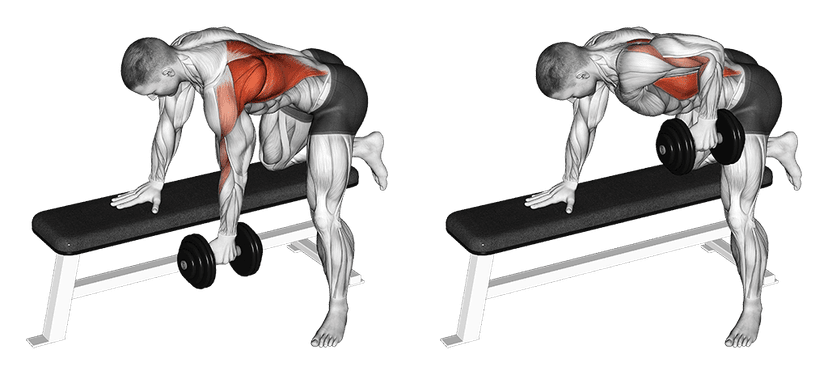
The single-arm dumbbell row is one of the best exercises for building a thick, symmetrical back. By working each side independently, it corrects muscular imbalances and allows a greater range of motion than the barbell row. It belongs in every serious back program.
Targeted Muscles
- Latissimus dorsi: primary mover, develops both width and thickness
- Mid trapezius: scapular retraction at the top of the movement
- Rhomboids: pulling shoulder blades together, thickness work
- Posterior deltoid: assists the pull, contributes to shoulder balance
- Biceps and brachialis: elbow flexors
- Forearms: grip strength
- Obliques and quadratus lumborum: anti-rotation trunk stabilization
The unilateral advantage forces your obliques to work hard to prevent your torso from rotating. This is a bonus that bilateral exercises do not offer.
Proper Execution
Starting Position
- Knee and hand of the non-working side placed on a flat bench. Your torso is parallel to the floor.
- Working-side foot on the floor, slightly behind and angled outward for a stable base.
- The dumbbell hangs at arm's length, directly below your shoulder.
- Flat back, eyes on the floor, neutral neck.
Concentric Phase (Pull)
- Initiate the movement by driving your elbow toward the ceiling, not your hand.
- The dumbbell travels along your body toward your hip (not your shoulder).
- Squeeze your shoulder blade toward your spine at the top.
- Your elbow slightly passes the plane of your back at the top.
- Hold for one second and contract the lat.
Eccentric Phase (Lowering)
Lower over 2 to 3 seconds under control. Let your arm extend fully at the bottom to stretch the lat. No bouncing.
Breathing
Inhale at the bottom (stretch), exhale during the pull. Maintain constant abdominal bracing.
Common Mistakes
1. Torso rotation This is the number one mistake. Rotating your torso to help lift the weight reduces lat engagement and creates lumbar torsion. Your torso stays parallel to the floor from start to finish.
2. Pulling toward the shoulder instead of the hip Pulling the dumbbell toward your shoulder mainly recruits the upper trap and rear delt. To target the lat, pull toward your hip while keeping the elbow close to your body.
3. Rounded back Your back must stay flat. If you round, it usually means the dumbbell is too heavy or the bench is too low. Adjust before continuing.
4. Moving too fast The single-arm row is perfectly suited for controlled tempo. Rushing robs your muscles of the mechanical tension that drives growth. Aim for 2 seconds up, 3 seconds down minimum.
5. Poor foot placement If your foot is too close to the bench, you lack stability. Place it slightly behind and outward to create a solid triangular base.
Variations
Standing Single-Arm Row on a Rack (Intermediate) Instead of a bench, brace yourself against a rack or support. This position allows a variable torso angle and frees up hip movement. Popular among advanced lifters for going heavy.
Split-Stance Single-Arm Row (Beginner) One foot forward, one foot back, no bench support. Requires more stability but strengthens your core. Ideal if you do not have a bench available.
Single-Arm Row with Rotation (Advanced) Add a slight torso rotation at the end of the concentric phase. Increases the range of motion and rhomboid recruitment. Reserved for lifters who already master the strict version.
Meadows Row (Advanced) Using a landmine bar, perpendicular to your body. The unique angle targets the lat from a different axis. Excellent for variety and complete development.
Programming
Strength (4x6-8 reps per side) As your second back exercise, after a heavy bilateral movement (deadlift or barbell row). Rest 90 seconds to 2 minutes.
Hypertrophy (3-4x10-12 reps per side) Primary or secondary exercise in your back session. Tempo 3-1-2. Rest 60 to 90 seconds. Focus on contraction, not on load.
Finisher (2-3x15-20 reps per side) At the end of a session with a light load. Work on the mind-muscle connection and the pump. Rest 45-60 seconds.
Frequency: 1 to 2 times per week. This exercise fits easily into a push/pull split or an upper/lower routine.
Key Takeaways
- Drive with the elbow toward the ceiling, not with the hand.
- Keep your torso parallel to the floor with zero rotation.
- Direct the dumbbell toward your hip, not your shoulder.
- Full range of motion: stretch at the bottom, squeeze at the top.
- Always start with your weaker side.
