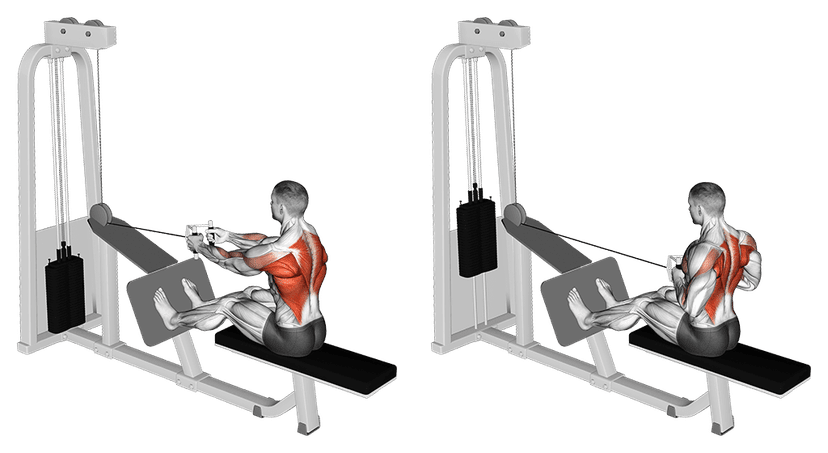
Seated Cable Row: Complete Guide
The seated cable row is a fundamental exercise for building a thick back. Unlike vertical pulling movements such as the lat pulldown or pull-up, the horizontal row primarily targets back thickness by engaging the muscles that pull the shoulder blades toward the spine. It is accessible from your first weeks in the gym and remains relevant at every level.
The cable pulley provides constant tension throughout the movement. No dead zone, no slack: your muscles work from start to finish. This is a considerable advantage over free-weight rows where gravity alters resistance depending on the angle.
Muscles targeted
- Latissimus dorsi: primary mover, responsible for humeral adduction and extension
- Mid and lower trapezius: scapular retraction and stabilization
- Rhomboids: pull the shoulder blades toward the spine
- Teres major: assists the lats during the pull
- Posterior deltoid: contributes at the end of the movement when the elbows pass behind the torso
- Biceps and brachialis: elbow flexion, important synergists
- Erector spinae: isometric trunk stabilization
Using a V-handle (close neutral grip) emphasizes lat and rhomboid recruitment. A straight bar with a wide overhand grip shifts the focus toward the mid-trapezius and posterior deltoid.
Proper execution
Starting position
Sit on the bench, feet braced on the foot pads, knees slightly bent. Grab the V-handle with arms extended in front of you. Sit tall: back straight, chest out, shoulder blades in a neutral position. Avoid leaning too far forward. A slight 10-15 degree lean is acceptable to stretch the lats, but your torso should never collapse forward.
Concentric phase (pull)
- Initiate the movement by squeezing your shoulder blades together.
- Pull the handle toward your lower sternum, keeping your elbows close to your body.
- Drive your elbows slightly behind your torso. This is where peak lat contraction occurs.
- Push your chest out at peak contraction. Imagine trying to touch the handle with your sternum.
Eccentric phase (return)
- Release under control, letting your arms extend gradually.
- Allow your shoulder blades to spread apart for a full lat stretch.
- Keep your torso stable. No rocking back and forth.
- Recommended tempo: 1-2 seconds pulling, 2-3 seconds returning.
Breathing: exhale while pulling, inhale while releasing.
Common mistakes
1. Rocking the torso
Leaning back to cheat with momentum is the most common fault. Your torso should stay nearly motionless. If you have to swing to finish your set, the weight is too heavy. Reduce it and focus on the contraction.
2. Pulling with the arms instead of the back
If your biceps fatigue before your back, you are pulling with your arms. The fix: think about pulling with your elbows, not your hands. Imagine your hands are hooks and the force comes from your shoulder blades.
3. Shoulders rising toward the ears
The upper traps take over when you shrug your shoulders. Keep your shoulders low and back throughout the movement. Before each rep, make a conscious effort to depress your shoulders.
4. Incomplete range of motion
Cutting the movement short by not pulling far enough or not fully extending reduces effectiveness. Pull until your elbows pass behind your torso and release until your arms are fully extended.
5. Knees too straight or too bent
Your knees should be slightly bent to protect the lower back. Fully locked knees pull on the hamstrings and force lumbar flexion. Excessively bent knees reduce stability.
Variations
Wide-grip horizontal row (intermediate)
Use a straight bar with a wide overhand grip. The work shifts toward the mid-trapezius and posterior deltoid. Range of motion is shorter but the scapular contraction is intense.
Single-arm cable row (intermediate)
One handle, one arm. Allows you to correct left-right imbalances and increase range of motion by adding trunk rotation. Start with your weaker side.
Rope cable row (beginner to intermediate)
The rope lets you spread your hands apart at the end of the movement, increasing rhomboid and posterior deltoid contraction. Excellent as a finisher at moderate loads.
Seated floor cable row (beginner)
If your gym lacks a dedicated station, attach a handle to the low pulley of a cable crossover and sit on the floor. The movement is identical, the position is just less comfortable.
Programming
Placement in your session: Second or third exercise in your back session, after a heavy compound like barbell rows or weighted pull-ups. The seated cable row is ideal as a volume exercise.
Volume and intensity:
- Beginner: 3 x 10-12 reps, moderate load, focus on the mind-muscle connection
- Intermediate: 4 x 8-10 reps, progressive loading
- Advanced: 4 x 8-12 reps with slow tempo (3-second eccentric) or drop sets
Frequency: The back handles two sessions per week well thanks to the variety of angles available. Place a horizontal pull on one day and a vertical pull on the other.
Starting weight: Begin light, 15-20 kg is enough to learn the movement. The priority is feeling your lats work before adding weight.
Key takeaways
- Shoulder blades first: initiate the pull with scapular retraction, not your arms
- Stable torso: zero rocking, the force comes from the back
- Elbows close to the body: to maximize lat recruitment
- Full range of motion: stretch forward, contract with elbows behind the torso
- Progression: master the mind-muscle connection before loading heavy
