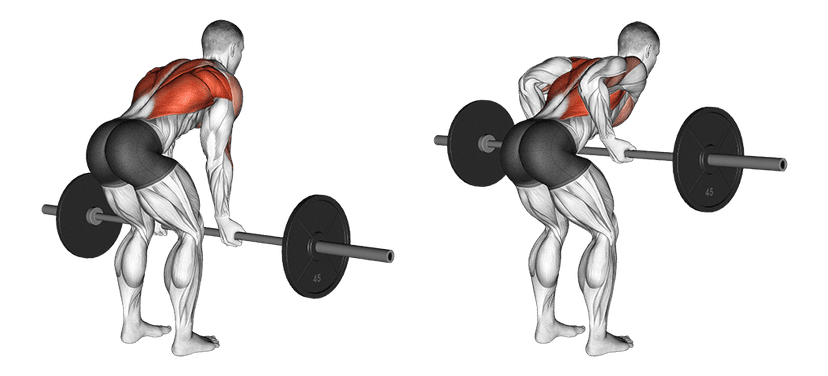
Barbell Row: Complete Guide
The bent-over barbell row is the essential compound movement for building a thick back. It recruits the lats, traps, and rhomboids massively while engaging the entire posterior chain. If you could only keep one back exercise, this would be it.
Targeted Muscles
- Latissimus dorsi: primary mover, responsible for pulling toward the torso
- Mid and lower trapezius: scapular retraction at the top of the movement
- Rhomboids: bringing shoulder blades together, upper back thickness
- Posterior deltoid: assists the horizontal pull
- Biceps: elbow flexors, active throughout the concentric phase
- Erector spinae and lower back: isometric hold to maintain the bent-over position
- Hamstrings and glutes: pelvic stabilization in the hip-hinge position
The lats do the heavy lifting. If your biceps give out before your back, you are probably pulling too much with your arms.
Proper Execution
Starting Position
- Feet hip-width apart, knees slightly bent (15-20 degrees).
- Hinge at the hips by pushing your glutes back. Your torso should form a 30 to 45-degree angle with the floor.
- Overhand grip (palms down), slightly wider than shoulder width.
- Arms fully extended, bar hanging below your shoulders. Flat back, eyes on the floor about 2 meters ahead.
Concentric Phase (Pull)
- Pull the bar toward your navel by driving your elbows up, not your hands.
- Squeeze your shoulder blades together at the top.
- Keep your torso stable. No jerking or standing up to cheat.
- Hold for one second at the top, elbows behind the plane of your back.
Eccentric Phase (Lowering)
Lower over 2 to 3 seconds until your arms are fully extended. No bouncing, no back relaxation.
Breathing
Inhale at the bottom (arms extended), exhale during the pull. On heavy sets, brace and hold your breath during the concentric phase (Valsalva maneuver).
Common Mistakes
1. Rounded back This is the biggest risk. A rounded back under load compresses spinal discs. Fix: reduce the weight, practice the hip-hinge with an empty bar, and film yourself from the side.
2. Excessive torso rise If you stand up with each rep to build momentum, you turn the exercise into a standing shrug. Your torso must stay fixed between 30 and 45 degrees.
3. Pulling with the biceps Your arms are just hooks. Think "elbows to the ceiling" rather than "hands to the belly." This mental cue activates the lats far more effectively.
4. Short range of motion Not fully extending your arms prevents the lats from stretching. Not pulling high enough robs the rhomboids of their peak contraction. Full range of motion is mandatory.
5. Too much weight The barbell row is an ego lift. But if your technique breaks down, you train poorly and risk a lower back injury. Clean reps at 70 kg beat sloppy reps at 100 kg every time.
Variations
Supinated Barbell Row (Yates Row) Palms facing up, torso more upright (about 60 degrees). Recruits more biceps and lower lats. Popularized by Dorian Yates. More accessible for beginners because the position is less demanding on the lower back.
Pendlay Row (Advanced) Each rep starts from the floor with a full stop. Torso is nearly parallel to the floor. Great for explosive strength and pulling power. Requires good hip mobility.
Smith Machine Row (Beginner) The guided bar removes the stabilization component. Useful for learning the movement pattern or isolating the back at the end of a session when the lower back is fatigued.
Banded Barbell Row (Intermediate) A resistance band attached to the floor increases tension at the top, where the lats are strongest. Perfect for working the final squeeze.
Programming
Strength (4x5-6 reps) Place the barbell row as your first back exercise after warming up. Rest 2-3 minutes. Linear progression: add 2.5 kg per week.
Hypertrophy (3-4x8-12 reps) As your second exercise after pull-ups or deadlifts. Rest 90 seconds. Controlled tempo 3-1-1 (3s lowering, 1s pause, 1s pull).
Muscular Endurance (3x15-20 reps) Light load, maximum control. Ideal in a circuit or superset with a pressing movement (bench press, for example).
Frequency: 1 to 2 times per week. Allow 48 hours between heavy back sessions.
Key Takeaways
- Flat back at all times, this is non-negotiable.
- Drive with the elbows, not the hands.
- Keep your torso fixed between 30 and 45 degrees.
- Squeeze shoulder blades at the top, fully stretch at the bottom.
- Start light and master the technique before adding weight.
