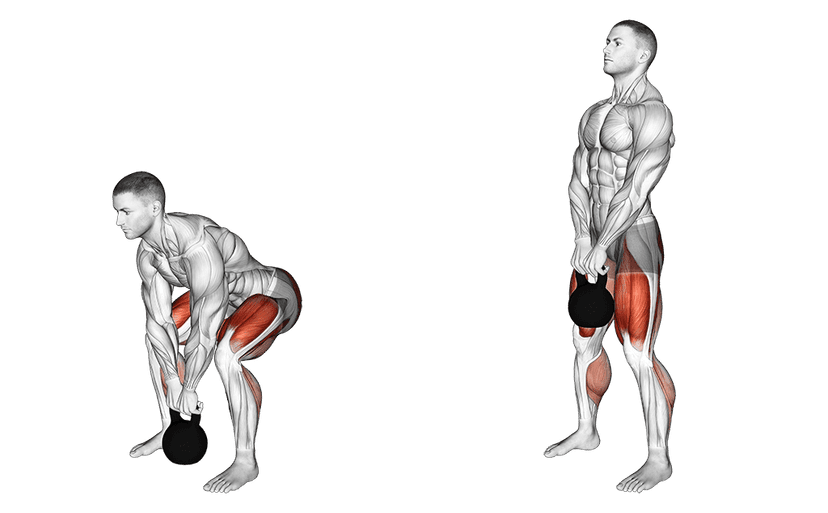
Deadlift: complete guide
The deadlift is arguably the most complete exercise in strength training. In a single movement, you train the posterior chain, legs, back, core, and grip. It is also the exercise that allows the heaviest absolute loads. But it is one of the most technical: poor execution can lead to serious injury.
Muscles targeted
Primary muscles:
- Spinal erectors: hold the spine in a neutral position under load
- Hamstrings: drive hip extension and are the primary movers in the initial pull
- Gluteus maximus: powerful hip extension in the lockout phase
- Quadriceps: extend the knee in the initial push off the floor
Secondary muscles:
- Latissimus dorsi: keeps the bar tight to the body throughout the lift
- Trapezius: scapular stabilization
- Full core: force transmission and spinal protection
- Forearms: grip strength to hold the bar
Proper execution
Setup: bar over the mid-foot, feet hip-width apart. Overhand or mixed grip, slightly wider than the legs.
Back position before the pull:
- Spine in a neutral position: neither over-arched nor rounded
- Chest up, sternum pointing toward the ceiling
- Eyes focused about 2 meters ahead on the floor
- Shoulders slightly in front of the bar
Creating tension:
- Deep breath, Valsalva maneuver -- hold it
- Engage the lats: imagine trying to bend the bar around your legs
- Build full-body tension throughout the chain BEFORE the bar leaves the floor
The lift:
- Push the floor away from you with your legs -- do not think "pull the bar up with your back"
- The bar stays against your legs the entire way up
- Hips and shoulders rise at the same rate
- At knee height, drive your hips forward to complete the lock
- At the top: hips fully extended, back straight, do not hyperextend
Common mistakes
Lower back rounding: the most dangerous error. It creates asymmetric disc compression. If your back rounds, reduce the weight immediately.
Hips shooting up too fast: all the load transfers to the lumbar spine. Synchronize hips and shoulders from the start.
Bar drifting away from the body: creates a massive lever arm on the spine. The bar should stay in contact with your legs from floor to lockout.
No tension before the pull: jerking the bar off the floor creates a shock load. Take 1-2 seconds to build full tension before the bar moves.
Hyperextending at the top: leaning back adds nothing and compresses the facet joints. Stand tall at lockout.
Variations
Sumo deadlift: very wide stance, more upright torso. Recommended for those with long legs, wide hips, or limited hamstring mobility.
Romanian deadlift (RDL): hips hinge back, bar lowers to mid-shin without touching the floor. Continuous hamstring tension throughout. Easier to learn and excellent for hamstring development.
Stiff-leg deadlift (SLDL): even less knee bend than the RDL. Maximum hamstring loading.
Trap bar deadlift: more upright position, less lumbar stress. The best starting point for beginners learning the hinge pattern.
Programming
Start of the session. 3-5 sets of 3-6 reps for strength, 3-4 sets of 6-8 reps for hypertrophy.
Frequency: a maximum of 2 times per week. Many experienced lifters deadlift heavy only once per week.
Key takeaways
- Neutral spine is non-negotiable: the absolute rule, no exceptions
- Engage the lats before and during the lift to keep the bar close
- Valsalva maneuver plus maximum abdominal bracing before the bar leaves the floor
- Push the floor away -- do not pull the bar up
- Bar stays against the body from floor to lockout
- A technically sound deadlift at 100 kg is worth more than a broken one at 150 kg
