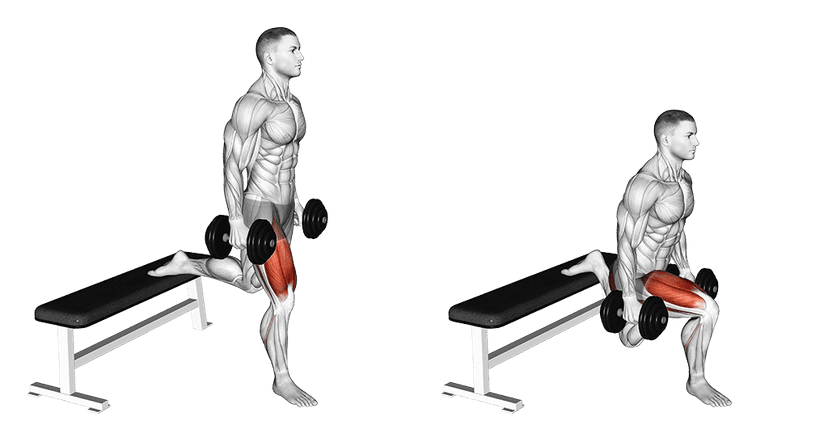
Bulgarian Split Squat: Complete Guide
The Bulgarian split squat (or rear foot elevated split squat) is one of the most effective unilateral exercises for legs and glutes. One foot resting on a bench behind you, you descend into a lunge: it looks simple but is brutally demanding. It corrects imbalances, builds stability, and develops strong legs without requiring heavy loads.
Targeted Muscles
- Quadriceps: primary mover for knee extension on the front leg
- Gluteus maximus: heavily recruited, especially with a more pronounced forward lean
- Adductors: hip stabilizers in the lunge position
- Hamstrings: secondary eccentric assistance role
- Gluteus medius and hip stabilizers: intense work to maintain lateral balance
The emphasis shifts with your lean angle. Upright torso with vertical shin: quad dominant. Slight forward lean: glute dominant.
Proper Execution
Setup
- Place a bench or box behind you (height: 30 to 45 cm, roughly knee height).
- Stand facing away from the bench, about one large step away.
- Rest the top of one foot on the bench (laces down, not toes). Some prefer toes down: both work, but the instep is generally more stable.
Eccentric Phase (Lowering)
- Keep your torso upright and brace your core.
- Bend your front knee and lower straight down. Your front knee may travel slightly past your toes, which is normal and safe as long as your heel stays on the floor.
- Lower until your back knee is a few centimeters from the floor (or your front thigh reaches parallel).
- Body weight is primarily on the front leg (80 to 90%).
- Inhale during the descent (2 to 3 seconds).
Concentric Phase (Rising)
- Push through the heel of your front foot to rise.
- Drive up explosively but with control.
- Do not lock out the knee at the top.
- Exhale on the way up.
Balance management: fix your gaze on a point on the floor about 2 meters ahead. Beginners can start by holding a rack or wall with one hand.
Common Mistakes
1. Front Foot Too Close to the Bench Danger: front knee shoots too far forward, overloading the patellar tendon. Fix: step far enough forward so your shin is nearly vertical at the bottom.
2. Front Foot Too Far from the Bench Danger: excessive hip flexor stretch and groin pain. Fix: adjust the distance so you can descend comfortably without excessive tension in the groin area.
3. Knee Caving Inward (Valgus) Danger: ACL stress and patellar pain. Fix: actively push your knee outward during the descent. If you cannot, reduce the load or work on hip stability first.
4. Too Much Weight on the Back Foot Danger: the exercise loses its unilateral purpose, the front leg is not challenged enough. Fix: the back foot is just a balance point. Aim for 80 to 90% of your weight on the front leg.
5. Excessive Forward Lean Danger: lumbar compression and loss of balance. Fix: a slight forward lean is acceptable (and recruits more glutes), but your torso should not exceed 20 to 30 degrees of inclination.
Variations
Standard Split Squat (Beginner) Both feet on the floor in a wide lunge stance. Less balance demanding than the Bulgarian version. Perfect for learning the movement pattern before elevating the rear foot.
Bodyweight Bulgarian Split Squat (Beginner to Intermediate) No load, hands on hips or out front for balance. Focus on depth and control. When you can manage 3 sets of 12 reps per leg, move to dumbbells.
Dumbbell Bulgarian Split Squat (Intermediate) A dumbbell in each hand, arms at your sides. This is the most common and practical version. Allows progressive loading without the demands of a barbell.
Barbell Bulgarian Split Squat (Advanced) Bar on the upper traps like a back squat. Allows heavier loading but demands excellent balance. Reserved for experienced lifters with a solid dumbbell Bulgarian base.
Programming
Placement: as a primary unilateral exercise (after a bilateral squat if you include one) or as the main exercise if you are not squatting that day.
- Strength (6 to 8 reps per leg): 3 to 4 sets, 6 to 8 reps per leg, 2 minutes rest
- Hypertrophy (8 to 12 reps per leg): 3 to 4 sets, 8 to 12 reps per leg, 90 seconds rest
- Endurance / stability (12 to 15 reps per leg): 2 to 3 sets, 12 to 15 reps per leg, 60 seconds rest
Frequency: 1 to 2 times per week. If you have an imbalance between legs, always start with the weaker leg and match the rep count on both sides.
Progression: add 1 to 2 kg per dumbbell every 1 to 2 weeks. Progression is slower than on bilateral squats, which is normal.
Key Takeaways
- Correct foot-to-bench distance: nearly vertical shin at the bottom
- 80 to 90% of weight on the front leg, back foot is just a balance point
- Knee tracking over the foot, never caving inward
- Fix your gaze on the floor ahead of you for balance
- Start with bodyweight, master the movement before adding load
