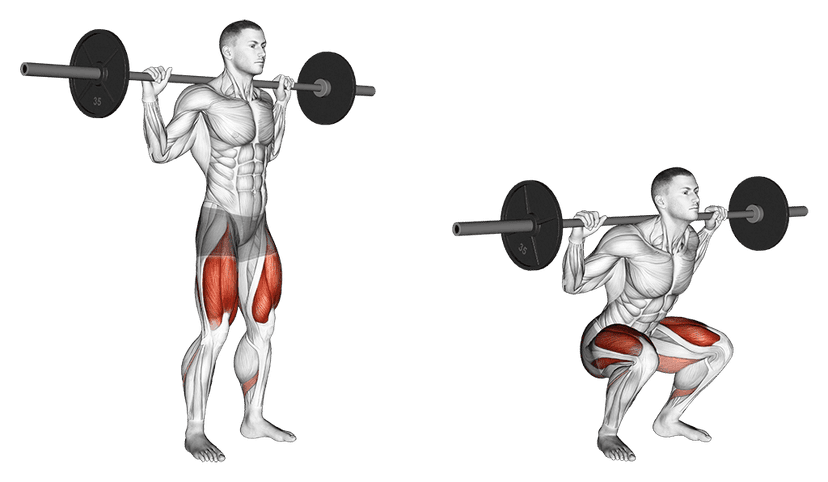
Barbell Back Squat: Complete Guide
The barbell back squat is the single most effective exercise for building strong legs and a balanced physique. No other movement recruits as much muscle mass in one rep. If you could only keep one exercise in your entire program, this would be it.
Muscles Targeted
Primary muscles:
- Quadriceps (vastus lateralis, vastus medialis, vastus intermedius, rectus femoris): drive knee extension and carry most of the load on the way up
- Glutes (gluteus maximus and medius): fire hard below parallel and drive hip extension
- Hamstrings: stabilize the knee and work in sync with the glutes
Secondary muscles:
- Adductors: stabilize the knees and control stance width
- Spinal erectors: keep the spine neutral under load
- Abs and obliques: brace the trunk and protect the spine
- Calves: stabilize the ankle throughout the movement
Proper Execution
- Starting position: place the bar on your upper traps (high bar) or slightly lower on the rear delts (low bar). Feet about shoulder-width apart, toes pointed out 20-30 degrees. Unrack the bar and take two steps back.
- Creating tension: before you descend, take a deep belly breath, hold it, and create maximum intra-abdominal pressure (Valsalva maneuver). Squeeze the bar, engage your lats, tighten your glutes.
- The descent: push your hips back and down simultaneously. Knees track over your toes. Eyes forward. Take 2-3 seconds to lower yourself under control.
- Depth: descend until the hip crease drops below the top of the knee, breaking parallel. This depth is what fully activates the glutes and hamstrings.
- The ascent: drive the floor away from you like you are pushing it down. Hips and shoulders rise at the same rate. Exhale once you pass the sticking point.
- Recommended tempo: 3 seconds down, no pause at the bottom, explosive up (3-0-X).
Common Mistakes
Knees caving in (valgus collapse) Places intense stress on the ligaments and menisci. Fix: actively push your knees out over your toes throughout the entire rep.
Heels rising off the floor Usually an ankle mobility issue. Fix: work on daily ankle stretches and place small plates under your heels until your mobility improves.
Chest collapsing forward The hips shoot up first and the torso tips over. Fix: build quad and core strength, and think about pushing the bar up through the ceiling with your upper back.
Stopping at parallel instead of below A partial squat puts more pressure on the knees because the glutes never fully engage. Go below parallel.
Hard bounce at the bottom Using the bounce to get back up unloads the muscles and overloads the joints. Control the descent, go deep, drive up with power.
Variations
Goblet squat (beginner): hold a dumbbell or kettlebell at your chest. Perfect for learning the movement pattern and warming up.
Front squat (intermediate to advanced): bar sits on the front delts, forcing a more upright torso. Significantly increases quad demand.
Pause squat (advanced): hold the bottom position for 2-3 seconds. Eliminates the stretch reflex and builds pure strength out of the hole.
Belt squat (intermediate): load hangs from a hip belt, zero spinal compression. Excellent option if you have back issues.
Programming
Placement: always first in the session, after your warm-up, when you are fresh.
Volume and intensity:
- Strength: 4-6 sets of 3-5 reps, 3-5 min rest
- Hypertrophy: 3-5 sets of 6-12 reps, 90 s to 2 min rest
- Muscular endurance: 3-4 sets of 15-20 reps, short rest
Frequency: 1 to 2 times per week. The squat is extremely demanding on the central nervous system. If you squat twice a week, vary the intensity: one heavy session, one moderate or technique session.
Starting weight: begin with an empty barbell (20 kg / 45 lb) to master the technique. Most beginners reach 60-80 kg within 3-6 months of consistent training.
Key Takeaways
- Always go below parallel to activate the glutes and protect the knees
- Knees track over your toes at every inch of the movement
- Eyes forward keeps the cervical spine neutral
- Build maximum intra-abdominal pressure before every heavy descent
- Technique before load: a clean squat at 60 kg beats a sloppy one at 100 kg
