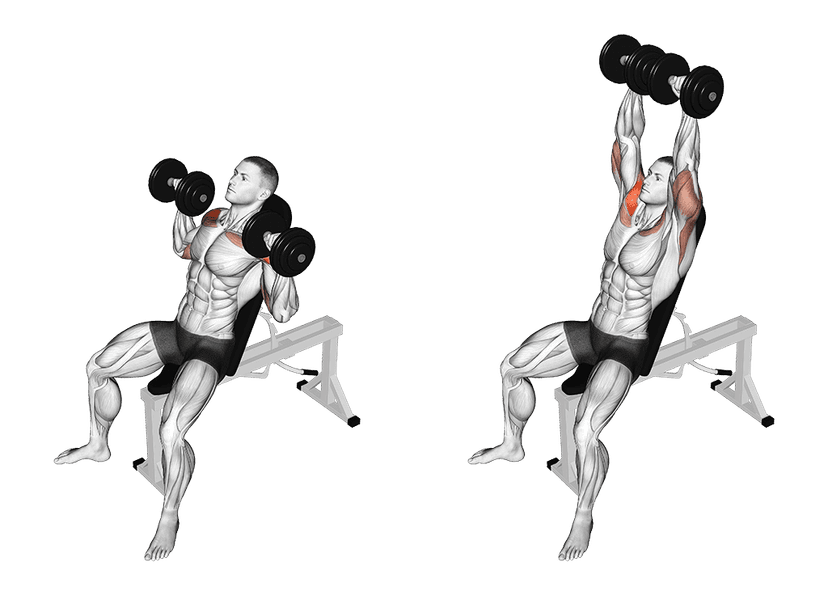
Seated Dumbbell Shoulder Press: Complete Guide
The seated dumbbell shoulder press is one of the best exercises for building massive, functional shoulders. Unlike the barbell overhead press, each arm works independently. The result: no compensation possible, imbalances correct themselves naturally, and the range of motion is greater.
This compound exercise recruits all three deltoid heads with a strong emphasis on the anterior head. It is a foundational movement that deserves a prime spot in your shoulder workouts.
Targeted Muscles
- Anterior deltoid: primary mover, responsible for shoulder flexion
- Lateral deltoid: significant contribution throughout the range of motion
- Posterior deltoid: stabilization and slight participation
- Triceps: elbow extension at the top of the movement
- Upper trapezius: assistance at the top
- Serratus anterior: scapula rotation and protraction
- Core muscles: bracing to maintain seated posture
The anterior deltoid handles the largest share of the work. The lateral head is recruited secondarily but significantly, especially if you use a neutral to semi-pronated grip.
Proper Execution
Starting Position
Sit on a bench set between 80 and 90 degrees (not fully vertical to protect the lower back). Feet flat on the floor, firmly planted. Grab a dumbbell in each hand. Bring them to ear height, elbows bent at 90 degrees, palms facing forward (pronated grip). Back pressed against the pad, chest open, shoulder blades squeezed together.
Concentric Phase (Pressing)
- Press the dumbbells upward while bringing them slightly closer together (without clanking them at the top).
- Arms travel in an arc, not a straight line.
- Extend your arms at the top without aggressively locking out the elbows.
- Exhale during the press.
Eccentric Phase (Lowering)
- Lower the dumbbells under control over 2 to 3 seconds.
- Elbows drop to 90 degrees or slightly below.
- Dumbbells return to ear height, not lower, to avoid overloading the rotator cuff.
- Inhale during the descent.
Recommended tempo: 1 to 2 seconds up, 2 to 3 seconds down.
Common Mistakes
1. Excessive lower back arch When the load is too heavy, the reflex is to arch the back, turning the movement into a disguised incline press. This overloads the lumbar spine and reduces shoulder work. Keep your back pinned to the pad.
2. Lowering the elbows too far Bringing the dumbbells below shoulder line overstretches the joint capsule and rotator cuff. Stop the descent when elbows reach shoulder height or slightly below.
3. Clanking the dumbbells at the top Smashing the dumbbells together at the top signals too light a load or poor control. Bring them close without contact, with a gap of a few centimeters.
4. Feet off the floor Feet in the air remove your stability base. Plant your feet flat on the ground to anchor your body and generate more force.
5. Shoulders rising toward the ears Shrugging recruits the traps instead of the delts. Focus on keeping your shoulders low and pulled back before each rep.
Variations
Neutral Grip Seated Press (Beginner) Palms face each other instead of facing forward. This grip is more natural for the shoulder joint and reduces rotator cuff stress. Ideal if you experience pain with a pronated grip.
Arnold Press (Intermediate) Start with dumbbells in front of you, palms facing your face. As you press, rotate your wrists to finish in a standard pronated grip. The rotation adds lateral deltoid recruitment and increases the range of motion.
Single-Arm Seated Press (Intermediate to Advanced) Press one dumbbell at a time. Your core must stabilize the imbalance, which heavily recruits the obliques and stabilizers. Excellent for correcting asymmetries.
Seated Press with Bottom Pause (Advanced) Hold for 2 seconds at the bottom with elbows at 90 degrees. This eliminates momentum and forces a pure concentric contraction. The load used will be lighter.
Program Integration
The seated dumbbell shoulder press is a compound movement: place it at the start of your session when you are fresh. It serves as the main shoulder exercise.
- Strength goal: 4 sets of 6 to 8 reps, 2 to 3 minutes rest
- Hypertrophy goal: 3 to 4 sets of 8 to 12 reps, 90 seconds rest
- Endurance goal: 3 sets of 12 to 15 reps, 60 seconds rest
- Frequency: 1 to 2 times per week
Follow up with isolation exercises (lateral raises, reverse flyes) to complete the work. In a push session, place it after your chest presses.
Key Takeaways
- Bench at 80 to 90 degrees, back pressed against the pad
- Controlled descent to ear level
- Bring dumbbells close at the top without contact
- No excessive back arching
- Shoulders down, shoulder blades squeezed
- Compound movement to place at the start of the session
