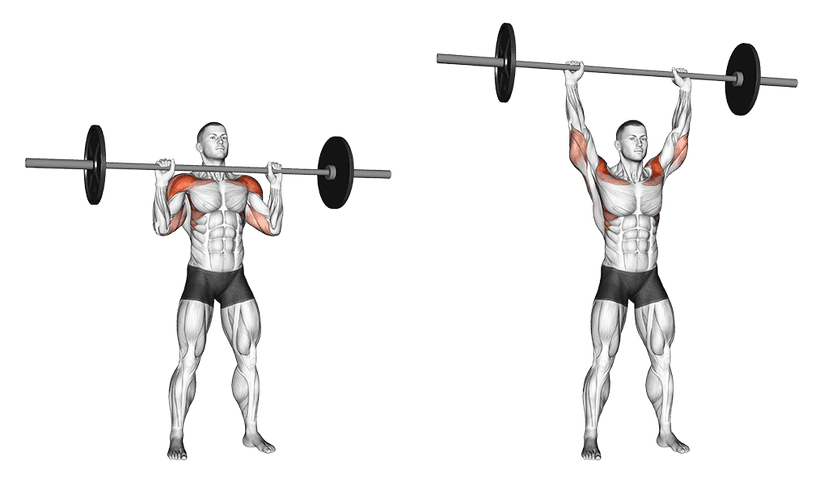
Overhead Press: complete guide
The overhead press is one of the most effective exercises for building shoulder strength and mass. Unlike isolation machines, it trains your entire shoulder girdle while demanding core stability and full-body coordination. Whether you want broader shoulders, stronger arms, or better athletic performance, the overhead press earns its place in your program.
Muscles targeted
The overhead press primarily works the deltoid in all three portions, with the anterior and lateral heads doing most of the work at the bottom and middle of the lift. The triceps extend the elbow to lock out the bar overhead. The upper trapezius and serratus anterior rotate and stabilize the scapula as you press to full extension.
Your core acts as a rigid platform to transfer force from the floor to the bar. If your core is weak or disengaged, your lower back hyperextends and you lose power while risking injury.
Proper execution
Starting position: Stand with feet hip-width apart or slightly wider. Clean the bar to the front-rack position: bar resting on your front deltoids, hands just outside shoulder width, elbows forward and slightly below the bar. Your grip should be firm, with the bar sitting in the heel of your palm rather than your fingers.
Bracing: Before you press, take a big breath and brace your core as if you were about to take a punch. Squeeze your glutes to lock your hips in a neutral position. This prevents excessive lower-back arch, which is the most common technical error.
The press: Drive the bar straight up. To clear your face, pull your chin back slightly as the bar passes your nose, then drive your head forward under the bar as it clears. The bar travels in a vertical line, not an arc around your face. Lock out fully at the top with your shoulders "packed" (shrug slightly into the bar, scapulae elevated and upwardly rotated).
The descent: Lower the bar under control back to the front-rack position. Do not let it crash down or allow your elbows to drop below the bar.
Breathing: Press on the exhale or use the Valsalva maneuver for heavier sets: breathe in, brace, press the rep, exhale at the top or between reps.
Common mistakes
Excessive lower-back arch. When your core is not braced or your thoracic mobility is limited, your lumbar spine compensates by going into hyperextension. This puts stress on your lower back and reduces force transfer. Brace your core and squeeze your glutes before every rep.
Bar path drifting forward. Pressing the bar out in front of your head instead of directly overhead puts your shoulder in a mechanically weak position. Think "bar over mid-foot" and keep it there from start to finish.
Flared elbows at the start. Letting your elbows drop and flare wide before you press shifts tension away from the deltoids and loads the shoulder joint unevenly. Keep elbows slightly in front of the bar at the start.
Partial range of motion. Stopping the press before full lockout means your shoulders never reach peak contraction. Press until your arms are fully extended and your ears are between your biceps.
Pressing with your legs (when you mean to strict press). A slight leg drive is fine for push press, but if you're working the strict press, keep knees locked and the drive comes entirely from your upper body. Leg drive in a strict set usually means the weight is too heavy.
Variations
Push press. Add a quick dip of the knees and hips, then drive explosively upward to help the bar past the sticking point. This allows you to use 10-30% more weight than a strict press and builds power. Great for athletes and for overloading the lockout position.
Seated barbell overhead press. Removes lower-body involvement entirely and reduces the need for core stabilization. Useful if you want to isolate the shoulders or if your back is an issue. Note that seated pressing with a barbell requires a rack with a high enough J-hook setting.
Dumbbell overhead press. Each arm works independently, which corrects imbalances and increases the range of motion at the bottom (you can lower the dumbbells below ear level). It also demands more shoulder stabilization throughout the lift.
Arnold press. Named after Arnold Schwarzenegger, this dumbbell variation starts with a supinated grip (palms facing you) and rotates to a pronated grip (palms forward) as you press. It hits all three deltoid heads through the rotation and adds variety to shoulder training.
Programming
For strength, use 3-5 sets of 3-6 reps at 80-90% of your 1RM with 2-3 minutes of rest between sets. Pair it with a pulling movement like the barbell row or pull-up on the same day.
For hypertrophy, use 3-4 sets of 8-12 reps with 60-90 seconds of rest. Tempo work (3 seconds down, 1 second up) increases time under tension and muscle growth stimulus.
For beginners, start with dumbbells or a lighter barbell to learn the movement pattern. Progress the load by 2.5 kg per week when you can complete all reps with clean form.
Train the overhead press 1-2 times per week. Because it overlaps with the bench press in terms of triceps and anterior deltoid demand, manage total pressing volume carefully if you train both in the same week.
Key takeaways
- Brace your core and squeeze your glutes before every rep to protect your lower back
- The bar travels in a straight vertical line: pull your chin back to clear your face, then drive your head through at the top
- Lock out fully at the top for complete shoulder engagement
- Push press is a valid variation for overloading and adding power, not a "cheat" version
- Progress consistently: the overhead press is one of the slowest-progressing barbell lifts, so small weekly jumps add up over months
