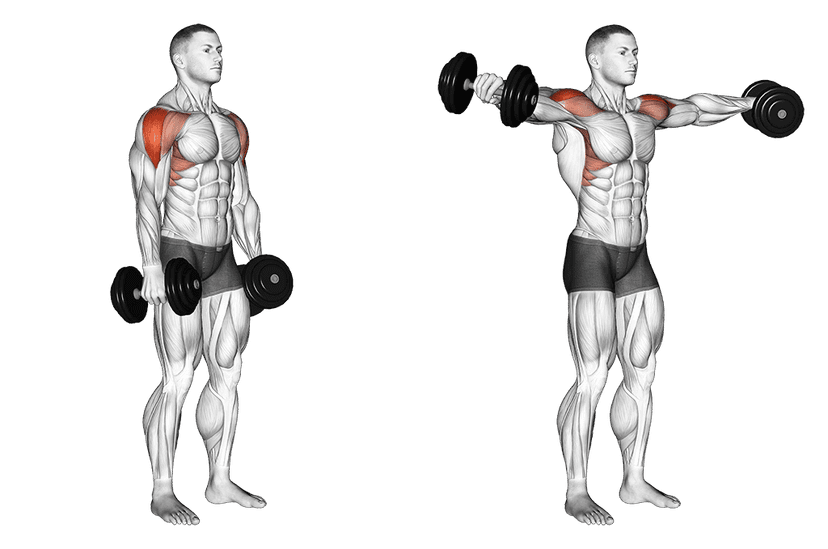
Dumbbell Lateral Raises: Complete Guide
Dumbbell lateral raises are the go-to isolation exercise for the lateral deltoid. This is the muscle head that creates shoulder width, that sought-after V-taper in bodybuilding. Simple in appearance, this exercise is one of the most poorly performed in the gym. The difference between an effective lateral raise and a sloppy one comes down to precise technical details.
Muscles targeted
- Lateral deltoid (medial head): primary mover, responsible for arm abduction (raising the arm to the side)
- Anterior deltoid: contributes at the start if the dumbbells drift in front of the body
- Upper trapezius: kicks in at the end of the range, especially if the movement goes above shoulder line
- Supraspinatus: initiates abduction in the first 15 degrees
- Serratus anterior: scapular stabilization during the movement
The lateral deltoid is a relatively small muscle but visually very impactful. It responds well to moderate to high rep sets (10-20 reps) with impeccable technique.
Proper execution
Starting position
Stand with feet hip-width apart. One dumbbell in each hand, arms at your sides, palms facing your thighs. Slight elbow bend (10-15 degrees) that you will maintain throughout the entire movement. Torso upright or very slightly leaning forward (5 degrees). Shoulders down, not shrugged up toward your ears.
Concentric phase (raising)
- Raise your arms out to the sides while keeping the slight elbow bend.
- Lead the movement with your elbows, not your hands. Imagine your elbows pulling toward the ceiling.
- Raise until your arms are parallel to the floor (shoulder line). No higher, unless you specifically want to recruit the traps.
- At the top, your hands are slightly lower than your elbows. Think of "pouring a pitcher of water" with each hand.
- Hold the top position for 1 second.
Eccentric phase (lowering)
Lower slowly over 2-3 seconds. Do not let the dumbbells drop to your sides. Stop the descent before the dumbbells touch your thighs to maintain tension.
Breathing
Exhale on the way up, inhale on the way down.
Common mistakes
1. Cheating with momentum The most common mistake. Swinging the torso, using a hip thrust, or performing mini-squats to propel the dumbbells. If you need to cheat, the weight is too heavy. Drop 2 kg and do clean reps.
2. Raising too high Going above shoulder line massively recruits the upper traps at the expense of the lateral deltoid. Unless you want to work your traps, stop at shoulder height.
3. Arms too straight Completely straight arms increase the lever arm and place unnecessary stress on the elbow. Keep a permanent 10-15 degree bend.
4. Hands higher than elbows If your hands rise above your elbows at the top, the anterior deltoid takes over. The elbows should always be the highest point in the movement.
5. Excessive speed Fast, jerky reps activate the traps and inertia more than the lateral deltoid. Ideal tempo: 2 seconds up, 1-second pause, 3 seconds down.
Variations
Seated lateral raises (beginner) Seated on a bench, you eliminate all possibility of cheating with the hips or torso. This is the best version for learning the movement and truly isolating the lateral deltoid. The weight used will be less than the standing version.
Low cable lateral raises (intermediate) The cable provides constant tension, especially at the bottom of the movement where dumbbells are ineffective (gravity is vertical, so is the movement). Work one arm at a time with the cable running behind your body. Excellent variation for pump.
Leaning lateral raises (intermediate) Lean your torso at 45 degrees while holding a support. The working arm starts from a more stretched position, which increases the effective range of motion. Also reduces trap contribution because the angle limits raising above the shoulder.
21s lateral raises (advanced) 7 reps in the lower range (0 to 45 degrees), 7 in the upper range (45 to 90 degrees), 7 full range. A brutal intensification technique for the lateral deltoid. Use sparingly: 1-2 sets at the end of a session.
Programming
Placement in your session: After compound shoulder exercises (overhead press, dumbbell press). Lateral raises complete the work on the lateral deltoid that presses do not sufficiently target.
Volume and intensity:
- Beginner: 3 x 12-15 reps, light dumbbells, technique is the priority
- Intermediate: 4 x 10-15 reps, last reps should be challenging
- Advanced: 4-5 x 12-20 reps + drop sets or partials at the end of the set
Frequency: 2-3 times per week. The lateral deltoid is a small muscle that recovers quickly and responds well to high frequency. You can place lateral raises in your Push sessions, shoulder sessions, and even as a recall in your Pull sessions.
Starting weight: Begin with 4-6 kg. Yes, that is light. But with strict technique and controlled tempo, those weights are enough to burn the lateral deltoid. Most advanced lifters rarely exceed 12-16 kg in strict form.
Key takeaways
- Lead with the elbows: elbows go up, hands follow
- No higher than the shoulders: above that, the traps take over
- Light weight, strict technique: this is the golden rule of lateral raises
- Slow tempo: 2 seconds up, 1-second pause, 3 seconds down
- High frequency: 2-3 times per week for wider shoulders
