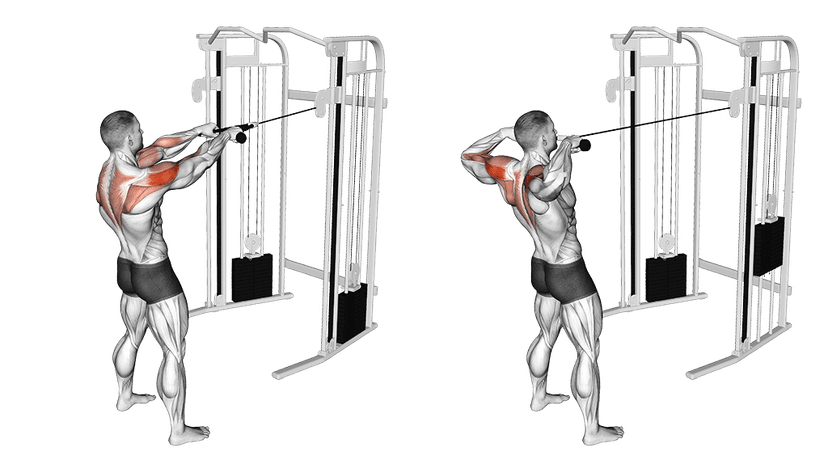
Face Pull: Complete Guide
The face pull is one of the most underrated exercises in the gym. Performed at a high cable pulley with a rope attachment, it targets the posterior deltoid, the external rotators of the shoulder, and the mid traps. It is as much a preventive exercise as a muscle builder: it balances the shoulders and fights the postural damage caused by too much bench pressing and screen time.
Targeted Muscles
- Posterior deltoid: external rotation and shoulder retraction
- Infraspinatus and teres minor: external rotators of the rotator cuff
- Mid and lower trapezius: scapular retraction and depression
- Rhomboids: shoulder blade approximation
- Teres major: assists the pulling motion
The face pull is first and foremost a joint health exercise. The external rotators are the most neglected muscles in strength training, and their weakness is the number one cause of shoulder pain among lifters.
Proper Execution
Setup
- High pulley, set at face level or slightly above.
- Attach a rope to the pulley.
- Light to moderate load. This is not an ego exercise.
Starting Position
- Step back two paces to put tension on the cable.
- Feet shoulder-width apart, a slight stagger for stability.
- Arms extended in front of you, hands in an overhand position on the rope.
- Chest up, shoulders down and back.
Concentric Phase (Pull)
- Pull the rope toward your face while spreading the two ends apart.
- Your elbows rise to shoulder height and flare outward.
- At the end of the movement, your hands are on each side of your ears.
- Your thumbs point backward. This is the external rotation.
- Squeeze your shoulder blades and hold the contraction for 1 to 2 seconds.
Eccentric Phase (Return)
Return slowly over 2 to 3 seconds. Do not let the weight pull you forward. Maintain control until your arms are fully extended.
Breathing
Exhale while pulling toward your face. Inhale while returning to the starting position.
Common Mistakes
1. Too much weight The most common mistake. The face pull is not a strength exercise. Too much weight prevents external rotation and turns the movement into a regular horizontal row. Lower the weight, increase the reps.
2. Elbows too low If your elbows stay pinned to your body, you are doing a row, not a face pull. Your elbows must rise to shoulder height and flare out laterally.
3. No external rotation at the end A face pull without external rotation loses half its purpose. In the final position, your thumbs should point backward, as if you were hitting a double biceps pose.
4. Body tipping forward If the weight pulls you forward, you are compensating with your lower back. Either the weight is too heavy or your stance is too close to the pulley. Step back and reduce the load.
5. Moving too fast The face pull is done with control. No jerking, no momentum. 2 seconds pulling, 1 to 2 seconds hold, 2 to 3 seconds returning.
Variations
Kneeling Face Pull (Intermediate) The kneeling position eliminates all lower-body cheating and forces greater core engagement. The cable pulls slightly upward, increasing lower trap involvement.
Banded Face Pull (Beginner) Attach a band to a support at face height. Ideal for warm-ups or home training. The progressive resistance of the band is perfect for this movement.
Incline Bench Face Pull (Advanced) Lying face down on a bench inclined at 30-45 degrees, light dumbbells in hand. Pull and open like a face pull. Eliminates any possibility of cheating. Burn guaranteed.
W-Raise (Advanced) Same pattern as the face pull but standing, bent forward, with light dumbbells. Your arms form a W at the top. Excellent for external rotators and lower traps.
Programming
Warm-Up (2-3x15-20 reps) Very light load, before any upper body session. Prepares the shoulders and activates the external rotators. 30 seconds rest between sets.
Accessory in a Back or Shoulder Session (3-4x12-15 reps) Mid or late in the session. Rest 45 to 60 seconds. Focus on the squeeze and external rotation.
Superset with Pressing (3x15 reps) Superset with bench press or overhead press. Pull between every pressing set to maintain muscular balance around the shoulder. Zero rest between the two exercises.
Frequency: 2 to 4 times per week. The face pull is a light exercise that recovers very quickly. The more pressing you do (bench, overhead), the more face pulls you should perform.
Key Takeaways
- Light weight, leave your ego at the door. This is a joint health exercise first.
- External rotation is mandatory: thumbs pointing back at the end.
- Elbows at shoulder height, flared outward.
- Do them often: 2 to 4 times per week, especially if you do a lot of pressing.
- This is the best investment you can make for the longevity of your shoulders.
