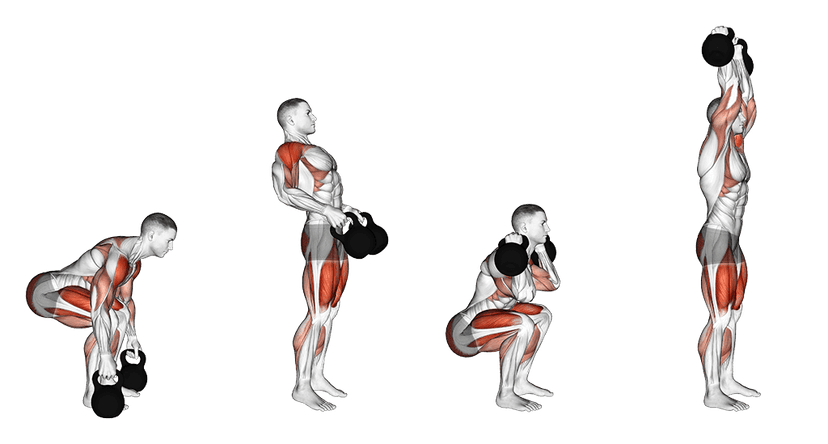
Kettlebell Clean and Press: Complete Guide
The kettlebell clean and press is a compound movement that chains two technical actions into one fluid sequence. You bring the kettlebell from the floor to the shoulder (clean), then push it overhead (press). This combo engages virtually the entire body and develops power, strength, and muscular endurance simultaneously. It is the perfect exercise when you have one kettlebell and 20 minutes.
The clean and press was a competition lift in Olympic weightlifting until 1972. With a kettlebell, it regains a functional and accessible dimension that the barbell does not always offer. The unilateral grip corrects imbalances, challenges anti-lateral bracing, and provides greater freedom of movement for the shoulder.
Muscles targeted
- Deltoids (all three heads): primary movers of the press, especially the anterior and lateral heads
- Triceps: elbow extension during the press, lockout at the top
- Traps and rhomboids: scapular stabilization during both the clean and the press
- Hamstrings and glutes: clean propulsion through the hip hinge
- Abs and obliques: intense anti-lateral bracing during unilateral work
- Forearms and grip: grip and control of the kettlebell throughout
- Spinal erectors: posture maintenance during both phases
This is a full-body exercise by definition. The clean recruits the posterior chain, the press recruits the upper body, and the trunk works continuously to stabilize the asymmetric load.
Proper execution
The clean (floor to shoulder)
- Starting position identical to the one-arm swing: kettlebell in front of you, feet shoulder width, hip hinge to grab the handle with one hand.
- Perform a hiking pass to load the movement.
- Drive your hips forward (like a swing) but instead of letting the kettlebell float in front of you, pull the elbow back to bring the load into the rack position.
- The kettlebell settles gently on your forearm and against your chest. The wrist stays straight (not bent back), the elbow is pinned to the body.
- In the rack position, the kettlebell rests in the cradle formed by your forearm, biceps, and chest. The weight is carried by the skeleton, not the arm muscles.
The press (shoulder to overhead)
- From the rack, squeeze your glutes and brace your abs to lock the trunk.
- Push the kettlebell upward, rotating the wrist slightly so the palm ends up facing forward.
- The arm locks out completely at the top, biceps close to the ear.
- The body stays straight: no lateral lean or arching.
- Lower the kettlebell back to the rack under control.
Return to the floor
From the rack, perform a reverse clean: let the kettlebell tip forward, accompany the movement with a hip hinge, and guide the load between your legs. Flow into the next rep.
Breathing: inhale during the hiking pass, exhale on the hip snap (clean), inhale in the rack, exhale during the press. Inhale on the descent back to the rack.
Common mistakes
1. The clean slapping the forearm
If the kettlebell crashes onto your forearm with every clean, you are not guiding the path enough. The load should not arc around your fist. Insert your hand into the handle by rotating it around the kettlebell, not the other way around. Think about "zippering" the kettlebell toward you.
2. Broken wrist in the rack
A wrist bent backward in the rack compresses the tendons and causes pain. Keep the wrist neutral and straight. The kettlebell handle sits diagonally in your palm, from the base of the thumb to the base of the pinky.
3. Excessive arching during the press
Arching to compensate for lack of pressing strength turns the exercise into a sloppy push press and overloads the lower back. If you cannot press without arching, reduce the weight. The trunk must stay rigid from start to finish.
4. Elbow flaring in the rack
The elbow must stay close to the body in the rack to create a solid base. A flared elbow fatigues the shoulder and reduces pressing power. Pin your elbow against your ribs.
5. Disconnected clean and press
Chaining the two phases in a jerky manner wastes energy. The clean should end in a stable rack, a brief pause to brace the trunk, then the press fires. No rushing, but no excessive pause either.
Variations
Double clean and press (advanced)
Two kettlebells at once. Increases total load and removes the anti-lateral component, but demands excellent coordination and bilateral rack mobility. Reserved for experienced trainees.
Clean and push press (intermediate)
Same clean, but the press uses a slight leg dip to help past the sticking point. Allows heavier loads than the strict press. Excellent for developing upper body power.
Clean and jerk (advanced)
The press is replaced by a jerk: a quick knee dip followed by an explosive drive. More technical, but allows much heavier loads overhead.
Bottoms-up clean and press (intermediate to advanced)
The kettlebell is held upside down, ball facing up. Demands exceptional grip and shoulder stability. Reduced load but massively increased stabilization and proprioception work.
Programming
Placement in your session: At the start as a main strength movement, or in a circuit with other kettlebell exercises for a complete metabolic workout.
Volume and intensity:
- Beginner: 3 x 5 reps per arm, 8-12 kg kettlebell (women) / 12-16 kg (men)
- Intermediate: 4-5 x 5-8 reps per arm, 12-16 kg / 16-24 kg
- Advanced: "Rite of Passage" program (Pavel Tsatsouline), ladders 1-2-3-4-5 reps
Frequency: 2-3 times per week. The press taxes the shoulders heavily, so allow at least 48 hours of recovery between pressing sessions.
Starting weight: Begin with the weight you use for the strict press, not your swing weight. The limiting factor is almost always the press, not the clean. A beginner male typically starts at 12 or 16 kg.
Key takeaways
- Clean clean: guide the kettlebell into the rack without slamming it on the forearm
- Neutral wrist: in the rack and during the press, the wrist stays straight
- Locked trunk: brace abs and glutes before every press
- Fluid sequence: clean, stable rack, press, controlled descent
- Progression: master the clean and the press separately before combining them
